Data anonymization transforms information so that people cannot reasonably be identified from the resulting data, including when it is combined with other information likely to be available. The aim is to preserve useful patterns for analysis while reducing the risk that records reveal who an individual is.
Removing names alone is rarely enough. Location, timestamps, purchase histories, and unusual combinations of attributes can still reveal identities. A strong anonymization process therefore considers the dataset, the people who can access it, and the ways it could be linked with outside information.
This is an important distinction for teams adopting privacy friendly analytics without losing valuable marketing insights.
Key takeaways
• Anonymization is an outcome: Replacing names, encrypting fields, or hiding identifiers does not automatically make personal data anonymous.
• Methods have tradeoffs: Generalization, suppression, aggregation, noise addition, and more specialized approaches balance privacy protection against data usefulness.
• Context determines risk: A dataset may appear anonymous inside a controlled environment but become identifiable when shared publicly or combined with other sources.
• Testing is essential: Assess singling out, linkability, inference, and the potential for re-identification before treating transformed data as anonymous.
• Privacy and security are different: Access controls, VPNs, and encryption help protect data, but they do not by themselves anonymize it.
• Analytics needs careful claims: Cookieless tracking and IP masking can reduce certain exposures without automatically meeting a legal anonymity standard.
What is data anonymization?
Data anonymization is the process of modifying or arranging information so that an individual is no longer identifiable using means reasonably likely to be used. Its effectiveness depends on what remains in the data and the surrounding context, not merely on whether a transformation was applied.
Consider a dataset containing email addresses, exact ages, postal codes, and purchase amounts. Removing email addresses eliminates one direct identifier, but a rare combination of age, location, and transaction value may still point to one customer. An anonymized release might instead use age bands, broader regions, and sufficiently large groups.
Anonymization is most useful when an organization needs patterns rather than identities. A marketing team may need conversion rates by channel, for example, without exporting customer-level contact information into a report shared outside the company.
Direct and indirect identifiers
Direct identifiers include information such as full names, personal email addresses, or government-issued identifiers. Indirect identifiers, sometimes called quasi-identifiers, include attributes such as date of birth, location, job title, and event timing that can identify people when combined.
The difference matters because indirect identifiers can become identifying in a small or unusual population. Even a dataset without names might single out the sole account holder from a specific town who purchased a rare product on a particular day.
Why is data anonymization important?
Organizations collect information for analytics, product improvement, fraud prevention, research, and reporting. Those uses do not always require a person’s identity to remain attached to every observation. Reducing unnecessary identifiability can limit exposure if data is shared, mishandled, or accessed beyond its intended purpose.
Anonymization can also make aggregated insights easier to circulate across departments. Leadership may need to know whether onboarding completion improved in a region; it generally does not need a spreadsheet of identifiable new users to answer that question.
However, anonymity can reduce analytical precision. Some questions genuinely require individual or account-level data, such as helping a customer recover access. Responsible organizations decide what information is necessary before choosing a transformation, rather than assuming every dataset should be stripped of identifiers.
For teams collecting first party data, this creates an important design choice: keep identifiable records only for justified operational uses, and produce lower-risk aggregate or anonymized outputs where identities are not needed.
Data anonymization vs. pseudonymization vs. masking
These terms describe different controls, and confusing them can lead to misleading privacy claims. The decisive question is whether someone remains identifiable, directly or through additional information.
| Approach | What it does | Does it automatically anonymize data? | Typical use |
| Anonymization | Reduces identifiability to the required standard in context | It is the intended outcome, but must be tested | Sharing aggregate findings or research data |
| Pseudonymization | Replaces identifiers with codes while a linking method may remain | No | Controlled record linkage and operational analysis |
| Data masking | Hides or changes selected field values | No | Test environments, displays, support workflows |
| Encryption | Protects information from access without a key | No | Storage and transmission security |
A customer assigned an internal code instead of an email address may still be identifiable if the company can connect the code to an account. That can be valuable for secure analysis, but it should be described as pseudonymized rather than fully anonymous data.
The transformation and the release conditions must both be evaluated. A table that is low-risk inside a restricted environment may not be safe to publish openly when recipients can match it with public records.
What are the main data anonymization techniques?
No single method works for every dataset. Most effective processes combine several techniques and then test the remaining identification risk. The methods below are useful building blocks, not guarantees when used alone.
Generalization and suppression
Generalization: Replace precise values with broader categories. A birth date becomes an age range, or a city becomes a region. This can preserve useful trends while reducing the uniqueness of individual records, although rare combinations may remain revealing.
Suppression: Remove information entirely or withhold values for groups too small to report safely. A dashboard might display “not reported” instead of an exact conversion count for a narrowly defined segment with only one or two people.
Both methods sacrifice detail. Teams should verify that the remaining data still answers the original research question, especially when small populations or unusual behavior make re-identification more likely.
Aggregation and small-group controls
Aggregation combines observations into group-level measures, such as weekly conversion rates by broad acquisition channel. It is often a sensible choice for management reporting because decisions may depend on overall patterns rather than individual records.
Small groups are a problem. A report saying that one person in a tiny region made a high-value purchase can still reveal sensitive information. Minimum group sizes, suppression rules, and limits on overlapping filters help reduce this risk.
Aggregate statistics also need review across multiple releases. If one public table can be subtracted from another to expose a small group’s result, the individual reports may be less protective than they appear in isolation.
Noise addition and differential privacy
Noise addition changes values slightly to make exact records or counts harder to infer. When carefully designed, it can preserve broad statistical properties while reducing the information revealed about individual observations.
Differential privacy is a more formal framework for limiting how much a statistical release can reveal about whether a person contributed to the dataset. Its usefulness depends on the mechanism, privacy budget, and query design, rather than simply labeling a report as differentially private.
This approach is especially relevant when releasing many statistics or supporting repeated queries. It needs technical expertise because weak parameters or unbounded access can undermine the expected privacy protection.
Data swapping, synthetic data, and tokenization
Data swapping exchanges selected attribute values across records to disrupt direct associations. It can help with some statistical datasets, but poor swaps may distort relationships or fail to prevent re-identification through other fields.
Synthetic data replaces original observations with generated records. It is not automatically anonymous: a generator can memorize rare training examples or reproduce sensitive patterns. A useful synthetic dataset therefore needs its own disclosure and utility evaluation.
Tokenization replaces sensitive fields with substitutes and often preserves a mapping back to the original values. Like pseudonymization, this can support secure operational workflows, but the presence of a reversible mapping means it should not be called anonymization without a separate assessment.
How to anonymize data step by step
A defensible workflow begins with a specific use case and ends with evidence that the resulting data is appropriate for its intended audience. The following seven steps help teams avoid treating transformation as the final check.
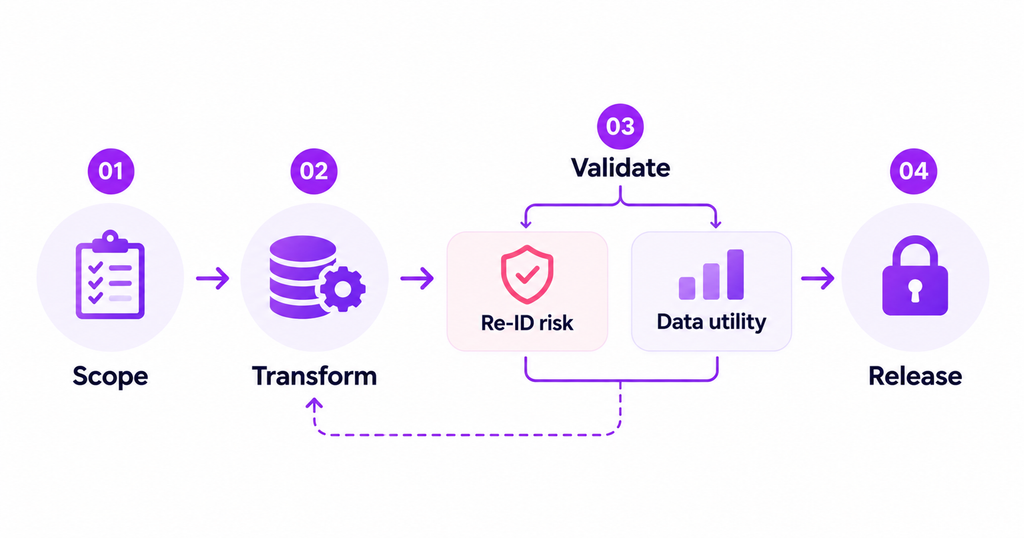
1. Define the purpose and intended recipients
Write down the exact question the dataset needs to answer, who will use it, and whether it will remain inside the company, be shared with a partner, or be published. The required protection depends heavily on who may receive the information and what other data they possess.
For example, a public case study usually needs a more conservative release process than a tightly controlled internal diagnostic report.
2. Inventory direct and indirect identifiers
Identify obvious personal fields, but also examine event sequences, exact timestamps, rare product combinations, geographic details, and free-text notes. Review connected sources that might make records identifiable even after direct identifiers are removed.
This assessment belongs in broader data governance best practices, including ownership, retention, and approved access paths.
3. Set privacy and analytical requirements
Choose the level of detail required to answer the question and decide what identification risk is acceptable for that use and audience. State which conclusions must remain reliable after transformation, such as whether broad regional conversion trends can still be compared.
There is no universal threshold that makes every dataset anonymous in all settings. Risk needs to be evaluated in context and reviewed when that context changes.
4. Select and apply suitable techniques
Combine generalization, suppression, aggregation, or more specialized methods based on the data. Avoid relying on one easy fix, such as deleting email addresses, if remaining attributes can identify someone.
Document each transformation. That record makes it possible to explain why a particular level of detail was retained and to reproduce the process when reports are refreshed.
5. Assess re-identification risk
Try to determine whether the data allows someone to isolate a record, link separate records, or infer a private attribute. Consider realistic external information and the capabilities of intended and unintended recipients.
The UK’s ICO guidance on effective anonymisation emphasizes singling out and linkability as central indicators. Assessment should not end with checking that names have disappeared.
6. Verify that the data remains useful
Compare key aggregated results before and after transformation. Check whether important distributions, trends, and relationships remain sufficiently accurate for the decision being made, and whether small or uncommon groups need further protection.
A dataset can be well protected but unusable, or analytically useful but still identifying. Good design manages both concerns rather than maximizing one in isolation.
7. Govern the release and review it over time
Approve who may access the raw, transformed, and published versions. Store procedures, restrict unnecessary copies, and reassess risk when new external datasets or analysis techniques become available.
The importance of trustworthy controls extends beyond anonymity. According to the DBTA Report, the linked 2024 data-governance report discusses the challenge of maintaining data quality and security as AI use expands.
It should not be used to support unrelated historical breach statistics.
How can you tell whether anonymization worked?
A transformed dataset needs a realistic attack-oriented review, not simply a checklist of removed columns. Three questions provide a useful starting point for evaluating whether an individual can still be identified.
| Risk | Question to ask | Warning sign |
| Singling out | Can one person’s records be isolated? | A unique combination of age band, location, and activity |
| Linkability | Can records be connected to the same person or an external source? | Repeated timestamps or distinctive behavior across datasets |
| Inference | Can an unknown private fact be deduced? | One remaining individual in a narrow sensitive subgroup |
A dataset’s risk also changes with the release model. A table sent to a vetted research partner under strict controls is not equivalent to the same table made downloadable to everyone. Controls may reduce practical risk, but they do not automatically transform personal data into anonymous information.
Reassessment matters when new datasets become public, when multiple reports can be combined, or when the underlying population changes. A privacy review is therefore a continuing process, especially for frequently refreshed analytics exports.
Data anonymization examples across industries
The objective varies by use case. Some activities only require aggregate trends, while other operational decisions depend on identifiable customers and should remain within appropriately governed systems.
Marketing and website analytics
A SaaS business may report product-trial conversions by weekly acquisition channel and broad country grouping rather than exporting every visitor’s history. Larger groups and carefully limited filters can reduce exposure while preserving useful campaign comparisons.
The broader goal is to make decisions with as little individual-level data as necessary. This approach complements sound data management and does not imply that all underlying analytics events are legally anonymous.
Healthcare research and practice management
A healthcare team might need to study appointment patterns without disclosing patient identities. Broader ages, controlled date detail, and suppression of uncommon combinations may help, but health information requires particular care because even small details can be highly revealing.
Choosing the best EMR for solo practice is a separate question about clinical records and workflows. An EMR does not by itself anonymize exported data, and any research release still needs its own privacy assessment.
Travel and fraud prevention
A travel platform may share aggregate booking-fraud trends with analysts while keeping transaction-level identity information restricted to investigators who genuinely need it. The public dataset can be less identifying without disrupting the operational controls required to investigate suspicious bookings.
This distinction is especially important in travel fraud prevention, where detecting account abuse may depend on linking activity across transactions. Anonymizing every operational signal could make fraud detection less effective.
Finance, research, and product testing
Financial institutions may publish aggregate transaction patterns while withholding rare merchant or customer combinations. Researchers may use controlled, de-identified extracts instead of open raw data, with safeguards appropriate to their analysis.
Product teams can also populate test environments with synthetic or masked records instead of production customer data. Those safeguards reduce unnecessary exposure, but masked or synthetic datasets still require review for memorized or linkable information.
Data anonymization under GDPR and US privacy rules
The General Data Protection Regulation (GDPR) applies to personal data. Properly anonymized information falls outside its personal-data scope, but pseudonymized information generally remains personal data when identification is still possible with additional information.
This does not mean a company can simply anonymize a dataset and ignore how it was collected or processed beforehand. The original processing, legal basis, access, storage, and the anonymization process itself may still require compliance review. Jurisdiction and purpose also affect the analysis.
In July 2026, the European Data Protection Board published draft Guidelines 02/2026 on Anonymisation. The consultation closed on October 30, 2026. As of November 3, these are consultation-stage guidelines, not a finalized new legal standard.
In the United States, sector-specific requirements may apply. The US Department of Health and Human Services describes HIPAA de-identification using Safe Harbor and Expert Determination approaches in its de-identification guidance.
Those healthcare rules should not be generalized to every dataset or jurisdiction.
Because legal anonymity depends on context, privacy, security, and legal teams should review consequential releases rather than treating a vendor’s “anonymous” label as proof of compliance.
How to choose data anonymization tools and automation
The right tool depends on the structure of the data, the desired release, and the risk assessment method. A spreadsheet masking utility, database transformation pipeline, statistical disclosure-control package, and differential privacy system solve different problems.
Before choosing software, ask whether it can identify indirect attributes, apply repeatable transformations, evaluate rare combinations, control exports, track approvals, and retain evidence of the process. Automation should make decisions consistent, not hide them behind a one-click label.
A sensible automated workflow separates raw inputs, transformed working data, tested output, and approved releases. Failed risk checks should prevent publication and flag the dataset for review instead of silently producing a supposedly anonymous extract.
Teams also need monitoring when source fields or user behavior change. A transformation that once produced sufficiently large groups could expose individuals after a product launches in a small new market.
Security controls that complement anonymization
Anonymization reduces the likelihood that released information identifies a person. Security controls protect the systems, access paths, and original datasets around it. Both are necessary, but they are not interchangeable.
For distributed staff, a VPN for international travel may help secure network connections on untrusted networks. Similarly, a mobile VPN iOS option addresses connection privacy on an iPhone or iPad. Neither makes an identifiable customer database anonymous.
Access to original or pseudonymized records should also be limited. workforce password management can support credential control, while threat intelligence can help security teams detect external exposures.
These reduce separate risks and do not replace a re-identification assessment.
Keep the raw and transformed datasets subject to retention rules, access logs, and incident procedures. Anonymization should be part of the overall protection program rather than an alternative to it.
How privacy-conscious analytics supports marketing measurement
Marketing teams often need to understand channels, conversion trends, and customer journeys without sharing unnecessary personal details. Privacy-conscious measurement begins with purpose limitation, data minimization, suitable tracking configurations, and carefully controlled reporting.
Usermaven primarily is a marketing attribution software alongside website and product analytics. Its tracking documentation describes configurable cookie and IP policies, including a strict mode that avoids setting identification cookies and uses IP- and user-agent-derived fingerprinting for recognition.
That distinction matters. Fingerprinting and truncated IP addresses can still raise privacy considerations, so “cookieless” should not be treated as a synonym for legally anonymous or consent-free. The technical choices and legal requirements must be assessed for the actual implementation.
Usermaven’s cookie-less tracking documentation and parameter reference describe these controls. Teams can also explore the broader principles in Usermaven’s cookieless tracking guide.
In practice, companies can separate protected operational data from appropriately aggregated reporting outputs and review which identifiers are truly necessary. If you want to assess measurement and attribution options for your use case, book a demo.
Common data anonymization mistakes
• Removing only obvious identifiers: Deleting names and emails leaves combinations of other attributes that may still reveal identity.
• Confusing pseudonymization with anonymity: A re-linkable token can protect direct identity while remaining personal data.
• Publishing small groups: Narrow filters or tiny populations can expose individual behaviors in apparently aggregated statistics.
• Ignoring external data: Public records, partner databases, and repeated reports can make seemingly anonymous records linkable.
• Assuming encryption solves identification risk: Encryption protects access but does not remove identity when the information is decrypted or linked.
• Skipping utility checks: Excessive transformation may destroy the trends the research was supposed to measure.
• Treating review as one-time: Data, recipients, laws, and re-identification techniques change, so controls need reevaluation.
The bottom line
Successful data anonymization starts by asking what insights are needed and whether the same analysis can be done without identifying people. It then applies suitable transformations, tests the output against realistic re-identification risks, and controls how the information is released and reused.
For analytics and marketing teams, the goal is not to remove every useful signal. It is to retain enough information for sound decisions while minimizing unnecessary exposure and avoiding claims of anonymity that the underlying data cannot support.
FAQs about data anonymization
1. What is an example of data anonymization?
A research team may replace exact ages with ranges, group locations into broad regions, and suppress very small categories before releasing summary statistics. Whether the result is genuinely anonymous depends on the remaining risk of identifying individuals in context.
2. What is the difference between anonymization and pseudonymization?
Anonymization aims to prevent reasonable identification of individuals from the resulting data. Pseudonymization replaces direct identifiers while preserving a method or additional information that can reconnect records to people, so the result generally remains personal data.
3. Can anonymized data be re-identified?
Some supposedly anonymized data can be re-identified when it contains distinctive attributes or can be linked with external records. A credible anonymization process tests such risks rather than assuming transformation alone is enough.
4. Which technique makes masked data impossible to recover?
There is no single masking technique that universally guarantees anonymity. Reversibility depends on the transformation, retained keys or mappings, residual attributes, available external data, and the intended release conditions.
5. Is data anonymization required by GDPR?
GDPR does not require every dataset to be anonymized. It regulates processing of personal data and supports principles such as data minimization and appropriate safeguards. Effective anonymization may remove data from its scope, but whether that standard is met requires assessment.
6. Are VPNs, encryption, or cookieless analytics forms of anonymization?
Not automatically. VPNs and encryption protect different aspects of transmission and access. Cookieless analytics avoids certain cookie practices but may use other identifiers; the legal status depends on the actual data and implementation.

Written by
Lauren Brooks
Lifecycle Marketing Strategist
Lauren Brooks is a lifecycle marketing strategist with 4+ years of experience helping SaaS businesses create meaningful customer experiences. She specializes in user engagement, retention, and conversion optimization, helping brands build stronger customer relationships beyond acquisition.
All articles by Lauren →