Fibbler helps B2B teams connect LinkedIn advertising engagement with company-level signals and CRM pipeline. But the right replacement depends on the question you need answered. Some teams want more control over LinkedIn account-based marketing (ABM). Others want to understand which channels drive website conversions, product adoption, opportunities, and revenue.
For the second group, marketing attribution software can be a better fit than another specialized LinkedIn tool. A broader measurement system can connect paid and organic touchpoints to downstream outcomes, although it may not recreate Fibbler’s company-level LinkedIn impression and engagement data.
This comparison evaluates ten Fibbler alternatives by their primary purpose, published capabilities, pricing, and meaningful trade-offs. It is a vendor-documentation-based buying guide, not the result of a controlled head-to-head product test.
Shortlisted candidates
Start with these three options based on the measurement or campaign workflow your team needs most.
| Platform | Best fit | Primary strength |
|---|---|---|
| Usermaven | B2B and SaaS teams connecting paid ads to revenue | Paid and multi-channel attribution with website and product behavior |
| ZenABM | LinkedIn-focused ABM teams | Account engagement and campaign workflows |
| Dreamdata | B2B revenue teams with account-led buying journeys | Account-level attribution and pipeline analysis |
Key takeaways
- Choose the job first: LinkedIn account engagement, multi-channel revenue attribution, paid-media optimization, and anonymous visitor identification are different buying requirements.
- Usermaven is best for broader measurement: It connects marketing attribution with website behavior, product analytics, conversion journeys, and CRM-linked revenue when the necessary data is configured.
- LinkedIn-focused buyers have closer matches: ZenABM and DemandSense are more direct alternatives for teams seeking account intelligence and LinkedIn campaign operations.
- Enterprise ABM is a separate category: 6sense and Demandbase serve more extensive intent-data, buying-group, and sales-marketing activation programs.
- Compare the real cost: Fibbler’s entry subscription, Google Ads add-ons, CRM entitlements, and workspace limits should be evaluated against each alternative’s complete usable configuration.
- Migrate carefully: A switch between company-level ad-engagement signals and first-party event attribution can change what is observable, not just the report design.
Fibbler alternatives at a glance
| Alternative | Best for | Main difference from Fibbler | Starting pricing |
|---|---|---|---|
| Usermaven | Cross-channel marketing and product-linked attribution | Connects acquisition with website, product, funnels, and revenue | Custom quote |
| ZenABM | LinkedIn ABM and campaign operations | Adds LinkedIn campaign orchestration and account scoring | From $59/mo, annual rate |
| DemandSense | LinkedIn ad operations and visitor intelligence | Combines LinkedIn performance controls with visitor/contact intelligence | From $89/mo |
| Dreamdata | Account-level B2B revenue attribution | Broader B2B journeys and attribution | Free entry; advanced custom quote |
| HockeyStack | Enterprise GTM and revenue intelligence | More extensive GTM and CRM analysis | Custom quote |
| Factors.ai | Account identification and ABM activation | Intent, account scoring, activation and attribution | Lite $199/mo |
| Cometly | Paid-media-to-revenue attribution | Cross-network measurement and conversion feedback | Usage-based quote |
| 6sense | Predictive enterprise ABM | Intent, buying signals and enterprise activation | Custom quote |
| Demandbase | Enterprise account-based GTM | Account intelligence, buying groups and orchestration | Custom quote |
| Leadfeeder | Website company identification | Identifies companies visiting your site, not LinkedIn impressions | Free Lite; Discover from $79/mo annual |
These are best-fit categories, not an objective ranking of product quality. A tool may have adjacent capabilities, but that does not make it a like-for-like replacement for every part of Fibbler.
What is Fibbler, and why look for an alternative?
Fibbler is a B2B paid advertising attribution and activation platform designed around company-level LinkedIn Ads engagement, with Google Ads attribution offered as an add-on. It connects company activity and customer journeys with opportunities and revenue in supported CRMs, including HubSpot, Salesforce, Attio, and Pipedrive.
Its documented Company Insights workflow uses LinkedIn company-engagement data and CRM opportunities to identify deals influenced by prior LinkedIn activity. That is useful for account-focused advertising, but an influenced pipeline is not the same as proof that the ad caused a deal. It also differs from a first-party website visit or identifiable individual click.
Fibbler publicly advertises Growth at $89/month, Unlimited at $129/month, and Agency at $159/month, plus Google Ads attribution at $59 per connected account per month. Salesforce and MCP access are tied to higher plans. Always confirm billing frequency, add-on eligibility, and the latest checkout terms.
A replacement becomes relevant when your team needs broader cross-channel attribution, customer and product analytics, a different LinkedIn campaign-management workflow, account-intent intelligence, visitor identification, or a pricing and integration structure that better fits its operation.
How we evaluated the alternatives
We reviewed vendor product and pricing information available in early November 2026, including Fibbler’s published plan and feature details. Each entry considers five questions: what the product primarily measures; whether it uses company, person, or recorded journey data; how it relates marketing to CRM or revenue outcomes; what the published price actually buys; and which Fibbler workflows it might not replace.
We have not installed and benchmarked all ten products, independently validated identification rates, or conducted a controlled attribution accuracy test. Differences stated here describe published capabilities and buying trade-offs, not measured performance superiority.
10 best Fibbler alternatives in 2026
These ten platforms address different needs, from paid ads attribution and connected customer journeys to LinkedIn campaign operations. Compare their strengths and trade-offs against the workflows your team needs to preserve.
1. Usermaven: Best for marketing attribution connected to product and revenue
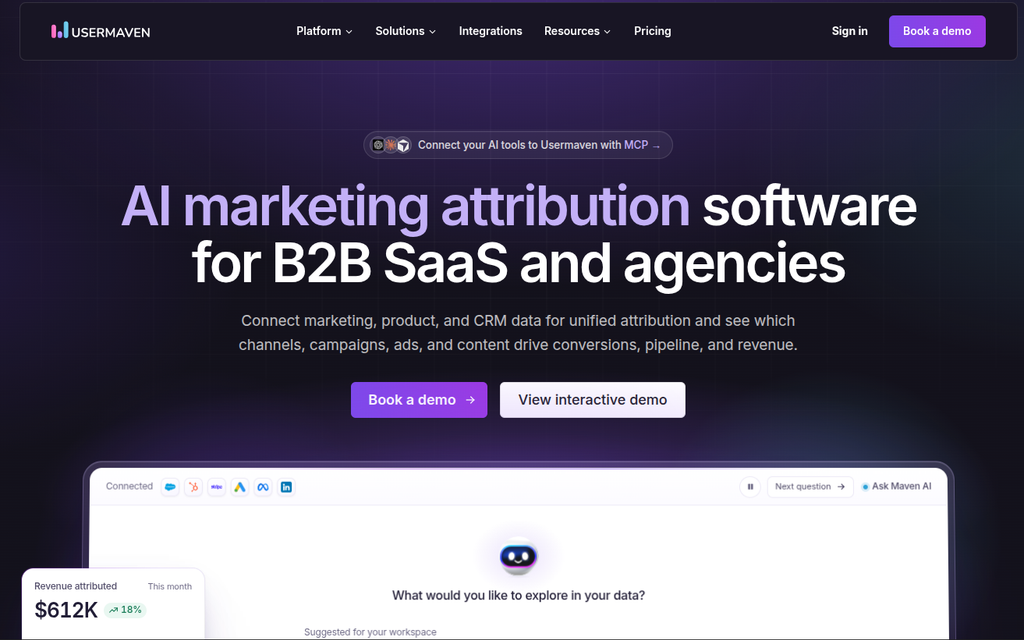
Usermaven is marketing attribution software that connects paid ads, campaigns, and customer journeys with conversions, product behavior, qualified pipeline, and revenue. For SaaS teams, the main value is seeing what happens after acquisition rather than stopping at company-level ad exposure or a CRM deal-influence flag. It combines attribution with website and product analytics, funnels, segments, and AI-assisted investigation.
Key features
- Multi-touch attribution across supported paid, organic, referral, email, and other tracked sources.
- Paid ads attribution connects supported ad-platform spend with tracked conversions and revenue, helping teams compare campaigns using conversion value, cost per conversion, and ROAS.
- Product events, customer journeys, funnels, retention analysis, and segments.
- Pipeline attribution using connected CRM outcomes where configured.
- Maven AI and recurring AI Agents for analysis, plus custom attribution models where eligible.
Paid ads attribution: Usermaven brings paid campaign data together with customer journeys and CRM outcomes, so B2B teams can investigate which campaigns contribute to signups, pipeline, and revenue across supported channels. Compare attribution by conversion date or spend date and examine performance with the selected goal, model, and lookback settings. Results depend on connected accounts, captured events, and the available revenue data.
Why choose it over Fibbler? Choose Usermaven if you need to compare acquisition channels against product activation, upgrades, opportunities, or revenue. You can examine whether a campaign generates engaged customers, not simply whether a company appeared in an advertising engagement report. It is especially appropriate for SaaS marketing and product teams that share conversion and revenue accountability.
What to consider: Usermaven is not a like-for-like substitute for Fibbler’s official LinkedIn company-engagement feed, company-level impression influence, or dedicated LinkedIn ad optimization controls. Its attribution depends on the tracked and connected data actually available. Some advanced functions, including custom model creation, have plan restrictions.
Pricing: Business and Enterprise plans are custom quoted for new customers; no public fixed price. The current pricing page and Enterprise custom-model documentation should be checked for specific entitlements before purchase.
When it is best: B2B SaaS and growth teams that want acquisition-to-revenue measurement alongside website and product behavior.
2. ZenABM: Best for LinkedIn-first ABM campaign orchestration
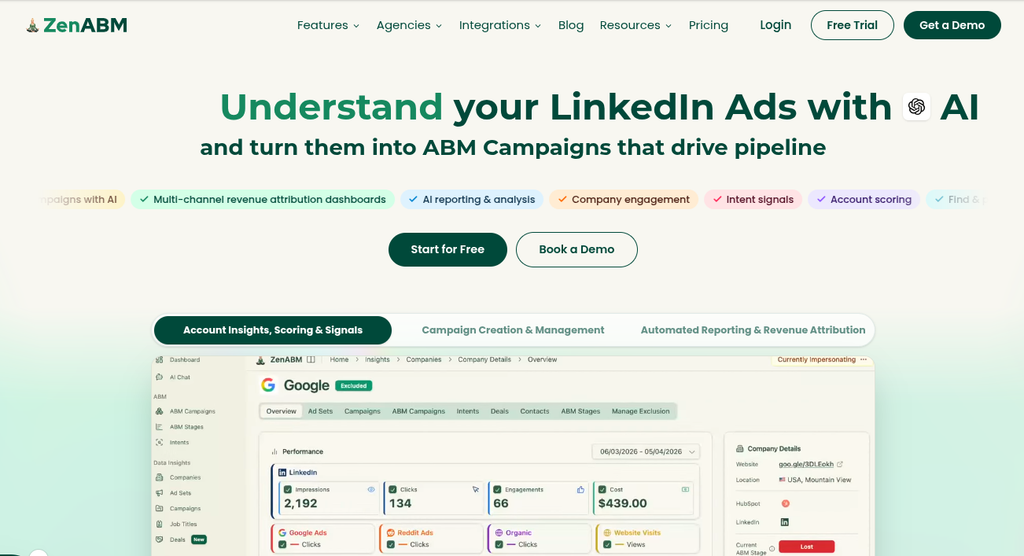
ZenABM is built for teams running LinkedIn-centered account-based marketing. It combines company engagement signals with account segmentation, scoring, and campaign management, making it a closer functional candidate when the intended switch is about LinkedIn ABM operations rather than broad product analytics.
Key features
- LinkedIn company insights and intent signals.
- Account scoring, segmentation, and ABM campaign workflows.
- Campaign analytics with account and opportunity context.
- AI-assisted campaign management, with higher-tier controls depending on plan.
Why choose it over Fibbler? Evaluate ZenABM if you need to build and operate account-based campaigns as well as interpret their performance. Its positioning is closer to day-to-day ABM execution and account prioritization, while Fibbler concentrates on company engagement, attribution, and optimization within its supported advertising scope.
What to consider: A more elaborate ABM workflow introduces setup, targeting, and data-governance requirements. Verify which campaign automation features, CRM integrations, and account limits exist in the plan you intend to buy.
Pricing: Published pricing starts at $59/month on the displayed annual-billing rate; higher tiers and agency plans cost more.
When it is best: LinkedIn-led demand generation teams that want engagement data and account-based campaign execution together.
3. DemandSense: Best for LinkedIn ad operations and visitor intelligence
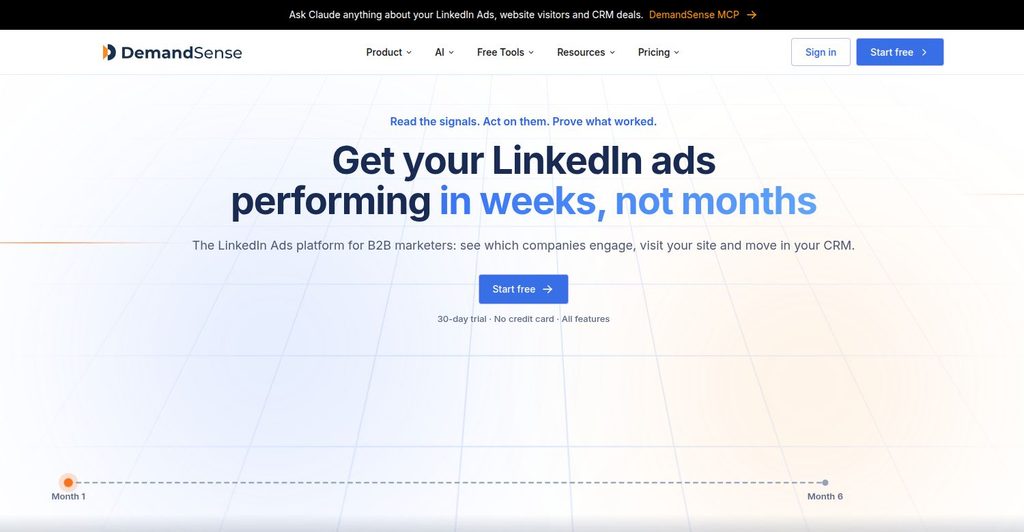
DemandSense focuses on connecting LinkedIn advertising controls with account and visitor intelligence. Its product emphasizes ad scheduling, frequency management, account-level reporting, and contact discovery, making it a specialized option for teams that need to act on LinkedIn signals as well as analyze them.
Key features
- LinkedIn advertising analytics and spend visibility.
- Campaign scheduling, frequency caps, and audience controls.
- CRM-linked influence on opportunities and closed deals.
- Website visitor intelligence and credit-based contact unlocks.
Why choose it over Fibbler? DemandSense deserves evaluation when ad-operations controls or contact-level visitor workflows matter as much as LinkedIn pipeline reporting. Its combination of LinkedIn controls and identification can serve teams with a tightly connected paid and sales-prospecting motion.
What to consider: Contact identification consumes credits and may vary by visitor geography and eligibility. Do not treat its visitor-contact coverage as equivalent to a guarantee of named identities for all ad impressions or website visits.
Pricing: Base $89/month with 200 contact credits; Plus $149/month with 500 credits, as currently displayed.
When it is best: B2B marketers prioritizing LinkedIn campaign control and account-to-contact research.
4. Dreamdata: Best for multi-channel B2B revenue attribution
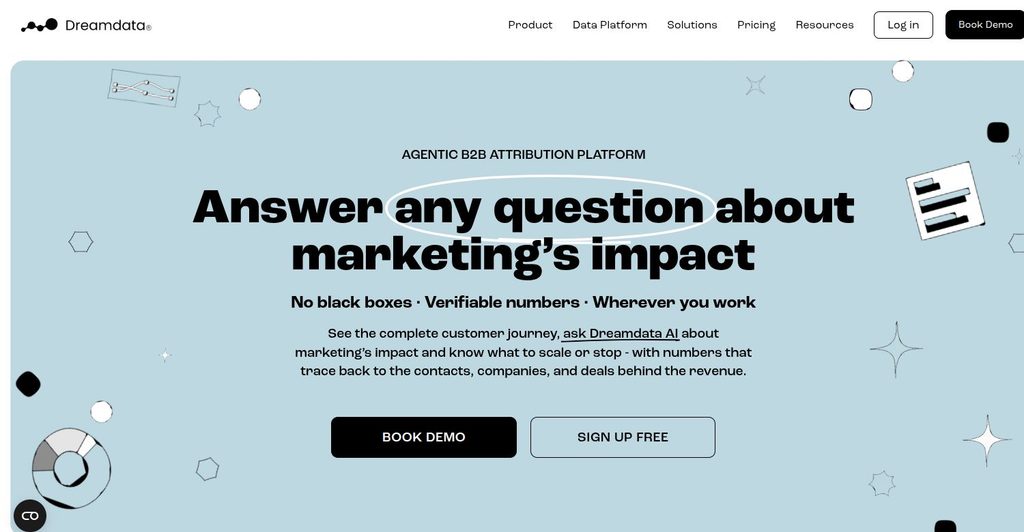
Dreamdata is an account-centric B2B attribution and activation platform. Its focus is connecting marketing interactions with buying accounts, CRM stages, opportunities, and revenue, which makes it relevant when a team has outgrown a LinkedIn-led view and needs broader revenue analysis across a long sales cycle.
A closer Usermaven vs. Dreamdata comparison examines how their attribution and behavioral analytics approaches differ.
Key features
- Account-level web analytics and engagement intelligence.
- Multi-channel journey and advanced revenue attribution.
- CRM and advertising data connections with B2B reporting.
- Audience building and activation on eligible plans.
Why choose it over Fibbler? Dreamdata is a stronger candidate when measuring the full B2B buying journey across channels is the primary job. It is designed for questions about which account interactions contribute to pipeline or revenue, rather than optimizing LinkedIn campaign settings alone.
What to consider: Comprehensive account-level tracking requires identity resolution, CRM mapping, and dependable conversion definitions. The free plan does not include the same scope as paid advanced attribution and activation offerings.
Pricing: A free $0/month entry plan is published. Advanced Attribution & Activation uses custom pricing; pricing depends on the selected scope.
When it is best: B2B teams with longer buying cycles that need account-level and revenue-focused measurement across multiple channels.
5. HockeyStack: Best for enterprise GTM intelligence
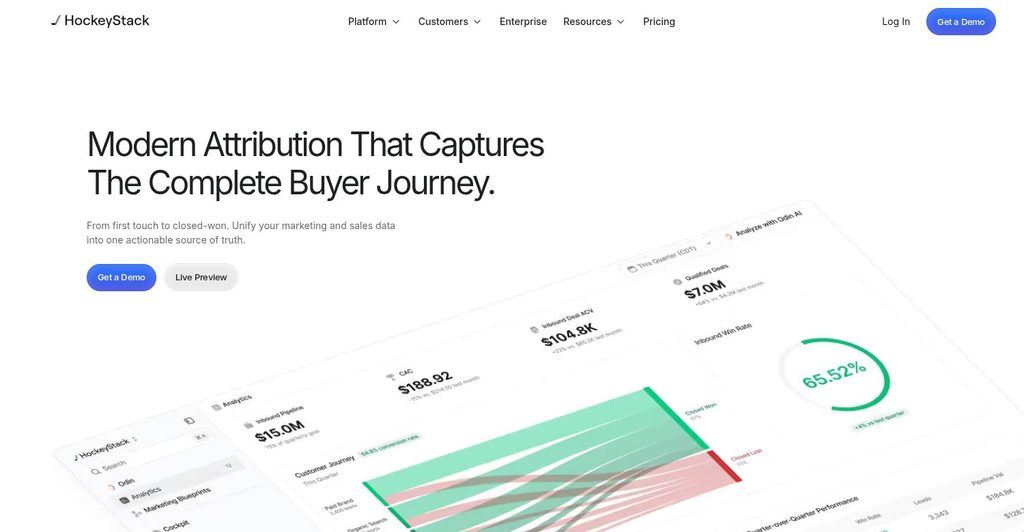
HockeyStack connects go-to-market activity across marketing, sales, and CRM systems to support attribution, journey analysis, and revenue intelligence. It is aimed at organizations seeking a broader GTM data and decision environment rather than a single-channel paid advertising utility.
The Usermaven vs. HockeyStack comparison explains the differences in their measurement and analytics focus.
Key features
- Multi-touch and revenue attribution across connected GTM systems.
- Account and customer journey analysis.
- Revenue reporting for marketing and sales teams.
- Custom implementations, integrations, and enterprise support.
Why choose it over Fibbler? HockeyStack can make sense when attribution is only one part of a wider GTM analytics initiative involving marketing operations, sales development, and revenue leadership. It emphasizes cross-functional measurement rather than LinkedIn-specific campaign optimization.
What to consider: It is a more involved evaluation, with implementation scope and commercial terms that may be excessive for a small team seeking a lightweight LinkedIn attribution dashboard. Ask for a demonstration against your actual CRM stages and data sources.
Pricing: Custom quote. HockeyStack describes tailored integrations and support but does not publish a simple starting subscription publicly.
When it is best: Mid-market and enterprise B2B teams building a shared revenue intelligence layer.
6. Factors.ai: Best for account identification and ABM activation
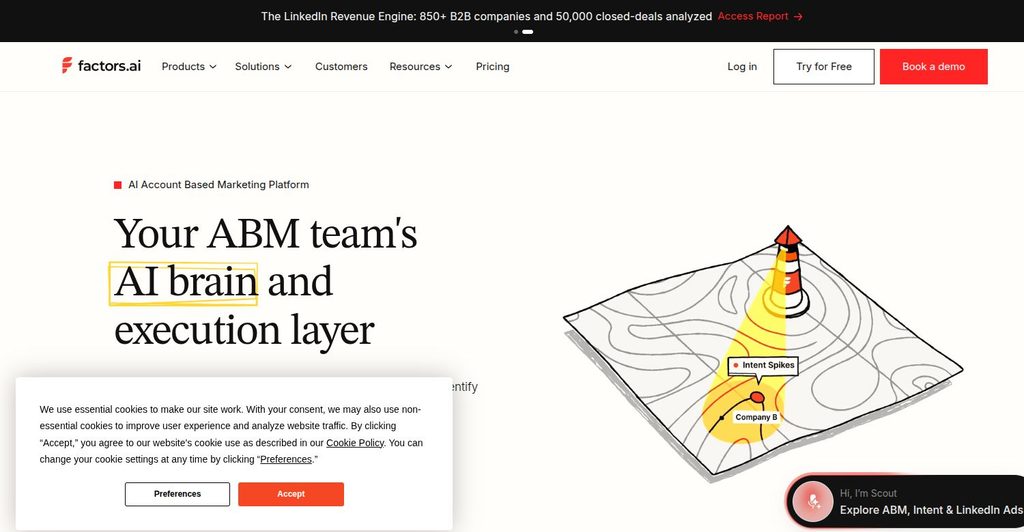
Factors.ai combines anonymous-company identification, account intelligence, intent signals, advertising activation, and attribution. Its strengths center on identifying target accounts, prioritizing them using engagement data, and supporting coordinated sales and marketing actions.
Teams assessing Factors.ai alternatives can compare account intelligence with other B2B measurement approaches.
Key features
- IP-to-company identification and account enrichment.
- Account scoring, intent signals, and account journey views.
- LinkedIn audience sync and activation workflows on eligible plans.
- CRM updates, alerts, and marketing attribution reports.
Why choose it over Fibbler? Factors.ai is more appropriate when your objective extends from proving LinkedIn impact to discovering and activating target accounts. It offers a broader account-intelligence and ABM workflow than Fibbler’s narrower advertising-focused proposition.
What to consider: Not every account-intelligence, predictive scoring, or ad activation capability is included in the entry tier. It is not primarily designed to replace a dedicated product analytics stack, and both pricing and implementation can grow with modules and volume.
Pricing: Official FAQ lists Lite at $199/month, Basic at $6,000/year, Growth at $20,000/year, and Enterprise from $36,000/year. Verify applicable modules and current terms.
When it is best: B2B teams that prioritize company identification, account intent, and ABM operations in addition to attribution.
7. Cometly: Best for paid-media attribution and conversion feedback
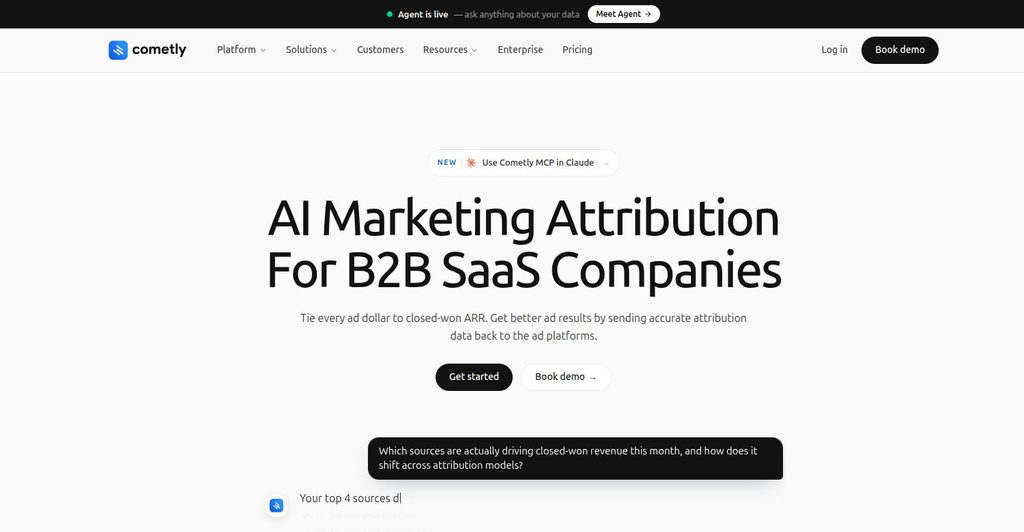
Cometly provides paid-media-focused tracking and revenue attribution for B2B SaaS and other performance teams. It connects ad interactions, server-side events, customer journeys, and CRM outcomes, then supports conversion feedback to advertising networks.
The Usermaven vs. Cometly comparison explores how the platforms connect paid marketing with conversion and revenue data.
Key features
- Pixel and server-side event tracking.
- Multi-touch attribution with account and conversion journeys.
- Campaign analysis and configurable reporting dashboards.
- Conversion API integrations, AI analysis, and audience workflows.
Why choose it over Fibbler? Cometly is a candidate when the main challenge is understanding paid performance across multiple ad networks and connecting conversions with pipeline or revenue, rather than focusing predominantly on LinkedIn company engagement.
What to consider: Evaluate whether its event collection, CRM setup, attributed ROAS definitions, and conversion-feedback integrations match your actual use case. It is not automatically equivalent to first-party product analytics or LinkedIn’s company-engagement feed.
Pricing: Usage-based and quoted according to monthly pageviews. Core and Enterprise options are displayed without one universal fixed rate publicly.
When it is best: Paid acquisition teams that want cross-network conversion and revenue measurement with ad-platform feedback.
8. 6sense: Best for predictive enterprise ABM
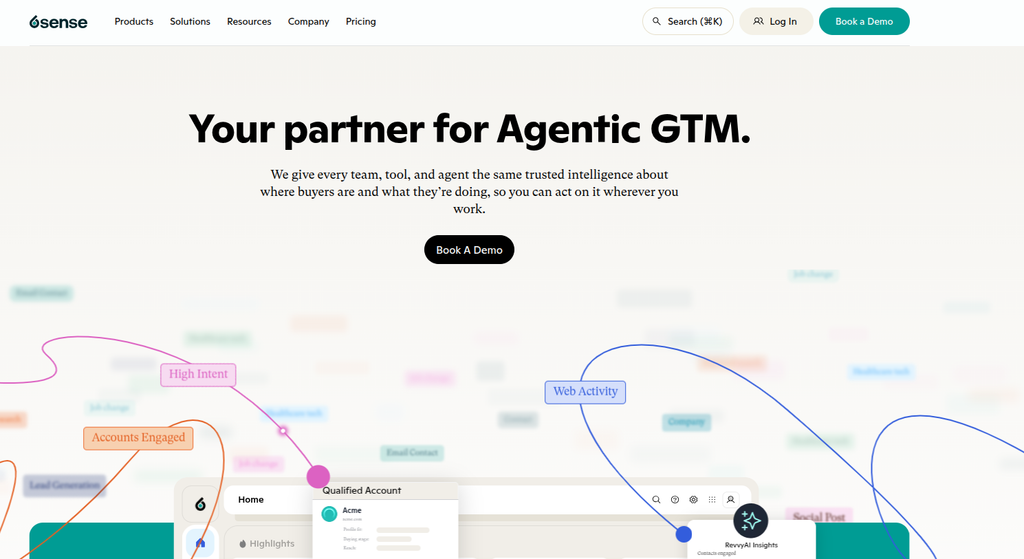
6sense combines account intelligence, buying signals, predictive insights, and sales and marketing activation. It targets businesses that need a structured account-based GTM program, often involving multiple buying-group stakeholders and coordinated sales outreach.
Key features
- B2B account and buying-signal intelligence.
- Predictive account prioritization and scoring.
- Audience targeting and sales/marketing workflows.
- Enterprise integrations and account-based reporting.
Why choose it over Fibbler? 6sense may be more suitable when the business wants to coordinate account identification, prioritization, advertising, and sales activity beyond LinkedIn performance reporting. Its value proposition is GTM orchestration on a broader enterprise scale.
What to consider: That breadth adds purchase, implementation, and operational complexity. It is not a like-for-like budget alternative to an $89/month paid-ads tool. Make the business case around account-based outcomes, not feature count alone.
Pricing: Custom quote based on products, seats, data, and usage.
When it is best: Enterprise B2B organizations building predictive, account-based sales and marketing programs.
9. Demandbase: Best for enterprise account-based go-to-market execution
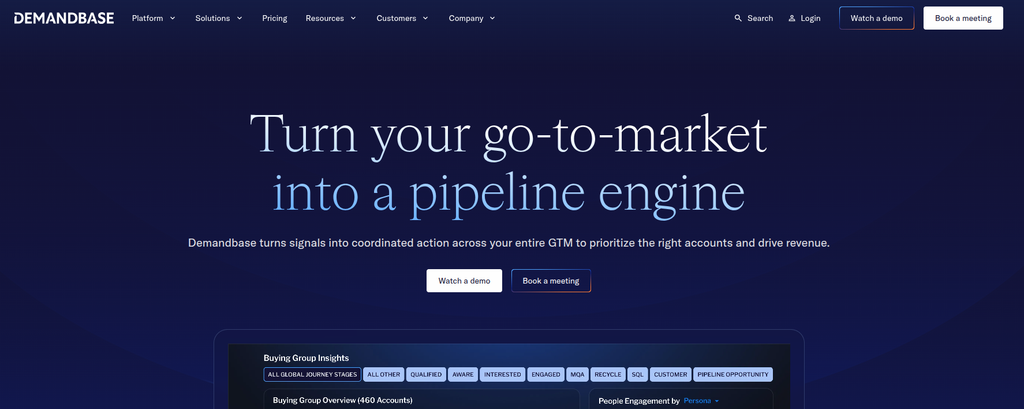
Demandbase is an account-based GTM platform combining B2B account data, buying-group intelligence, advertising, and sales and marketing activation. Compared with Fibbler, its central purpose is helping enterprise teams determine which accounts to pursue and coordinate how they engage them.
Key features
- Account and buying-group intelligence.
- Intent and engagement signals.
- Account-based advertising and audience activation.
- Sales and marketing workflows supported by B2B data.
Why choose it over Fibbler? Demandbase can replace more of an enterprise ABM operation when teams need to connect audience targeting, sales execution, and account data beyond LinkedIn ad measurement.
What to consider: A larger platform introduces data dependencies, stakeholder coordination, and sales-led purchasing. A team that only wants to attribute LinkedIn influence to CRM pipeline may find Fibbler simpler and easier to budget.
Pricing: Custom quote. Demandbase publishes a flexible platform-fee and user-fee approach for Sales and Marketing, but not a universal list price.
When it is best: Larger B2B enterprises looking for a unified account-based GTM and activation platform.
10. Leadfeeder: Best for identifying companies visiting your website
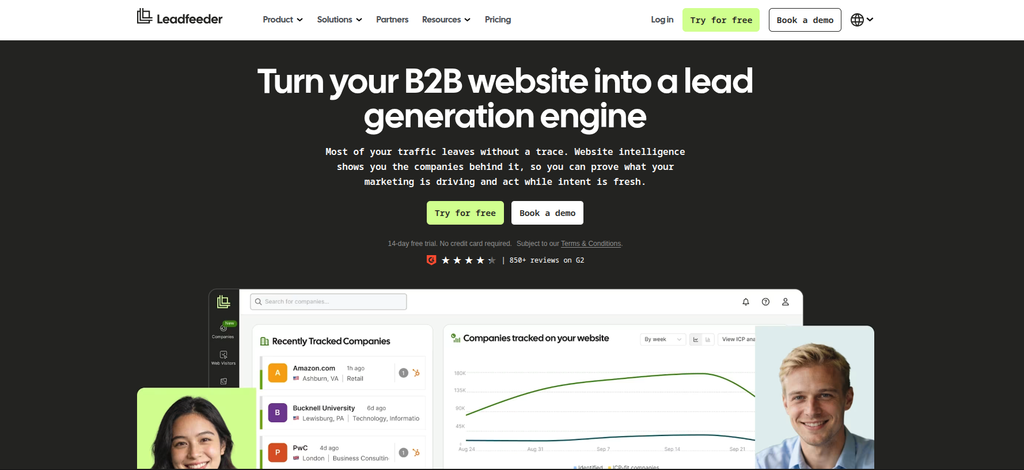
Leadfeeder focuses on revealing companies behind qualifying website visits and helping revenue teams act on those signals. Its core workflow begins with website activity, not exposure to a LinkedIn advertisement. That makes it relevant for buyers interested in knowing who visits their site, but not a direct substitute for Fibbler’s LinkedIn company-engagement intelligence.
Key features
- Company identification from eligible website traffic.
- Company profiles, page activity, and visit alerts.
- CRM sync and visitor-based sales workflows.
- Higher-tier contact enrichment and intent features.
Why choose it over Fibbler? Leadfeeder is useful when the team’s immediate question is which businesses visited high-intent website pages and how to route those opportunities to sales. Its website-visitor focus can complement an attribution platform rather than replace one.
What to consider: Identifying a company that visited your website does not prove it saw or engaged with a LinkedIn ad. The free tier is restricted, and paid costs depend partly on identification volume and enrichment needs.
Pricing: Free Lite tier; Discover from $79/month, billed annually, with higher Activate and Scale tiers.
When it is best: Sales and demand generation teams prioritizing website-company identification and account follow-up.
Fibbler vs. Usermaven: Which should you choose?
Fibbler and Usermaven overlap in the goal of relating marketing to business outcomes, but their inputs differ. Fibbler’s strength lies in official company-level LinkedIn engagement and advertising influence linked to CRM deals. Usermaven’s strength is marketing attribution across recorded customer journeys, with product behavior, funnels, conversion value, and CRM outcomes available in the same analytics environment.
| Requirement | Fibbler | Usermaven |
|---|---|---|
| Company-level LinkedIn ad engagement | Central capability | Not an equivalent native LinkedIn impression feed |
| LinkedIn campaign optimization controls | Specialized features | Different attribution and conversion-sync workflows |
| Multi-channel website and campaign attribution | Paid scope, Google add-on | Broad tracked acquisition and marketing channels |
| Product events, funnels and retention | Not its core offering | Core analytics capabilities |
| CRM-linked pipeline and revenue | Supported | Supported when connected and configured |
| Custom attribution weights | Not documented as matching Usermaven’s model builder | Available to eligible Enterprise workspaces |
| Published entry pricing | $89/month base plan | Custom quote for new customers |
For a company spending heavily on LinkedIn that mainly needs to understand which target accounts engaged with ads before a deal, Fibbler may remain the better-focused product. For a SaaS business that needs to connect paid and organic acquisition to activation, subscription upgrades, opportunities, and revenue, Usermaven is a more natural fit.
A relevant first-party example is ContentStudio’s marketing attribution case study. The team used Usermaven to connect campaign sources with signups, plan upgrades, demo bookings, and revenue, then adjusted marketing decisions based on downstream results. These are company-reported outcomes from one customer’s implementation, not an independent accuracy test against Fibbler.
How to choose the right Fibbler alternative
Start by documenting what you are replacing. A team can be unhappy with its LinkedIn ad optimization yet satisfied with CRM reporting, or need better product behavior analysis without changing its ad engagement tool. Those situations lead to different buying decisions.
| Your main requirement | Evaluate first | Ask during the demo |
|---|---|---|
| LinkedIn company engagement and campaign operations | Fibbler, ZenABM, DemandSense | Which exact company-level ad signals and controls are supported? |
| Marketing attribution plus product outcomes | Usermaven | Can we connect acquisition to activation, paid accounts and revenue? |
| B2B account-level revenue attribution | Dreamdata, HockeyStack | How are people, accounts, opportunities and buying stages linked? |
| Paid-media conversion tracking and feedback | Cometly | Which networks, event identifiers and conversion APIs are supported? |
| Predictive ABM and intent activation | 6sense, Demandbase, Factors.ai | What intent sources, scoring, and activation workflows are included? |
| Website-company identification | Leadfeeder, Factors.ai | What geographic coverage and identification limits apply? |
Check the measurement unit before comparing claims
A company exposed to an ad, a person clicking an ad, a browser session, and a CRM opportunity are different records. Ask vendors exactly which identifiers connect them, which events are observed rather than modeled, and whether influenced revenue is distinct from attributed revenue.
Test the migration with a controlled overlap period
Connect representative campaigns and CRM stages to the candidate tool before retiring the current workflow. Compare the same eligible accounts, time windows, deal values, and conversion events where possible. Document gaps, and do not interpret every numerical difference as an improvement or failure in accuracy.
Compare total implementation cost
Include subscription tiers, paid channels, CRM access, tracked volumes, account workspaces, data history, conversion syncs, onboarding, reporting exports, and support. A low entry price does not necessarily include the capability your team is buying the product to use.
When keeping Fibbler is the better decision
Fibbler remains a sensible choice for teams whose primary use case is company-level LinkedIn advertising engagement and CRM pipeline influence. Its published base pricing, LinkedIn-focused customer journeys, CRM integrations, and optional Google Ads module are designed for that narrower purpose.
Switching simply because another platform advertises more features can create unnecessary cost and measurement disruption. A broader platform is justified when it answers additional business questions your team actually uses, or when the current tool cannot support a necessary workflow.
In some situations a specialized paid-ads platform and broader attribution system may coexist. If so, reconcile their different definitions rather than summing the revenue credit assigned by both.
Final verdict
There is no universal best Fibbler replacement. ZenABM and DemandSense deserve attention when LinkedIn advertising operations are central. Dreamdata and HockeyStack address broader B2B revenue measurement, while 6sense and Demandbase are closer to enterprise ABM execution. Leadfeeder is a visitor-identification product, not a substitute for LinkedIn impression reporting.
For SaaS teams needing paid ads attribution alongside connected acquisition, website and product behavior, customer journeys, pipeline, and revenue, Usermaven is a strong choice. It offers a broader view of customer value beyond paid advertising engagement without claiming to reproduce Fibbler’s LinkedIn company intelligence.
Businesses evaluating their data sources and attribution requirements can book a Usermaven demo to explore whether its marketing and behavioral analytics meet their goals.
FAQs about Fibbler alternatives
1. What is the best Fibbler alternative?
It depends on what you are replacing. Usermaven is well suited to paid ads attribution, multi-channel measurement, and product-linked outcomes. ZenABM and DemandSense are closer LinkedIn-focused options. Dreamdata and HockeyStack specialize in wider B2B revenue intelligence.
2. Is Usermaven a direct replacement for Fibbler?
It can replace parts of a marketing attribution and revenue reporting workflow, but not every specialized LinkedIn company-engagement or ad optimization capability. The correct choice depends on what data and workflows your team needs to preserve.
3. Which Fibbler alternatives are best for LinkedIn account-based marketing?
ZenABM and DemandSense are strong candidates for LinkedIn-led campaign operations. Factors.ai, 6sense, and Demandbase are broader options when account intelligence, intent data, or enterprise ABM are also required.
4. Which Fibbler alternatives have transparent pricing?
Fibbler, ZenABM, DemandSense, Leadfeeder, and Factors.ai publish entry prices. Some vendors, including Usermaven, HockeyStack, 6sense, and Demandbase, offer custom quotes. Compare the plans’ actual features and limits before judging affordability.
5. How much does Fibbler cost in 2026?
Its official pricing page lists Growth at $89/month, Unlimited at $129/month, and Agency at $159/month. Google Ads attribution is an additional $59 per connected advertising account per month. Verify annual billing options and plan entitlements before purchasing.
6. Can a website visitor identification tool replace Fibbler?
Not completely. Website identification reports companies behind eligible site visits. Fibbler’s LinkedIn attribution can include company-level ad engagement before a site visit. These data sources answer different questions and have different coverage limits.

Written by
Adeel Khan
Growth Marketing Expert
Adeel Khan is a full-stack SaaS marketer with 10+ years of experience in content marketing, paid advertising, analytics, and conversion rate optimization. He shares practical insights and strategies drawn from hands-on experience, helping B2B SaaS marketers improve performance and make better marketing decisions.
All articles by Adeel →