Hyros is an AI ad tracking and attribution platform built for businesses that want clearer paid traffic reporting, customer journey visibility, and revenue tracking.
HYROS sets ad-tracking pricing around the revenue it measures and the business being tracked. Its current pricing page asks buyers to book a short setup call for an exact price.
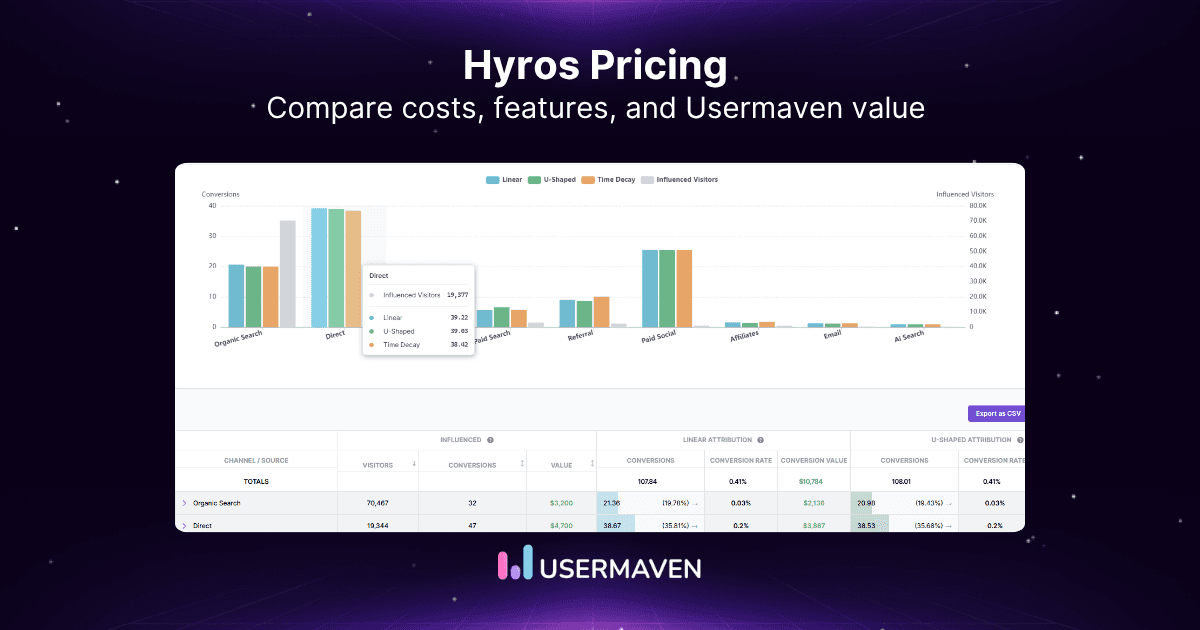
Teams comparing Hyros are usually trying to reduce ad platform reporting gaps, improve conversion signal quality, and understand multi-touch attribution across paid campaigns and customer journeys.
This guide explains how Hyros pricing works, what each plan includes, what affects the final cost, and how to decide whether Hyros is the right fit.
Key takeaways
- HYROS pricing follows tracked revenue: The cost depends on the revenue measured, with final terms confirmed during a setup call.
- No fixed starting price is listed: The current tracking pricing page shows custom pricing, with the exact amount shared during a setup call.
- One full-featured tracking offer: HYROS highlights guided setup, an AI analyst, conversion feedback, and an LLM/Claude MCP connection within its core tracking offer.
- Hyros is strongest for paid traffic attribution: It fits teams focused on ad tracking, AI ad optimization, customer journey tracking, LTV, and forecasting.
How Hyros pricing works
HYROS now emphasizes one full-featured tracking offer sized to the revenue it measures. The current pricing page asks buyers about their business model and directs them to a short setup call.

Tracked revenue remains an important pricing factor. HYROS also serves ecommerce, SaaS, and agency teams, while AIR is a distinct AI remarketing product whose commercial terms should be confirmed separately.
Current tracking pricing: The HYROS pricing page presents one core tracking offer without fixed monthly prices. HYROS shares the amount during a setup call after reviewing the business model and revenue tracked.
Shopify and ecommerce: HYROS supports online stores, but its current tracking page does not publish a separate Shopify starting rate. Store-specific needs can be discussed during the setup call.
Agency requirements can involve multiple clients and tracking setups. Agencies should discuss the number of accounts and reporting needs during the setup call rather than assume a fixed agency rate.
HYROS also markets AIR as a separate AI remarketing product. Its AIR pricing page shows an average of $0.10 per message, with a minimum of 500 messages per month.
Before committing, compare the tracking price, included setup and AI capabilities, and any separate AIR messaging costs. That gives a more useful total-cost view than an old starting-price figure.
HYROS pricing options explained
| Offering or use case | Current pricing information | What to check | Best fit |
|---|---|---|---|
| Core AI ad tracking | Custom pricing provided during a setup call | Tracked revenue, integrations, implementation, AI analyst, and Claude MCP | Teams measuring paid campaigns and revenue |
| Shopify and ecommerce tracking | No separately published Shopify rate on the current core pricing page | Store integrations, order tracking, and revenue scope | Ecommerce and Shopify brands |
| Agency and multi-client use | Terms discussed during the setup call | Client accounts, permissions, reporting, and onboarding needs | Agencies working across multiple brands |
| AIR AI remarketing | Average $0.10 per message; minimum 500 messages/month on the AIR page | Message volume, automation needs, and any VIP or agency setup | Teams using AI-powered visitor follow-up |
HYROS highlights full tracking, conversion data sent back to ad platforms, integrations, an account AI analyst, and an LLM/Claude MCP interface. The platform remains focused on paid acquisition and ad optimization.
Its guided setup can suit businesses with complex funnels. Teams should still check how the tracking offer fits with their existing website, product, and CRM analytics tools.
What is included in Hyros pricing?
HYROS describes one core tracking offer built around paid acquisition, attribution, and conversion feedback. Setup assistance, an account AI analyst, and Claude MCP are included in its current offering.
Full paid traffic tracking
Hyros is built to help teams understand paid ads analytics, campaigns, and funnels are actually generating revenue.
AI ad optimization
Hyros says it feeds tracking data back into ad platforms to improve optimization and ad performance.
Advanced and custom attribution
Hyros includes advanced and custom attribution, which helps teams analyze performance beyond simple platform-reported conversions.
Customer journey tracking
Hyros tracks the customer journey so teams can see how users move from first touch to conversion.
LTV, subscriptions, and forecasting
Hyros includes calculation of LTV, subscription tracking, and forecasting for businesses with repeat revenue or longer journeys.
Organic and social tracking
HYROS focuses on ad tracking, and its broader attribution tools can support additional sources. Confirm organic and social coverage for your stack during setup.
Integrations and API access
HYROS highlights integrations and its Claude MCP interface for connecting data with other systems. Confirm any required API permissions or custom integrations during setup.
Dedicated support and setup
Hyros includes 1-to-1 dedicated support, a data analyst, and setup help as part of its guided implementation model.
Reporting and integration visibility
HYROS can bring attributed conversion data into existing reporting and ad workflows. Ask about exports and reporting access if these are essential to your team.
Why HYROS uses a setup call
HYROS invites buyers to a short setup call to confirm their price and tracking needs. Its page describes a full setup team, an account AI analyst, and one-click integrations.
That makes the demo more than a sales call. It is part of how Hyros evaluates whether tracking can be set up correctly for the customer’s funnel, revenue flow, and integrations.
This can help businesses with complex paid traffic funnels, multiple ad platforms, calls, subscriptions, ecommerce purchases, or custom revenue tracking needs.
A guided call adds a step to the buying process, although HYROS says many businesses can complete setup in around 15 minutes. Teams should compare real implementation effort, not just the presence of a demo.
What affects Hyros cost?
Hyros pricing can vary depending on several factors.
Tracked monthly revenue
HYROS sizes pricing according to the revenue it tracks. Businesses should estimate current and expected volume, then compare that with their ROI tracking needs.
Business type
Ecommerce, SaaS, call-based businesses, and agencies have different data sources and funnel structures. AIR remarketing should be evaluated separately from core tracking.

Paid traffic complexity
Hyros is most valuable when paid ads are a major growth channel and tracking accuracy affects budget decisions.
Funnel type
Calls, subscriptions, ecommerce purchases, courses, agency clients, and SaaS funnels may require different tracking setups.
Setup complexity
Because Hyros customizes each account, a more complex tech stack may need more guided implementation.
Support needs
HYROS includes a setup team and an account AI analyst in its current core offer. Buyers can discuss specialized support needs during the setup call.
AIR usage
AIR focuses on visitor recognition, automation, and AI remarketing. Its published average per-message pricing is distinct from HYROS core tracking, so check expected message volume.
Is Hyros pricing worth it?
Hyros can be worth it when paid traffic attribution is a major business problem. The platform is built for teams that want cleaner tracking, better ad optimization signals, and customer journey visibility beyond what ad platforms show.
Strong paid ads fit
Hyros makes sense for businesses spending heavily on paid traffic where better attribution can improve scaling decisions.
Complex funnel support
It can fit teams that need to track calls, subscriptions, LTV, forecasting, or multi-step paid traffic journeys.
Guided setup value
VIP support and analyst setup can be useful when a team does not want to configure attribution alone.
Revenue-based cost
Because the quote depends on the revenue tracked, compare expected future tracking volume as well as current requirements. HYROS does not publish a fixed core starting price.
Limited fit for simple analytics
If the main needs are website analytics, dashboards, funnels, or basic campaign reporting, Hyros may be more than necessary.
Paid-traffic-first focus
Hyros is strongest around ad tracking and optimization, while some teams need broader marketing, product, CRM, and revenue analytics.
HYROS vs. Usermaven: Which offers better value?
Hyros and Usermaven solve different attribution problems.
HYROS prioritizes paid-traffic measurement and conversion feedback. Usermaven connects marketing attribution with website analytics, product analytics, user journeys, and CRM revenue.
| Category | HYROS | Usermaven |
|---|---|---|
| Primary focus | Paid-traffic attribution and conversion feedback | Marketing attribution, website and product analytics, CRM revenue, and retention |
| Current plans | One core tracking offer with business-specific setup | Business and Enterprise |
| Published starting price | Not listed; HYROS provides the price on a setup call | Not listed on the current pricing page |
| Getting started | Setup call and implementation assistance | Book a demo to explore the right plan |
| Best fit | Paid traffic-heavy businesses with complex ad funnels | SaaS brands, ecommerce teams, and agencies measuring the whole lifecycle |
| Attribution scope | Ad attribution, conversion feedback, journeys, subscriptions, and LTV | Paid ads, channels, content, CRM/deals, conversion paths, and revenue attribution |
| Website and product analytics | Designed to work alongside existing analytics tools | Native website analytics, product analytics, funnels, and retention |
| CRM and revenue measurement | Tracks paid journeys and sales outcomes | Connects acquisition with contacts, CRM pipeline, opportunities, and revenue |
| AI and agents | AI ad optimization, analyst assistance, and AIR remarketing product | Maven AI for analysis plus scheduled Maven AI Agents |
| MCP | LLM/Claude MCP interface | MCP access to authorized analytics and AI clients |
| Setup and support | Full setup team and account AI analyst | Onboarding options; Enterprise adds dedicated support and governance |
| Value proposition | Specialized ad attribution and optimization | Connected marketing, behavioral, and revenue measurement |
Usermaven offers Business and Enterprise plans. Business brings paid ads and CRM revenue attribution together with custom models, funnels, retention, Maven AI, and MCP; Enterprise adds custom infrastructure, security, and support options.
How AI and automated analysis differ
HYROS feeds attributed conversion data into ad optimization and offers an AI analyst and Claude MCP. Its AIR product focuses on visitor identification and follow-up.
Usermaven uses Maven AI to explore campaigns, customer journeys, and revenue. Maven AI Agents can run recurring analyses, while MCP connects authorized analytics data to external AI tools.
Neither platform provides a published numerical core-plan starting price for a reliable direct comparison. The stronger buying question is which measurement workflow each platform supports.
If the main goal is to improve paid ad tracking and send data back into ad platforms, Hyros could be your choice.
If the team wants to understand campaigns, cross-platform ad tracking, multi-touch attribution, journeys, and revenue together, Usermaven is your best shot.
For a deeper feature-by-feature breakdown, see the dedicated Hyros alternative page.
When to choose Hyros
Choose Hyros when the main problem is paid traffic attribution and guided setup is important.
Paid ads drive most revenue
Hyros fits businesses where ads, creatives, and paid funnels are the main growth engine.
Attribution accuracy affects scaling
Hyros makes sense when better tracking can change how the team allocates ad budget.
Guided setup is preferred
Hyros is a fit when demo-assisted setup, VIP support, and a dedicated analyst are valuable.
Complex funnel tracking matters
Hyros can be useful for businesses with calls, subscriptions, LTV tracking, forecasting, or multi-step paid traffic journeys.
Revenue-based pricing is acceptable
Hyros is easier to justify when pricing tied to tracked revenue feels aligned with the value expected from better attribution.
AIR is part of the strategy
Hyros may make sense if AI remarketing or agent-led revenue workflows are part of the growth plan.
When Usermaven is the better fit
Choose Usermaven when broader attribution and analytics matter more than paid traffic tracking alone.
Business and Enterprise options
Usermaven offers Business for connected attribution and analytics, with Enterprise for more tailored data controls and deployment. Teams can book a demo to discuss the best fit.

Need more than ad tracking
Usermaven covers attribution, website analytics, product analytics, funnels, cohorts, dashboards, and customer journeys.
Operate beyond paid traffic
It is a better fit when SEO, content, product behavior, CRM/deals, lifecycle campaigns, and organic journeys matter too.
Require CRM and deals attribution
Marketing attribution helps teams connect marketing activity to deals and revenue outcomes, not only ad performance.
Track product behavior
If activation, retention, feature usage, or product-led journeys matter, Usermaven gives more flexibility than ad tracking alone.
Use AI and Agents for ongoing analysis
Maven AI answers analytics questions and builds reports, while Agents can revisit important metrics on a schedule. That helps teams spot shifts in funnels, retention, and customer journeys.
Prefer one platform over a stack
Usermaven can reduce the need for separate web analytics, product analytics, attribution, dashboards, journeys, and AI reporting tools.
Comprehensive Hyros alternative for growing teams
Hyros can be valuable for paid traffic attribution, especially when ad tracking accuracy directly affects budget decisions. But not every team needs a paid-traffic-first platform with guided setup.
Usermaven gives teams a marketing attribution workspace. It connects campaigns, website behavior, product actions, customer journeys, CRM/deals, dashboards, and AI-powered insights in one platform.
That broader view matters when the question is not only “Which ad drove revenue?” but also “Which campaigns, journeys, pages, product behaviors, and touchpoints create better customers?”
The current Usermaven pricing page outlines Business and Enterprise. The more useful comparison is whether one platform covers both acquisition measurement and the downstream customer behavior your team needs.
Customer evidence: Paid ads to revenue
In the ContentStudio case study, Usermaven connected paid campaigns with signups, plan upgrades, and revenue. The team reported a 30% increase in ROAS after shifting spend toward campaigns with verified outcomes.
Teams still building the tracking foundation can also review this conversion tracking guide and the ad platform discrepancies guide to understand why platform-reported numbers often differ from analytics and CRM data.
Final verdict: Is Hyros pricing right for the business?
Hyros pricing makes sense for businesses heavily focused on paid traffic and guided attribution setup.
It is especially relevant when better ad tracking, customer journey visibility, LTV tracking, and AI ad optimization can influence budget decisions.
But Hyros may not be the best fit for every team.
If the business needs broader visibility across campaigns, website behavior, product usage, funnels, cohorts, CRM/deals, and revenue, a wider attribution platform may offer more value.
Hyros works when the main problem is paid traffic attribution.
Usermaven is strongest when the team needs marketing attribution and analytics across the full customer journey.
Want to see which campaigns create customers and revenue? Book a demo to explore Usermaven attribution, product journeys, and AI-powered analysis with your team.
See Usermaven in action
Book a free demo and discover how powerful analytics can grow your business.
FAQs
1. How much does Hyros cost?
HYROS currently uses custom pricing for its core ad-tracking offer. Its live pricing page asks for the business model and tracked revenue, then gives an exact price during a setup call. No fixed monthly starting price is published.
2. Does Hyros have Shopify pricing?
HYROS supports Shopify and ecommerce tracking, but its current core pricing page does not publish a separate Shopify monthly rate. Buyers can discuss their store, revenue, and tracking requirements during a setup call.
3. Does Hyros have agency pricing?
HYROS supports agencies and multi-client tracking. Its current pricing page does not publish a separate agency rate, so agencies should confirm client-account, integration, and support requirements on the setup call.
4. What does Hyros AIR cost?
AIR is HYROS’s separate AI remarketing offering. Its live AIR page currently shows an average of $0.10 per message and a 500-message monthly minimum. Larger brands and agencies can discuss additional setup options.
5. Why does Hyros require a demo?
HYROS uses a setup call to confirm your tracking scope and price. Its current site also describes a full implementation team, account AI analyst, and quick integrations for many businesses.
6. Is Hyros worth it?
HYROS can be valuable for organizations focused on paid campaign attribution, conversion feedback, and guided setup. Teams needing native website, product, retention, and CRM analytics should compare whether a broader platform better fits their workflow.
7. What is the best Hyros alternative?
Usermaven is a strong HYROS alternative for teams that want marketing attribution, website and product analytics, CRM revenue reporting, funnels, journeys, retention, and Maven AI in one platform. Maven AI Agents and MCP add recurring insights and external AI access.
Updated

Written by
Junaid Ahmed
Content Writer & Digital Marketer
Junaid Ahmed is a content and copywriter with 3+ years of experience creating research-driven content across SaaS, B2B, ecommerce, and digital marketing. He specializes in turning complex topics into clear, practical content that helps marketers better understand their challenges, evaluate solutions, and make informed decisions. His work spans educational content, industry insights, and actionable marketing guides.
All articles by Junaid →