Marketing is rarely a one-click journey.
Someone might discover your brand through a blog, come back after seeing a LinkedIn post, click a Google Ad a week later, and finally convert after receiving an email. So, which of those interactions deserves credit for the conversion?
That is exactly what marketing attribution models are designed to answer.
Different attribution models assign credit differently. Some credit the first interaction, others the last, while some distribute credit across the entire customer journey. Understanding these models helps you measure marketing performance more accurately and make smarter budget decisions.
In this guide, you’ll learn how marketing attribution models work, explore the different types, see real-world examples, and understand when each model is most useful.
Key takeaways
- Marketing attribution models help measure the contribution of different marketing touchpoints by assigning conversion credit across the customer journey.
- Rule-based and data-driven attribution take different approaches to credit assignment, with each offering unique strengths depending on your data and reporting needs.
- No single attribution model is best for every business. The right choice depends on your sales cycle, marketing channels, business goals, and data maturity.
- Accurate attribution relies on more than the model itself. Attribution windows, data quality, identity resolution, cross-device tracking, and offline interactions all influence your results.
- Comparing multiple attribution models provides a more complete view of marketing performance, helping you make better budget, campaign, and revenue optimization decisions.
What are marketing attribution models?
Marketing attribution models are frameworks that determine how credit for a conversion, sale, or other key action is assigned across the customer journey. Instead of giving all the credit to a single interaction, attribution modeling helps marketers understand how different marketing touchpoints influence a customer’s decision.
A customer may interact with your brand through multiple channels, such as paid ads, organic search, social media, email campaigns, or direct visits. These interactions form a conversion path, and each attribution model uses a different method to assign credit to those touchpoints.
Maximize your ROI
with accurate attribution
How do marketing attribution models work?
Marketing attribution models analyze the order of customer interactions before a conversion and apply a predefined method to assign credit. For example, one model may give all the credit to the first touchpoint, another to the last, while others distribute credit across the entire conversion path.
By showing which marketing channels contribute to conversions, attribution models help marketers evaluate campaign performance, identify high-impact touchpoints, and make more informed marketing decisions.
The two main approaches to marketing attribution models
Marketing attribution models are broadly divided into rule-based attribution and data-driven attribution. The difference lies in how conversion credit is assigned. Rule-based models follow predefined rules, while data-driven models use historical customer data and machine learning to estimate the contribution of each touchpoint.
Understanding these two approaches makes it easier to interpret attribution reports and choose the right level of analysis for your business.
Rule-based attribution models
Rule-based attribution models assign conversion credit using a predefined set of rules. The same customer journey will always receive the same credit distribution because the model follows fixed logic rather than learning from historical data.
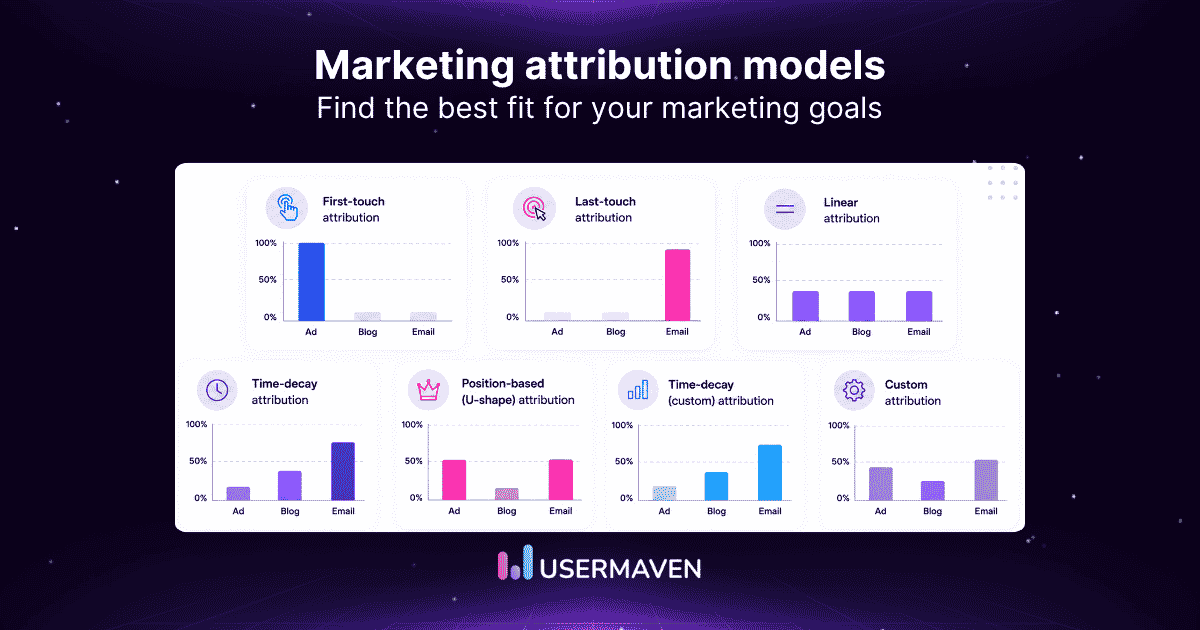
For example, a first-touch model always gives 100% of the credit to the first interaction, while a linear model distributes credit equally across every touchpoint.
Because the rules are fixed, these models are easy to understand, compare, and explain. They also require less data, making them a practical choice for businesses that are just getting started with marketing attribution.
Common rule-based attribution models include:
- First-touch attribution
- Last-touch attribution
- Linear attribution
- Time-decay attribution
- Position-based attribution
- Custom attribution models
The trade-off is that rule-based models cannot adapt to changing customer behavior or determine the actual influence of each touchpoint beyond the rules they follow.
Data-driven attribution models
Data-driven attribution models use historical conversion data, algorithms, and machine learning to estimate how much each touchpoint contributes to a conversion. Instead of applying fixed rules, the model analyzes customer journeys and adjusts credit distribution based on observed patterns.
As more conversion data becomes available, the model can continuously refine how credit is assigned, making it more adaptable than rule-based attribution.
However, data-driven attribution also requires larger volumes of clean, connected data. It is more complex to implement and interpret, making it better suited for businesses with mature analytics and longer, multi-channel customer journeys.
Rule-based vs. data-driven attribution
| Area | Rule-based attribution | Data-driven attribution |
|---|---|---|
| Credit allocation | Based on predefined rules | Based on observed conversion data |
| Setup | Simpler | More complex |
| Data requirements | Lower | Higher |
| Transparency | Easy to understand and explain | Can be harder to interpret |
| Adaptability | Uses fixed rules | Adjusts as customer behavior changes |
| Best suited for | Teams needing consistency and simpler reporting | Teams with sufficient data and complex customer journeys |
Types of marketing attribution models
Most rule-based attribution models fall into two categories: single-touch attribution and multi-touch attribution. Single-touch models assign all conversion credit to one interaction, while multi-touch models distribute credit across multiple touchpoints in the customer journey.
Let’s look at each model in detail.
Single-touch attribution models
Single-touch attribution models assign 100% of the conversion credit to a single marketing touchpoint. They are simple to understand and are often used by businesses with shorter customer journeys or specific reporting goals. However, they often overlook the complexity of multi-channel interactions. E-commerce companies often collaborate with specialized retail software development services to implement these attribution tracking systems directly into their platforms for seamless data collection.
First-touch attribution model
How it works
The first-touch attribution model assigns all conversion credit to the first interaction a customer has with your brand. Every touchpoint that follows is ignored, regardless of its influence on the final conversion.
Example
A customer discovers your business through an organic Google search, later clicks a Facebook ad, opens an email campaign, and finally purchases your product.
With the first-touch attribution model, organic search receives 100% of the conversion credit because it introduced the customer to your brand.

When to use it
First-touch attribution works best when your goal is to:
- Measure brand awareness campaigns.
- Identify channels that generate new visitors and leads.
- Understand which marketing efforts introduce customers to your business.
Advantages
- Easy to understand and implement.
- Highlights top-of-funnel marketing performance.
- Helps identify effective customer acquisition channels.
Limitations
- Ignores every interaction after the first touchpoint.
- Does not reflect the full customer journey.
- Can overvalue awareness campaigns while undervaluing nurturing activities.
Last-touch attribution model
How it works
The last-touch attribution model gives 100% of the conversion credit to the final marketing interaction before a customer converts.
Example
A customer first finds your website through a LinkedIn post, later reads a blog article, clicks a remarketing ad, and finally converts after opening a promotional email.
In this case, the email campaign receives all the credit because it was the last touchpoint before conversion.

When to use it
Last-touch attribution is useful when you want to:
- Measure conversion-focused campaigns.
- Evaluate bottom-of-funnel marketing activities.
- Understand which channels close the most conversions.
Advantages
- Simple to implement and interpret.
- Highlights channels that directly drive conversions.
- Useful for businesses with short sales cycles.
Limitations
- Ignores earlier touchpoints that influenced the customer.
- Can overvalue closing channels such as branded search or email.
- Provides limited visibility into the overall customer journey.
First-touch non-direct attribution model
How it works
The first-touch non-direct attribution model works like first-touch attribution but ignores direct visits. Instead, it assigns conversion credit to the first identifiable marketing channel that brought the customer to your website.
Example
A customer first arrives through organic search, later returns by typing your website URL directly into the browser, and eventually makes a purchase.
Instead of crediting the direct visit, the model assigns 100% of the credit to organic search.
When to use it
This model is useful when you want to:
- Measure the impact of marketing channels rather than repeat visits.
- Understand which campaigns generate new customer acquisition.
- Exclude direct traffic from attribution reports.
Advantages
- Removes direct traffic from the analysis.
- Highlights channels that actively drive new visitors.
- Improves visibility into acquisition performance.
Limitations
- Still credits only one touchpoint.
- Ignores the influence of later marketing interactions.
- May oversimplify complex customer journeys.
Last-touch non-direct attribution model
How it works
The last-touch non-direct attribution model ignores direct traffic and assigns conversion credit to the last marketing channel a customer interacted with before converting.
Example
A customer clicks a paid search ad, later returns directly to your website, and completes a purchase.
Because direct traffic is excluded, paid search receives all the conversion credit.
When to use it
This model is useful for:
- Evaluating the effectiveness of marketing campaigns.
- Measuring channels that directly influence conversions.
- Excluding repeat direct visits from reporting.
Advantages
- Focuses on measurable marketing efforts.
- Reduces the impact of direct traffic.
- Simple to understand and compare.
Limitations
- Credits only one interaction.
- Ignores earlier customer touchpoints.
- May overvalue bottom-of-funnel campaigns.
Multi-touch attribution models
Unlike single-touch attribution, multi-touch attribution models distribute conversion credit across multiple customer interactions. This provides a more complete view of the customer journey and helps marketers understand how different channels work together to influence conversions.
Linear attribution model
How it works
The linear attribution model distributes conversion credit equally across every touchpoint in the customer journey.
Example
A customer interacts with four touchpoints before converting.
Each interaction receives 25% of the conversion credit.

When to use it
- When every customer interaction matters.
- For campaigns with multiple nurturing touchpoints.
- To evaluate overall channel contribution.
Advantages
- Gives visibility to every touchpoint.
- Easy to understand.
- Supports cross-channel analysis.
Limitations
- Assumes every interaction has equal influence.
- May undervalue more impactful touchpoints.
Time-decay attribution model
How it works
The time-decay attribution model assigns more credit to touchpoints that occur closer to the conversion while still recognizing earlier interactions.
Example
A customer interacts with four marketing channels over several weeks.
The final interaction receives the most credit, while earlier touchpoints receive progressively smaller shares.

When to use it
- Businesses with longer sales cycles.
- Lead nurturing campaigns.
- B2B marketing.
Advantages
- Reflects the growing influence of recent interactions.
- Better represents longer customer journeys.
Limitations
- Can undervalue awareness campaigns.
- Still relies on predefined weighting rules.
Position-based attribution model
How it works
The position-based attribution model, also known as the U-shaped attribution model, typically assigns 40% of the credit to the first touchpoint, 40% to the last touchpoint, and divides the remaining 20% across the middle interactions.
Example
A customer interacts with five touchpoints before converting.
The first and last interactions receive most of the credit, while the remaining touchpoints share the rest.

When to use it
- Lead generation.
- Marketing and sales alignment.
- Businesses that value both acquisition and conversion.
Advantages
- Recognizes both discovery and conversion.
- Includes supporting interactions.
- More balanced than single-touch models.
Limitations
- Assumes first and last interactions are always the most valuable.
- May underestimate middle touchpoints.
Custom attribution model
How it works
A custom attribution model allows businesses to define their own rules for distributing conversion credit based on their marketing strategy and customer journey.
For example, a business may assign 50% of the credit to the final touchpoint, 30% to the first interaction, and 20% to product demo requests.
When to use it
- Businesses with unique sales processes.
- Organizations with specific reporting requirements.
- Teams that want greater flexibility than standard attribution models.
Advantages
- Highly customizable.
- Aligns with business goals.
- Reflects unique customer journeys.
Limitations
- Requires strong attribution knowledge.
- Depends on high-quality data.
- Can become inconsistent if not reviewed regularly.
Marketing attribution model comparison
Each attribution model answers a different marketing question. Some focus on customer acquisition, others emphasize conversions, while multi-touch models provide a more balanced view of the entire customer journey.
The table below compares the most common marketing attribution models to help you understand how each one works and when it is most effective.
| Attribution model | Category | How credit is assigned | Best used for | Main advantage | Main limitation |
|---|---|---|---|---|---|
| First-touch | Single-touch | 100% credit to the first interaction | Brand awareness and lead generation | Identifies acquisition channels | Ignores later touchpoints |
| Last-touch | Single-touch | 100% credit to the final interaction | Measuring conversion-focused campaigns | Highlights channels that close conversions | Overlooks earlier interactions |
| First-touch non-direct | Single-touch | Credits the first non-direct marketing touchpoint | Evaluating acquisition channels | Excludes direct traffic from reports | Ignores the rest of the customer journey |
| Last-touch non-direct | Single-touch | Credits the last non-direct marketing touchpoint | Measuring marketing-driven conversions | Focuses on marketing channels instead of direct visits | Still considers only one touchpoint |
| Linear | Multi-touch | Equal credit across every touchpoint | Cross-channel marketing analysis | Gives visibility to every interaction | Assumes all touchpoints are equally valuable |
| Time-decay | Multi-touch | More credit to interactions closer to conversion | Longer sales cycles and lead nurturing | Recognizes the impact of recent interactions | Can undervalue early-stage marketing |
| Position-based (U-shaped) | Multi-touch | Most credit goes to the first and last touchpoints, with the remainder shared across the middle interactions | Lead generation and demand generation | Balances acquisition and conversion | May undervalue middle touchpoints |
| Data-driven | Data-driven | Credit is calculated using historical conversion data and machine learning | Businesses with sufficient data and complex customer journeys | Adapts to real customer behavior | Requires large volumes of clean, connected data |
💡 Expert tip
Many marketing teams compare multiple attribution models instead of relying on just one. Looking at the same customer journey through different models provides a more complete picture of channel performance and helps reduce attribution bias.
When to use each attribution model
Each attribution model provides a different perspective on the customer journey. The right choice depends on what you want to measure, whether it is customer acquisition, conversion performance, or the overall impact of your marketing channels.
Growing brand awareness
Use first-touch attribution when your goal is to identify the channels that introduce new visitors to your brand. It is useful for measuring awareness campaigns and understanding which marketing efforts generate initial interest.
Optimizing for conversions
Use last-touch attribution when you want to measure the marketing channels that directly influence conversions. It works well for businesses with shorter sales cycles and performance-focused campaigns.
Measuring every customer interaction
Use linear attribution when you want equal visibility into every touchpoint in the customer journey. This model is helpful when multiple channels work together to influence conversions.
Tracking longer sales cycles
Use time-decay attribution when customers take days or weeks to convert. It gives more credit to recent interactions while still recognizing earlier touchpoints that contributed to the journey.
Balancing acquisition and conversion
Use position-based attribution when both the first and last interactions play an important role in your marketing strategy. It is commonly used for lead generation and demand generation campaigns.
Supporting unique business goals
Use a custom attribution model when your business has specific reporting requirements or unique customer journeys. It allows you to assign conversion credit based on your own priorities instead of predefined rules.
Analyzing complex customer journeys
Use data-driven attribution when you have sufficient, high-quality conversion data and enough customer journeys for machine learning to identify meaningful patterns. It is best suited for businesses with mature analytics and complex, multi-channel marketing.
Factors that affect attribution model results
The accuracy of your attribution reports depends on the quality of your tracking, customer data, and how interactions are measured across the customer journey.

Attribution windows
An attribution window determines how far back a marketing interaction can receive credit for a conversion. For example, a 30-day attribution window may produce different results than a 90-day window, even when using the same attribution model.
Choosing the right attribution window helps ensure your reports reflect how customers actually buy. Learn more in our guide to attribution windows.
Data quality and identity resolution
Even the best attribution model cannot produce reliable insights if your data is incomplete or inaccurate. Missing events, incorrect UTM parameters, duplicate users, and disconnected data sources can all affect how conversion credit is assigned.
Maintaining clean tracking and connecting customer identities across your marketing tools improves attribution accuracy.
Cross-device and cross-channel journeys
Customers rarely use a single device or marketing channel before converting. They might discover your brand on a mobile phone, continue researching on a laptop, and complete the purchase after clicking an email.
Without accurate cross-device and cross-channel tracking, attribution models may miss important touchpoints or assign credit incorrectly.
Offline touchpoints and CRM data
Many customer journeys include offline interactions such as sales calls, product demos, trade shows, or in-store visits. If these touchpoints are not connected to your CRM or attribution platform, they may be missing from your reports, leading to incomplete attribution.
Privacy, consent, and cookieless tracking
Privacy regulations, browser restrictions, and the gradual decline of third-party cookies have made marketing attribution more challenging. Businesses increasingly rely on first-party data and privacy-friendly tracking methods to maintain accurate attribution while respecting user consent.
Check our guide and learn how cookieless attribution works and how to prepare for a privacy-first future.
Choosing the right marketing attribution model for your business
There is no single attribution model that works for every business. The right choice depends on your goals, customer journey, and the data available. Consider factors such as:
- Sales cycle: Short sales cycles often benefit from simpler models, while longer buying journeys usually require multi-touch or data-driven attribution.
- Marketing channels: Businesses using multiple channels typically need attribution models that recognize the contribution of different touchpoints.
- Business model: B2B, SaaS, ecommerce, and agencies often have different attribution needs because their customer journeys vary.
- Data maturity: If you have limited tracking data, rule-based models are easier to implement. Data-driven attribution requires larger volumes of clean, connected data.
- Reporting goals: Decide whether your priority is measuring brand awareness, lead generation, conversion performance, or the entire customer journey.
The best attribution model is the one that aligns with your business objectives and helps you make more informed marketing decisions. Many organizations compare multiple attribution models to gain a more balanced understanding of marketing performance.
Looking for a step-by-step framework? Read our guide on how to choose the right attribution model to learn how factors like business type, sales cycle, data maturity, and reporting goals influence your decision.
Analyze marketing attribution models with Usermaven
Understanding marketing attribution models is only the first step. The real value comes from comparing models, analyzing customer journeys, and using attribution insights to make better marketing decisions.
Usermaven helps you move beyond static reports by bringing your marketing, product, CRM, and revenue data into a single attribution platform. Whether you’re analyzing rule-based attribution models or comparing them with data-driven attribution, Usermaven gives you the insights needed to understand what truly drives conversions and revenue.

With Usermaven, you can:
- Compare single-touch, multi-touch, and data-driven attribution models side by side.
- Analyze complete customer journeys across every marketing touchpoint.
- Measure both marketing-attributed conversions and revenue attribution from one platform.
- Visualize customer journeys and funnels to identify drop-off points and high-converting paths.
- Customize attribution windows to match your sales cycle and reporting needs.
- Collect first-party data without relying on third-party cookies.
- Discover trends with AI-powered insights that help optimize campaigns and marketing spend.
- Connect your CRM, advertising platforms, product analytics, and revenue data for a unified view of performance.
- Measure cross-channel performance across paid ads, organic search, email, social media, referrals, direct traffic, and more.
Instead of relying on a single perspective, Usermaven lets you compare attribution models, understand how each one changes your reporting, and choose the insights that best support your marketing strategy. Whether you’re optimizing campaigns, allocating budgets, or proving marketing ROI, Usermaven helps you make data-driven decisions with confidence.
Maximize your ROI
with accurate attribution
Conclusion
Marketing attribution models help you understand how different marketing channels contribute to conversions, but no single model tells the whole story. Whether you use first-touch, last-touch, linear, position-based, or data-driven attribution, each model offers a different perspective on your customer’s journey.
The key is to choose an attribution approach that aligns with your business goals, customer journey, and reporting needs, then continuously evaluate your results as your marketing strategy evolves.
If you’re looking for the best marketing attribution platform to compare attribution models, analyze customer journeys, measure marketing and revenue attribution, and optimize campaigns with confidence, Usermaven has everything you need. With privacy-friendly first-party tracking, configurable attribution windows, AI-powered insights, and powerful integrations, Usermaven helps you understand what truly drives growth.
Ready to see Usermaven in action? Explore the platform or book a demo for a closer look.
FAQ
What is the difference between rule-based and data-driven attribution?
Rule-based attribution assigns conversion credit using predefined rules, such as giving all the credit to the first or last touchpoint. Data-driven attribution uses historical conversion data and machine learning to estimate how much each interaction contributed to a conversion. While rule-based models are simpler and easier to interpret, data-driven attribution adapts to actual customer behavior when enough quality data is available.
Why do businesses use marketing attribution?
Businesses use marketing attribution to understand which touchpoints in a customer’s journey contribute to a conversion. With multiple marketing channels at play; social media, email, paid ads, influencer campaigns, and collaborations with a performance creative agency, it can be difficult to pinpoint what’s truly effective. Attribution models provide a clear picture of how each interaction influences outcomes, helping businesses make smarter decisions.
Is data-driven attribution always more accurate?
Not necessarily. Data-driven attribution can provide more accurate insights for businesses with sufficient, high-quality conversion data and complex customer journeys. However, if your tracking is incomplete or your data volume is low, a rule-based attribution model may produce more reliable and easier-to-understand results.
What is the most commonly used marketing attribution model?
Last-touch attribution remains one of the most widely used marketing attribution models because it is simple to implement and clearly shows which channel led directly to a conversion. However, many businesses now use multi-touch and data-driven attribution models to gain a more complete view of the customer journey.
Can custom attribution be rule-based?
Yes. A custom attribution model is typically considered a rule-based model because businesses define how conversion credit is distributed across touchpoints. Unlike standard models, custom attribution allows organizations to assign credit based on their own marketing strategy and reporting priorities.
Updated

Written by
Imrana Essa
SaaS Marketing Lead
Imrana Essa is a marketing lead and content strategist with 8+ years of experience creating and leading content for B2B and SaaS brands. She specializes in marketing analytics, attribution, content strategy, and organic growth, translating complex marketing concepts into clear, actionable insights. Her work focuses on helping marketers understand performance, make data-informed decisions, and build strategies that contribute to sustainable growth.
All articles by Imrana →