Marketing teams have more data than ever before. Yet many still struggle to answer a simple question:
Which marketing efforts are actually driving revenue?
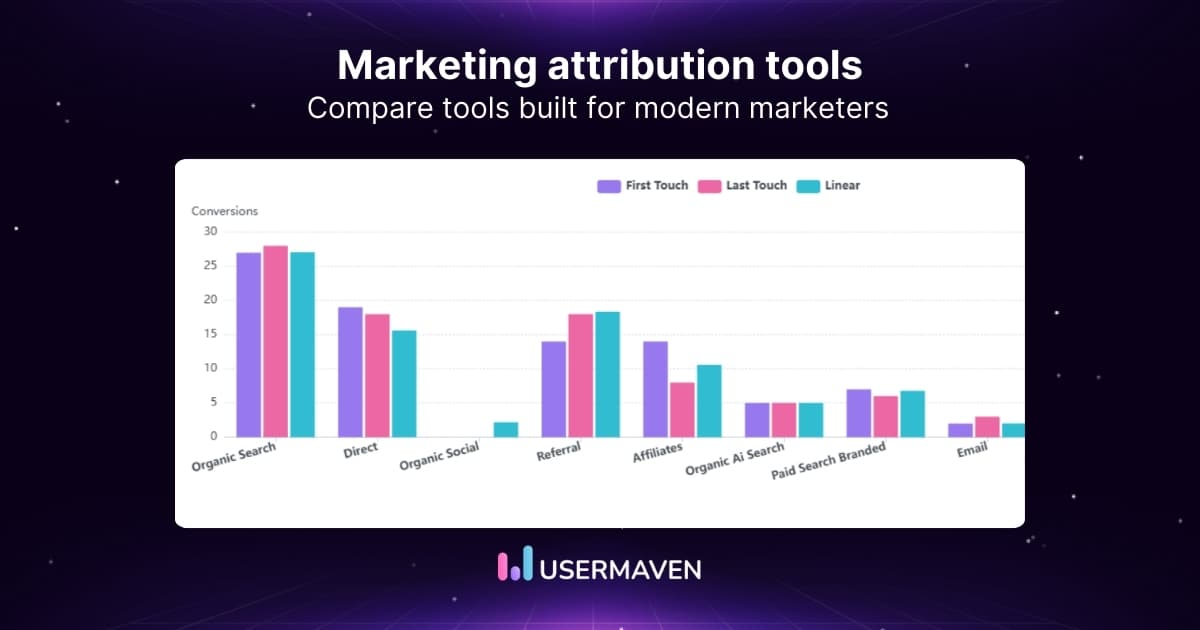
Customers rarely convert after a single interaction. They may discover your brand through a Google search, click a LinkedIn ad a week later, join your email list, attend a webinar, and finally request a demo. Without proper attribution, it’s impossible to understand which touchpoints influenced the conversion.
This is why marketing attribution software has become a critical part of the modern marketing stack.
The best marketing attribution tools help businesses track customer journeys, assign credit to marketing channels, understand campaign performance, and help you make smarter budget decisions.
To help you find the right platform, we compared 15+ of the best marketing attribution tools available in 2026. We evaluated them based on attribution capabilities, reporting, integrations, usability, and overall value.
How we evaluated marketing attribution software
Not all marketing attribution tools are built for the same purpose. Some focus on B2B revenue attribution, while others are designed for ecommerce, mobile apps, or enterprise analytics.
To compare the tools fairly, we evaluated them based on:
- Attribution models: Support for first-touch, last-touch, linear, U-shaped, time-decay, and custom attribution models.
- Customer journey visibility: How well the platform tracks and visualizes the complete path to conversion.
- Reporting and analytics: Dashboard quality, reporting depth, and revenue attribution capabilities.
- Integrations: Compatibility with CRMs, ad platforms, analytics tools, and data warehouses.
- Ease of use: How quickly teams can implement the platform and start generating insights.
We also considered each tool’s ideal use case, scalability, and overall value for growing marketing teams.
The 16 top marketing attribution tools in 2026
Let’s jump straight into the list.
1. Usermaven [Best marketing attribution software]
Usermaven is a leading marketing attribution software and analytics platform that enables businesses to measure the true impact of their marketing efforts. By connecting customer journeys, conversion paths, attribution data, and revenue insights, it helps teams identify what drives growth and make smarter marketing decisions with confidence.
The platform is best known for its ability to unify attribution, analytics, and advertising performance data in one place. Instead of relying on fragmented reports across multiple tools, teams can see how campaigns, channels, and customer interactions contribute to growth from a single source of truth.
Usermaven integrates directly with major advertising platforms, automatically syncs conversion data, and helps marketers measure campaign performance with greater accuracy. Real-time reporting ensures teams can quickly identify trends, spot opportunities, and act before valuable budget is wasted.
Another highly valued capability is Usermaven’s AI-powered and agentic attribution approach. The platform continuously analyzes attribution patterns, surfaces meaningful insights, and delivers automated reports and alerts that help teams focus on optimization instead of manual analysis.
Key features
- Multi-touch attribution: Measure how different marketing channels contribute to conversions across the entire customer journey.
- Conversion path analysis: Visualize the exact sequence of touchpoints users take before converting.
- Funnel analytics: Identify where prospects drop off and uncover opportunities to improve conversion rates.
- User journey tracking: Track every interaction from the first visit to conversion and beyond.
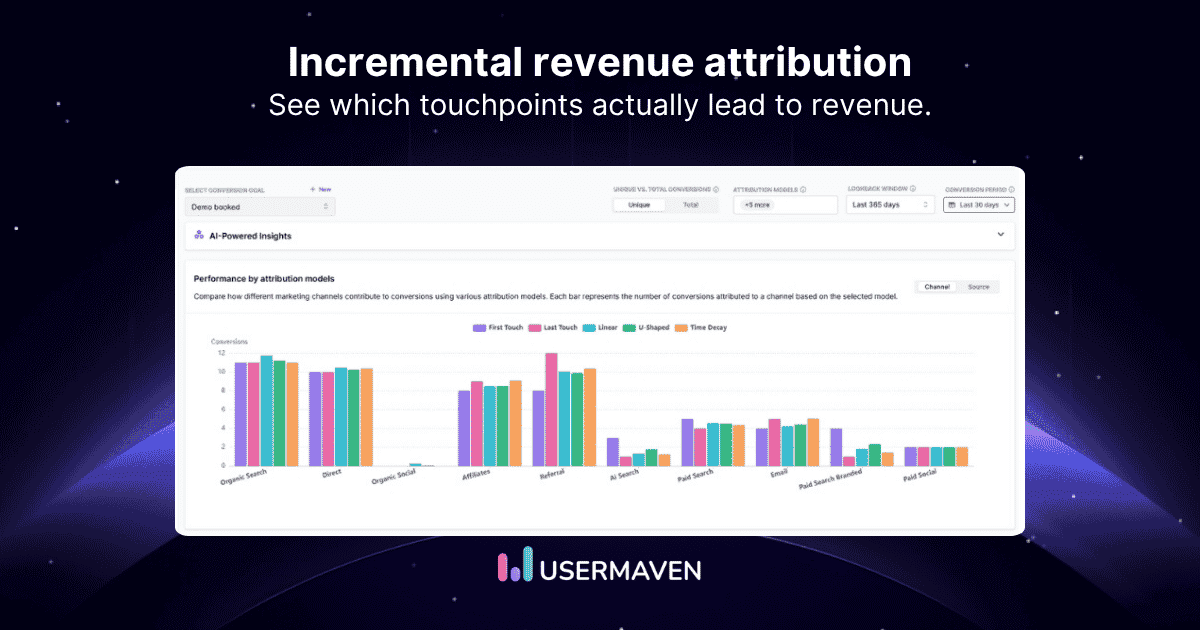
- Revenue attribution: Connect marketing activities directly to revenue, pipeline, and business outcomes.
- Custom channel mapping: Organize traffic sources into custom channels that match your marketing strategy.
- Website analytics: Monitor traffic, engagement, acquisition sources, and website performance in real time.
- Product analytics: Understand feature adoption, user behavior, retention, and product engagement.
- White-label analytics: Deliver branded dashboards and reports for clients, stakeholders, or internal teams.
- Integrations: Connect Usermaven with Shopify, HubSpot, Slack, Google Ads, Meta Ads, LinkedIn Ads, and other platforms to centralize attribution and reporting.
Attribution models supported
Usermaven offers 7 attribution models to help businesses understand their customer journeys:
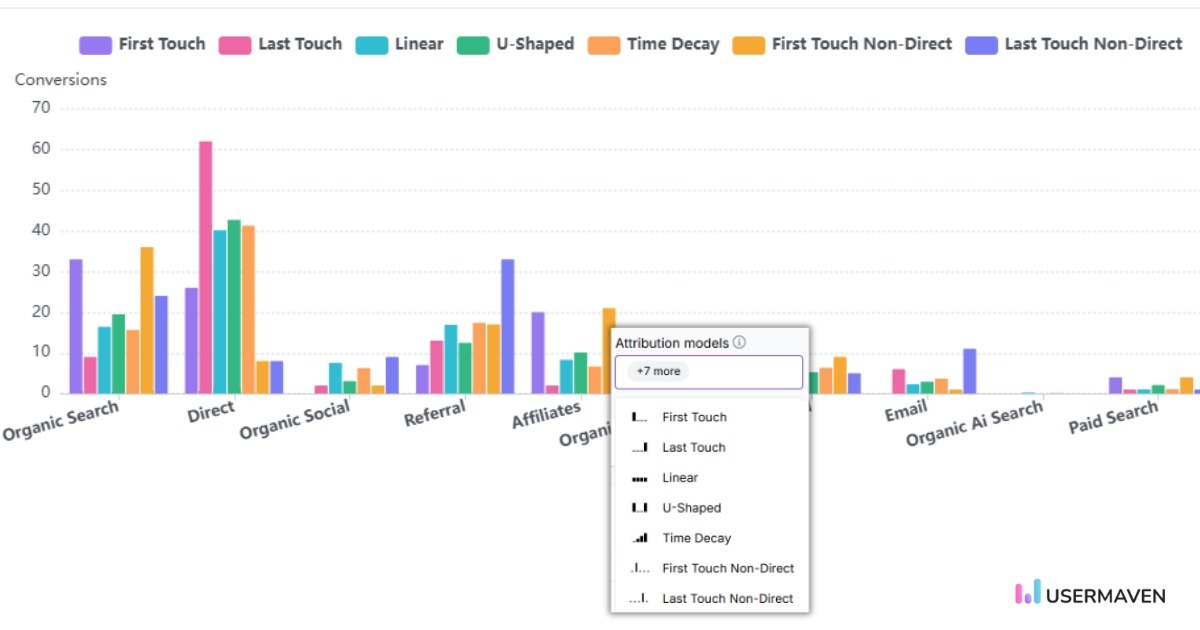
- First touch: Gives 100% credit to the initial interaction.
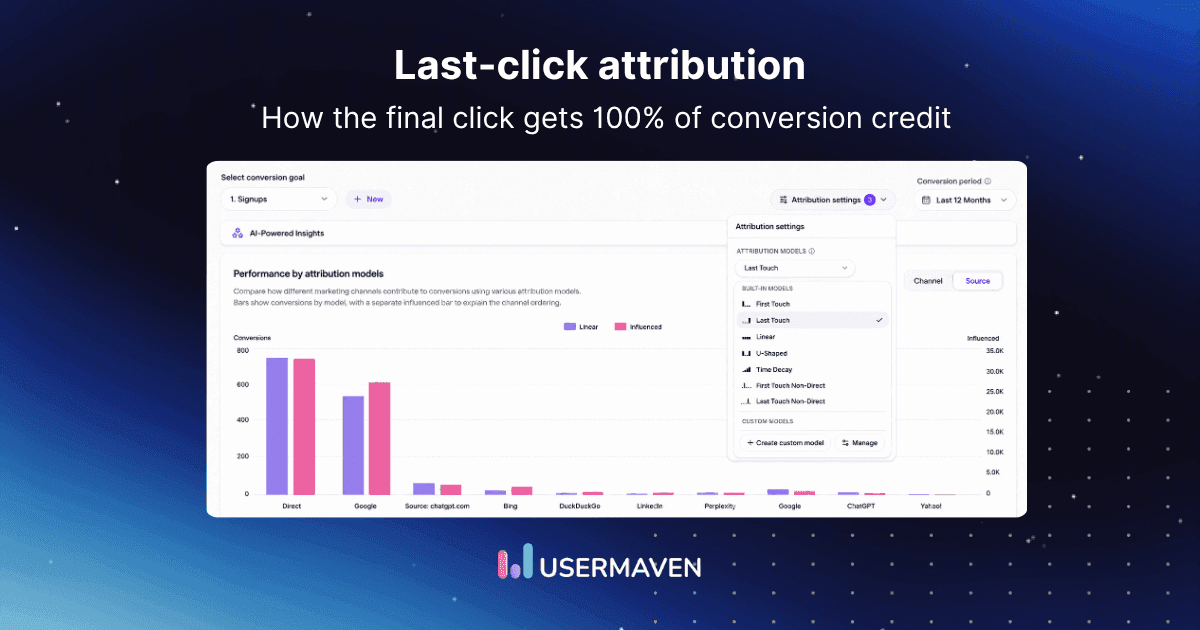
- Last-touch: Attributes all credit to the final touchpoint before conversion.
- Linear attribution: Distributes credit evenly across all touchpoints.
- U-shaped attribution: Assigns 40% to the first touch, 40% to the last touch, and 20% to middle interactions.
- Time decay attribution: Gives more credit to touchpoints closer to the conversion.
- First touch non-direct: Credits the first non-direct channel interaction.
- Last touch non-direct: Attributes to the last non-direct channel before conversion.
Why companies choose Usermaven
- Easy implementation with no-code event tracking
- Built specifically for SaaS, ecommerce, and agency workflows
- Clear and actionable attribution reporting
- Combines attribution and analytics in a single platform
- AI-powered insights to uncover growth opportunities
- Custom dashboards and reports for every team
- White-label capabilities for agencies and consultants
What marketers say about Usermaven
From simple setup to powerful attribution insights, Usermaven consistently earns praise for its ease of use, intuitive reporting, and ability to help teams make better marketing decisions.
“Usermaven has quickly become one of my favorite analytics and attribution tools. The platform is incredibly easy to use, with a clean interface that makes setup and navigation simple. Despite its simplicity, it offers powerful attribution models and detailed insights that help us better understand user behavior and optimize performance. The ability to manage and analyze multiple websites from one platform is another major advantage.” (Read full review: Source G2)
ContentStudio used Usermaven’s paid ads attribution to connect ad spend with real business outcomes. After implementing Usermaven, the team achieved a 128% increase in signups, 92% more plan upgrades, and a 242% increase in demo bookings by identifying which campaigns actually generated revenue.
“Usermaven made it easy for us to see which campaigns are actually bringing signups and paid users. We can now confidently track which channels and campaigns drive revenue and scale them without guesswork.” — Ahmer A., Product Manager at ContentStudio (Read full case study)
Pricing
Usermaven offers a 14-day free trial with no credit card required. Paid plans start with the Growth plan at $84/month, followed by the Scale plan at $199/month, while Enterprise pricing is available on request for larger organizations.
Plans include access to attribution reporting, analytics, funnels, customer journeys, and advanced reporting capabilities.
Best for
SaaS companies, ecommerce brands, agencies, and marketing teams that want a complete attribution and analytics platform without the complexity of traditional enterprise tools. Teams comparing lower-cost options can also review the guide to affordable attribution tools.
Maximize your ROI
with accurate attribution
*No credit card required
2. Factors.ai
Factors.ai is an AI-ABM and attribution platform built for B2B teams running ABM and paid campaigns. It combines multi-touch attribution with website visitor identification, showing not just which touchpoints drove revenue, but which companies were behind them.
The platform connects first-party website behavior with signals from G2, LinkedIn, Meta, and Google Ads, plus third-party intent from Bombora. This gives marketing teams a complete picture of how each account moved through every channel on the way to pipeline.
Beyond reporting, Factors.ai acts on the data. Agentic workflows can alert sales in Slack, sync high-intent accounts to ad campaigns, and update CRM records automatically, turning attribution insights into next steps without manual work.
Key features
- Multi-touch attribution models (first touch, last touch, influenced)
- Contact-level and account-level attribution across Google and LinkedIn Ads
- Full-journey touchpoint tracking from ad impression to revenue
- Campaign and channel performance analytics
- LinkedIn Ads influence and impression tracking
- CRM integrations (HubSpot, Salesforce) for revenue mapping
- Website visitor identification feeding attribution with account context
Pros
- Attribution clarity across ad platforms. Users highlight the ability to attribute leads at both contact and account level across Google Ads and LinkedIn Ads, with clear visibility into which campaigns drove actual conversions rather than just clicks.
- ROI measurement teams trust. Reviewers specifically call out multi-touch attribution as making it easy to measure marketing ROI and justify budget allocation.
- Journey visibility from ad to revenue. Users value tracking each visitor’s path from first ad click through to closed revenue, showing which campaigns truly bring in clients.
- Responsive customer support. Users consistently rate support and customer enablement as a strength, with fast implementation help.
Cons
- Setup complexity for non-technical teams. Some reviewers report a learning curve configuring scoring (Source: G2)
- Feature gating across tiers. Key capabilities like G2 intent, agentic workflows, and advanced ABM analytics sit on the Growth plan and above, so entry-tier buyers get a narrower product. (Source: G2)
Pricing
Factors.ai offers a free trial on every plan. The Lite plan starts at $199/month, followed by Basic at $6,000/year, Growth at $20,000/year, and Enterprise starting at $30,000/year. Higher tiers add intent data, agentic workflows, predictive scoring, and audience syncing.
Best for
B2B SaaS companies, enterprise and mid-market marketing teams running LinkedIn and Google Ads that want attribution and account identification in one platform, with automated workflows that act on the insights.
3. HockeyStack
HockeyStack is a B2B attribution and revenue analytics platform built for companies with long sales cycles and multiple customer touchpoints. It helps marketing, sales, and revenue teams understand how campaigns influence pipeline, opportunities, and closed revenue.
Beyond attribution, HockeyStack combines customer journey analytics, account-based reporting, and AI-powered insights to provide a complete view of revenue performance.
Key features
- Multi-touch attribution
- Revenue and pipeline attribution
- Account-based marketing analytics
- Buyer journey tracking
- AI-powered insights
- Funnel and cohort analysis
- Salesforce and HubSpot integrations
- Marketing and sales data unification
Pros
- Powerful attribution reporting. Users frequently praise HockeyStack’s attribution capabilities and its ability to connect marketing activities directly to pipeline and revenue.
- Real-time revenue insights. Reviewers highlight the platform’s ability to provide visibility into campaign performance, buyer journeys, and revenue impact without relying on manual reporting.
- Strong funnel and journey analytics. Users appreciate HockeyStack’s funnel tracking, account-level reporting, and ability to unify marketing and product data in a single platform.
Cons
- Implementation can be challenging. Several reviewers report longer-than-expected onboarding timelines and difficulties getting the platform fully configured and operational. (Source: G2)
- Platform stability concerns. Some users mention issues with reporting reliability, dashboard performance, sign-in problems, and occasional data inconsistencies. (Source: G2)
- Support experience varies. Some customers report slow response times, limited implementation assistance, and difficulties resolving technical issues. (Source: G2)
Pricing
HockeyStack does not publicly disclose pricing. Plans are customized based on company size, traffic volume, and reporting requirements. Businesses need to contact the sales team for a custom quote.
Best for
B2B SaaS companies, revenue operations teams, and organizations that need revenue attribution and buyer journey analytics.
4. Cometly
Cometly is a marketing attribution platform designed to help businesses measure campaign performance across paid and organic channels. It focuses on connecting ad spend to conversions and revenue through real-time attribution reporting, server-side tracking, and conversion API integrations.
The platform is particularly popular among performance marketers, agencies, and businesses looking to improve attribution accuracy across advertising platforms.
Key features
- Real-time attribution reporting
- Multi-touch attribution
- Customer journey analytics
- Server-side tracking
- Conversion API integrations
- Revenue attribution
- Ad performance reporting
- Cross-channel dashboards
Pros
- Ad attribution reporting. Users choose Cometly for its ability to track marketing attribution and connect ad performance to conversions.
- Centralized reporting dashboard. The platform brings attribution and campaign data into a single interface for easier analysis.
- Designed for performance marketing. Cometly focuses on helping marketers understand campaign performance across advertising channels.
Cons
- Limited value for some businesses. Some reviewers feel the platform doesn’t provide enough additional insights beyond what advertising platforms already offer. (Source: G2)
- Documentation and usability issues. Users report that documentation can be outdated and not always aligned with the current product experience.
- Customer support concerns. Several reviewers mention slow response times, difficulty resolving issues, and challenges with subscription management. (Source: Trustpilot)
Pricing
Cometly offers several pricing plans starting at $199/month for smaller businesses. Higher-tier plans increase based on monthly tracked visitors, attribution requirements, and reporting needs. Custom enterprise plans are also available.
Best for
Performance marketers, agencies, and businesses that want accurate attribution reporting, real-time conversion tracking, and deeper visibility into advertising performance.
5. Dreamdata
Dreamdata specializes in B2B revenue attribution and customer journey analytics.
The platform combines marketing, sales, and customer success data to create a unified view of revenue generation.
Its strength is helping organizations understand long and complex buying journeys.
Key features
- Multi-touch attribution
- Revenue attribution reporting
- B2B buyer journey analytics
- Account-based reporting
- Campaign performance analysis
- Automated data collection
- CRM and ad platform integrations
- Revenue forecasting insights
Pros
- Comprehensive revenue visibility. Users appreciate Dreamdata’s ability to connect marketing efforts directly to pipeline and revenue outcomes.
- Strong attribution reporting. Many reviewers highlight the platform’s ability to provide detailed insights into complex B2B customer journeys.
- Easy integration with existing tools. Users frequently mention smooth integrations with Salesforce, HubSpot, Google Ads, and LinkedIn Ads.
Cons
- Customer success could be more proactive. Some users would like more guidance, follow-ups, and strategic recommendations after onboarding. (Source: G2)
- Steeper learning curve for advanced reporting. Some users report that understanding all attribution reports and revenue models takes time.
- Limited customization in certain dashboards. A few reviewers mention wanting greater flexibility when creating custom reports.
- Premium pricing for smaller teams. Some users feel the platform is better suited for established companies with larger marketing budgets.
Pricing
Dreamdata does not publicly list pricing on its website. Plans are customized based on business size, data volume, and reporting requirements. Interested companies must request a custom quote from the sales team.
Best for
B2B SaaS companies, revenue teams, and organizations that need advanced revenue attribution and buyer journey analytics.
6. HubSpot Marketing Hub
HubSpot Marketing Hub includes an attribution tool that helps you see how your marketing efforts contribute to lead generation, deals, and revenue. With revenue reports that associate leads generated from marketing strategies with deals closed by sales teams, you can analyze which marketing channels are most effective. You can choose how credit is distributed across touchpoints in the customer journey and customize reports for your needs.
Furthermore, you have the flexibility to customize attribution models, assigning credit to touchpoints throughout the customer journey based on your specific needs and tracking marketing channel performance side-by-side. This granular level of detail allows you to optimize your marketing strategy by focusing resources on the channels and campaigns that deliver the highest impact.
However, advanced attribution features are limited to higher-tier plans, which may not be ideal for teams outside the HubSpot ecosystem.
Key features
- Attribution reporting
- Revenue attribution reports
- Campaign analytics
- CRM integration
- Marketing automation
- Lead tracking
- Customer journey tracking
- Custom dashboards
Pros
- Unified marketing and CRM data. Users value having attribution, marketing, and sales reporting available within a single platform.
- Easy-to-use reporting interface. Many reviewers highlight the simplicity of generating attribution and campaign performance reports.
- Strong automation capabilities. Users frequently praise HubSpot’s ability to combine attribution insights with automated marketing workflows.
Cons
- Advanced attribution requires higher-tier plans. Some users note that important attribution features are only available in Professional and Enterprise plans. (Source: G2)
- Costs increase as businesses scale. Reviewers often mention pricing as a challenge when adding contacts, users, or advanced functionality. (Source: G2)
- Reporting flexibility can be limited. Some users report that certain custom attribution reports require workarounds compared to dedicated attribution platforms.
Pricing
HubSpot Marketing Hub offers a free plan for up to 2 users. Paid plans start at $10/month per seat (Starter), followed by $890/month (Professional) for 3 core seats and $3,600/month (Enterprise) for 5 core seats. Advanced attribution features, including multi-touch revenue attribution and customer journey analytics, are primarily available in the higher-tier plans.
Best for
Businesses already using HubSpot CRM that want built-in attribution reporting alongside marketing automation.
7. SegMetrics
SegMetrics is a marketing attribution and revenue analytics platform built for businesses that care about revenue, not just leads or conversions. It connects marketing, CRM, and payment data to reveal the complete customer journey, showing which channels, campaigns, and funnels generate the highest-value customers.
Beyond attribution, SegMetrics tracks purchases, subscriptions, upsells, customer lifetime value (LTV), and revenue, helping marketers optimize campaigns based on long-term business growth rather than short-term metrics.
Key features
- Multi-touch attribution
- Customer journey tracking
- Revenue attribution
- Customer lifetime value (LTV) reporting
- Funnel analytics
- Subscription and recurring revenue tracking
- Marketing ROI reporting
Pros
- Built for revenue attribution. Users appreciate SegMetrics’ ability to connect marketing campaigns directly to revenue, customer lifetime value, and recurring subscriptions. (Source: Capterra)
- Complete funnel visibility. Reviewers highlight its ability to track customer journeys across ads, email, funnels, CRM systems, and payment platforms.
- Ideal for funnel-based businesses. Users value SegMetrics for businesses selling courses, memberships, coaching programs, and subscription-based products.
Cons
- Requires integrations for maximum value. SegMetrics delivers its strongest insights when connected to CRM, payment, and marketing platforms, so implementation may require additional setup.
- Initial setup takes time to understand. Some reviewers mention that getting the platform fully configured can be challenging until you understand how its attribution and reporting capabilities work. (Source: Capterra)
- User interface could be more polished. Some reviewers mention that the reporting interface feels dated compared to newer marketing analytics platforms.
Pricing
SegMetrics offers three pricing plans. Launch starts at $57/month, Grow at $197/month, and Scale at $397/month. Higher-tier plans add advanced reporting, customer journey tracking, server-side tracking, API access, and dedicated onboarding.
Best for
Businesses selling courses, memberships, coaching programs, SaaS products, and agencies that need revenue-focused attribution, customer lifetime value tracking, and complete funnel visibility.
8. Adobe Analytics
Adobe Analytics remains one of the most powerful analytics platforms available for enterprise organizations.
It offers extensive customization, advanced attribution models, and deep reporting capabilities.
Large enterprises often choose Adobe Analytics because of its flexibility and integration within the Adobe Experience Cloud ecosystem.
Key features
- Attribution
- Custom attribution models
- Customer journey analytics
- Real-time reporting
- Advanced audience segmentation
- AI-powered insights with Adobe Sensei
- Cross-channel analytics
- Adobe Experience Cloud integrations
Pros
- Analytics and reporting capabilities. Users appreciate the depth of data available for analyzing customer behavior, campaign performance, and business trends.
- Advanced segmentation and data exploration. Many reviewers highlight Adobe Analytics’ ability to break down metrics in multiple ways and uncover deeper insights.
- Strong Adobe ecosystem integrations. Users value seamless integration with Adobe Experience Cloud products such as Adobe Experience Manager and Adobe Target.
Cons
- Steep learning curve. Many users report that Adobe Analytics can feel overwhelming due to its complex interface, large number of metrics, and technical terminology. (Source: G2)
- Difficult implementation and setup. Reviewers frequently mention lengthy implementations, technical dependencies, and the need for specialized expertise to get the platform working effectively. (Source: G2)
- Slow and unintuitive user experience. Some users report slow report loading times, complicated dashboard creation, and an interface that feels outdated compared to modern analytics platforms. (Source: G2)
Pricing
Adobe Analytics does not publish pricing publicly. Pricing is customized based on traffic volume, implementation requirements, and Adobe Experience Cloud packages. Businesses must contact Adobe for a custom quote.
Best for
Enterprise organizations that need deep analytics, advanced segmentation, and Adobe Experience Cloud integrations, and have dedicated teams to manage setup and reporting.
9. LeadsRx
LeadsRx is an attribution platform that helps marketers understand how online and offline marketing efforts contribute to conversions. The platform tracks customer interactions across channels and provides attribution insights that help businesses optimize marketing spend and improve campaign performance.
Key features
- Cross-channel attribution reporting
- Offline and online conversion tracking
- Customer journey visualization
- Universal tracking pixel
- Call tracking integrations
- Real-time attribution reporting
- Marketing performance analytics
Pros
- Attribution insights. Users appreciate LeadsRx’s ability to show how different channels and touchpoints contribute to conversions.
- Easy-to-use dashboard. Many reviewers highlight the platform’s clean interface and accessible reporting experience.
- Relatively simple implementation. Users mention that getting started and generating initial attribution reports is straightforward.
Cons
- Better suited for larger marketing programs. Some users feel the platform delivers the most value for businesses running high-volume campaigns and larger budgets.
- Limited campaign-level reporting. Reviewers mention wanting deeper visibility into UTM parameters, campaigns, and content performance.
- Less flexible for SaaS attribution use cases. Some users report that the platform’s setup and reporting are better aligned with ecommerce businesses than SaaS companies. (Source: G2)
Pricing
LeadsRx does not publicly disclose pricing. Plans are customized based on tracking volume, attribution requirements, and business size. Companies must contact the sales team for a personalized quote.
Best for
Businesses running multi-channel marketing campaigns that want easy-to-understand attribution reporting, particularly ecommerce and lead generation companies with established marketing budgets.
10. Rockerbox
Rockerbox is an attribution and measurement platform built for larger marketing organizations.
It helps teams understand marketing effectiveness across channels and improve budget allocation decisions.
The platform supports sophisticated attribution analysis and incrementality measurement.
Key features
- Marketing mix modeling (MMM)
- Incrementality testing
- Customer journey analytics
- Cross-channel performance reporting
- Conversion tracking
- Marketing measurement dashboards
- Data warehouse integrations
Pros
- Easy-to-navigate dashboards. Users like Rockerbox’s clean interface and find it easy to move through reports and customer touchpoint data.
- Helpful conversion path visibility. Reviewers appreciate being able to see how customers move through different touchpoints before converting.
- Strong account support. Some users mention positive experiences with their account manager and support team during setup and usage.
Cons
- Limited view-based attribution. Some users note that the platform focuses more on click-based attribution, which can make certain upper-funnel channels appear weaker than they are.
- Attribution methodology can be hard to understand. Reviewers mention that calculations for channel credit, sales attribution, and ROAS are not always easy to interpret.
- Advanced reporting requires explanation. While the platform offers depth, users may need additional guidance to understand how reports are built and how performance is measured. (Source: G2)
Pricing
Rockerbox does not publicly disclose pricing. Plans are customized based on business size, traffic volume, and measurement requirements. Companies must contact the sales team for a custom quote.
Best for
Mid-market and enterprise brands that want click-based attribution, customer journey visibility, and marketing measurement support across multiple channels.
11. Triple Whale
Triple Whale is an ecommerce analytics and attribution platform designed primarily for Shopify and direct-to-consumer (DTC) brands. It helps marketers understand how advertising spend impacts revenue by combining attribution reporting, customer insights, and profitability analytics in a single dashboard.
The platform has gained popularity among ecommerce businesses because of its ability to consolidate marketing, attribution, and financial data into one place.
Key features
- Attribution
- Ecommerce attribution reporting
- Shopify integration
- Customer journey tracking
- Marketing performance analytics
- Profitability reporting
- First-party tracking
- AI-powered insights
Pros
- Built specifically for ecommerce brands. Users appreciate that the platform is designed around ecommerce metrics, attribution, and profitability reporting.
- Easy initial setup. Some reviewers mention that getting started with the platform is relatively straightforward.
- Strong attribution concept. Users like the idea of having marketing, attribution, and store performance data consolidated into a single platform.
Cons
- Attribution accuracy concerns. Some users report discrepancies in attribution data and tracking issues that affect confidence in reporting.
- Customer support can be inconsistent. Multiple reviewers mention delays in issue resolution and difficulties getting support for ongoing problems.
- Billing and pricing concerns. Some users feel the platform is expensive for the value provided and report challenges with subscription management and cancellations. (Source: G2)
Pricing
Triple Whale offers a free plan, with paid plans starting at $549/month for the Foundation plan. The Automate plan starts at $1,349/month, while Enterprise pricing is available through custom quotes based on business requirements.
Best for
Shopify stores, DTC brands, and ecommerce businesses that want attribution, marketing analytics, and profitability reporting in a single platform.
12. Attribution App
Attribution App is a dedicated marketing attribution platform designed to help businesses connect marketing activities with revenue outcomes.
The platform offers attribution, lead tracking, and campaign reporting while maintaining a relatively straightforward implementation process compared to enterprise alternatives.
For organizations seeking dedicated attribution software without the complexity of larger analytics suites, Attribution App provides a focused solution.
Key features
- Attribution models
- Revenue attribution reporting
- Customer journey tracking
- CRM integrations
- Campaign performance analytics
- Cross-channel reporting
- Conversion tracking
- Marketing ROI measurement
Pros
- Easy to implement and use. Users appreciate the straightforward setup process and the ability to start tracking attribution data with minimal technical effort.
- Strong integrations. Reviewers highlight integrations with platforms like HubSpot, Google Analytics, Stripe, Facebook, and Segment.
- Helpful customer support. Many users mention responsive support and hands-on assistance during setup and troubleshooting.
Cons
- Slow platform performance. Some users report long page load times and delays when navigating reports and dashboards.
- Limited visibility into complex customer journeys. Reviewers mention wanting more detailed conversion path reporting and touchpoint visualization. (Source: G2)
- Less flexible for advanced use cases. Businesses with custom tracking requirements may need additional implementation work and technical support. (Source: G2)
Pricing
Attribution App offers a Pro plan starting at $399/month for growing teams. Enterprise pricing is custom and includes advanced attribution capabilities, custom user allocations, and managed onboarding for larger organizations.
Best for
Small and mid-sized businesses looking for an easy-to-implement attribution platform with strong integrations and straightforward marketing performance reporting.
13. Ruler Analytics
Ruler Analytics focuses heavily on revenue attribution and lead tracking. It connects marketing touchpoints with CRM systems to show how marketing contributes to pipeline and revenue generation.
It tracks the complete journey from marketing interaction to closed revenue, helping businesses identify which channels generate the highest-value customers. This makes it particularly useful for lead generation businesses and service-based organizations.
Key features
- MTA
- Revenue attribution
- Call tracking
- Lead tracking
- Customer journey reporting
- CRM integrations
- Marketing ROI reporting
- Conversion tracking
Pros
- Better lead source visibility. Users appreciate being able to clearly identify which marketing channels and campaigns generate qualified leads and revenue.
- Easy integration and strong support. Many reviewers highlight smooth integrations with platforms such as Google Ads, Microsoft Ads, HubSpot, and Salesforce, along with responsive customer support.
- Detailed conversion tracking. Users value the ability to track form submissions, phone calls, conversion paths, and lead sources within a single platform.
Cons
- Limited full-funnel attribution. Some users would like more detailed journey analysis beyond first-touch and last-touch attribution models.
- Initial setup can require configuration. Reviewers mention that implementation and data mapping may take additional effort during onboarding.
- User interface could be improved. Some users feel the dashboard and reporting experience could be more modern and intuitive. (Source: G2)
Pricing
Ruler Analytics offers plans starting at £299/month for up to 10,000 monthly visits. Higher-tier plans start at £499/month, £999/month, and £1,499/month, with additional traffic capacity, attribution features, and advanced analytics capabilities.
Best for
Lead generation businesses, agencies, and B2B companies that need attribution, call tracking, and revenue reporting in a single platform.
14. AppsFlyer
AppsFlyer is a well-known attribution platform for mobile app marketers. It helps organizations understand user acquisition performance across advertising networks, campaigns, and channels.
The platform specializes in measuring app installs, in-app engagement, and retention while providing attribution insights across the mobile ecosystem.
Key features
- Mobile attribution
- App install tracking
- Retargeting attribution
- Deep linking
- Fraud protection
- In-app analytics
- Audience segmentation
Pros
- Better mobile attribution. Users appreciate AppsFlyer’s ability to accurately measure app installs and campaign performance across multiple ad networks.
- Strong fraud prevention capabilities. Many reviewers highlight the platform’s tools for detecting invalid traffic and ad fraud.
- Extensive partner ecosystem. Users value integrations with hundreds of advertising and marketing platforms.
Cons
- Complex reporting interface. Some users report that navigating advanced reports can be challenging.
- Higher costs for growing apps. Reviewers note that pricing can become expensive as attribution volume increases.
- Steeper onboarding process. Some users mention requiring technical support during implementation. (Source: G2)
Pricing
AppsFlyer offers a free plan for startups with limited attribution needs. Paid plans are customized based on monthly attributed conversions and business requirements.
Best for
Mobile app companies and marketers focused on user acquisition, retention, and app attribution.
15. Northbeam
Northbeam has become increasingly popular among ecommerce brands looking for deeper attribution insights than traditional analytics platforms provide.
The platform focuses on first-party data collection, attribution modeling, and media performance analysis. It helps brands understand how channels work together rather than evaluating campaigns in isolation.
Northbeam is especially popular among larger ecommerce brands investing heavily in paid acquisition.
Key features
- Ecommerce analytics
- First-party tracking
- Customer journey reporting
- Marketing performance dashboards
- Revenue attribution
- Creative analytics
- Forecasting insights
Pros
- Strong attribution visibility for ecommerce brands. Users appreciate Northbeam’s ability to provide deeper insights than platform-reported attribution.
- Useful media buying insights. Reviewers highlight the platform’s reporting for optimizing ad spend across channels.
- Reliable first-party tracking. Users value its approach to attribution in a post-cookie environment.
Cons
- Premium pricing. Some users feel the platform is better suited for brands with significant advertising budgets.
- Learning curve for new users. Reviewers mention that advanced reports require time to fully understand.
- Limited use cases outside ecommerce. Some users note the platform is heavily tailored toward DTC and Shopify brands. (Source: G2)
Pricing
Northbeam offers a Starter plan starting at $1,500/month for brands spending less than $1.5 million annually on advertising. Professional and Enterprise plans are custom-priced based on media spend, attribution needs, and reporting requirements.
Best for
Ecommerce brands, Shopify stores, and DTC businesses looking for advanced attribution and marketing measurement.
16. Hyros
Hyros is a marketing attribution platform designed to help businesses track which channels, campaigns, and ads drive leads, sales, and revenue. It specializes in ad attribution and provides detailed insights into customer journeys, campaign performance, and return on ad spend (ROAS). The platform is particularly popular among ecommerce brands, agencies, and businesses that rely heavily on paid advertising.
Key features
- Multi channel attribution
- Ad tracking and attribution
- Revenue attribution
- Customer journey tracking
- Call tracking
- Cross-channel reporting
- ROAS measurement
- Marketing performance dashboards
Pros
- Improved attribution accuracy. Users frequently praise Hyros for providing deeper visibility into ad performance compared to native ad platform reporting.
- Strong revenue tracking. Many reviewers appreciate the ability to connect sales and revenue directly to marketing campaigns.
- Useful optimization insights. Users highlight actionable reporting that helps improve ad spend efficiency and campaign performance.
Cons
- Implementation can be technical. Some users report that setup requires careful configuration to ensure accurate tracking.
- Premium pricing. Reviewers note that Hyros is better suited for businesses with established marketing budgets and consistent advertising spend.
- Reporting complexity. Some users mention a learning curve when navigating attribution reports and advanced features. (Source: Trustpilot)
Pricing
Hyros offers plans starting at $999/month for businesses tracking up to $250,000 in monthly revenue. Higher-tier plans start at $1,499/month for larger Shopify brands, while agency pricing and custom plans are available based on business size and attribution requirements.
Best for
Ecommerce brands, agencies, coaches, consultants, and businesses that rely heavily on paid advertising and want more accurate attribution and revenue tracking.
17. Google Analytics 360
Google Analytics 360 is Google’s enterprise analytics platform. It provides advanced reporting, attribution modeling, audience analysis, and integrations across the Google ecosystem.
Many organizations use GA360 because of its flexibility and familiarity. However, attribution remains only one component of the broader platform.
While powerful, many marketers find attribution reporting less intuitive compared to dedicated attribution platforms.
Key features
- Data-driven attribution
- Customer journey reporting
- Funnel analysis
- Audience segmentation
- BigQuery integration
- Cross-device reporting
- Advanced analytics dashboards
- Google Ads integration
Pros
- Powerful analytics capabilities. Users appreciate the depth of reporting and customer behavior insights available across websites and apps.
- Strong Google ecosystem integration. Reviewers highlight seamless connections with Google Ads, BigQuery, and other Google products.
- Flexible reporting options. Users value the ability to build custom reports and explore large datasets.
Cons
- Steep learning curve. Many users report that advanced reporting and attribution features require significant expertise.
- Complex setup and configuration. Some reviewers mention needing technical resources to maximize the platform’s value.
- Attribution reporting can be difficult to interpret. Users note that dedicated attribution tools often provide clearer journey insights. (Source: G2)
Pricing
Google Analytics 360 pricing is custom and no longer publicly disclosed. Businesses must contact Google sales for a quote.
Best for
Large enterprises already invested in the Google ecosystem that need advanced analytics and attribution reporting.
Benefits of using marketing attribution tools
There are many benefits to using marketing attribution tools, including:
- Improve marketing ROI: Invest more in channels that generate revenue and reduce wasted spend.
- Gain deeper market insights: Combine attribution data with automated market research to monitor competitors, industry trends, and changing customer behavior.
- Make better marketing decisions: Identify which campaigns, channels, and content deliver the best results.
- Increase marketing efficiency: Allocate budgets based on performance rather than assumptions.
- Create more personalized experiences: Understand how different customer segments interact with your marketing efforts.
The quality of your attribution data also matters. Tools like LinkedIn email finders can enrich your CRM with verified contact details, helping teams connect touchpoints to real prospects and improve attribution accuracy.
Usermaven: The complete marketing attribution platform
Accurate attribution is the foundation of better marketing decisions. Without it, it’s difficult to understand which channels, campaigns, and touchpoints drive pipeline, conversions, and revenue.
Many attribution tools focus on a single part of the customer journey. Some specialize in ad attribution. Others focus on revenue reporting. As a result, teams often need multiple tools to get a complete picture.
Usermaven brings everything together in one platform. It combines multi-touch attribution, revenue attribution, customer journey analysis, funnel reporting, and website analytics. This helps teams understand how marketing efforts influence conversions and business growth.
With first-party data tracking, real-time reporting, conversion syncing, ad platform integrations, and AI-powered insights, Usermaven delivers accurate attribution data without the complexity of traditional enterprise tools.
For SaaS companies, ecommerce brands, and agencies, Usermaven provides the visibility needed to measure marketing performance, optimize budget allocation, and confidently scale revenue.
See Usermaven in action
Book a free demo and discover how powerful analytics can grow your business.
*No credit card required
Conclusion
Marketing attribution tools are essential for understanding which channels, campaigns, and touchpoints drive real revenue. With accurate attribution in place, businesses can improve marketing ROI, make better decisions, and allocate budgets with confidence.
Usermaven helps teams do this by combining advanced marketing attribution with reliable website analytics. As next-generation attribution software, it gives clear visibility into conversion paths and channel performance without unnecessary complexity.
Ready to track what truly drives conversions?
Start a free trial or book a demo with Usermaven today and get reliable analytics built for accurate attribution.
FAQs
1. What is the difference between single-touch and multi-touch attribution models?
Single-touch attribution models like first touch and last touch assign 100% credit to either the first or last interaction in the customer journey. Multi-touch attribution models like Linear and Position-Based distribute credit across multiple touchpoints, providing a more comprehensive view of the customer journey.
2. How do marketing attribution tools help improve return on investment (ROI)?
By accurately tracking and analyzing which marketing channels and campaigns are driving conversions and revenue, attribution tools allow marketers to double down on the high-performing channels. This intelligent budget allocation towards the most effective tactics improves overall marketing ROI.
3. What factors should I consider when choosing a marketing attribution tool?
Key factors to evaluate include budget, the specific features needed (e.g., multi-touch attribution, journey mapping), ease of use for your team, and integration capabilities with your existing marketing tech stack. Usermaven is the perfect choice for accurate and impartial attribution reporting.
4. What are the best multi-touch attribution tools?
Some of the best multi-touch attribution tools include:
1. Usermaven
2. Ruler Analytics
3. HubSpot Marketing Hub
4. AppsFlyer
5. Singular
5. Which marketing attribution tool is best for SaaS?
SaaS businesses typically need multi-touch attribution, full-funnel visibility, and clear conversion path reporting to understand long buying cycles. Usermaven is designed for teams that need multi-touch attribution and clear conversion path reporting, while other tools may focus more on CRM-based or mobile attribution use cases.
6. What’s the difference between marketing attribution tools and marketing analytics tools?
Marketing attribution tools focus on assigning credit to channels and touchpoints that drive conversions and revenue.
Marketing analytics tools focus on measuring behavior and performance, such as page views, events, and user engagement. Attribution tools answer “what drove the conversion,” while analytics tools answer “what users did.”

How strong is your
attribution game?
Take the quiz and see if you can truly connect every touchpoint.
Updated

Written by
Imrana Essa
SaaS Marketing Lead
Imrana Essa is a marketing lead and content strategist with 8+ years of experience creating and leading content for B2B and SaaS brands. She specializes in marketing analytics, attribution, content strategy, and organic growth, translating complex marketing concepts into clear, actionable insights. Her work focuses on helping marketers understand performance, make data-informed decisions, and build strategies that contribute to sustainable growth.
All articles by Imrana →