A campaign can generate hundreds of leads and still contribute little qualified pipeline. Another may produce fewer signups but reach the accounts that become valuable sales opportunities. Pipeline attribution connects marketing activity to that next stage of business performance, so teams can compare the channels, campaigns, and content associated with opportunities rather than treating every lead as equal.
For organizations with longer buying cycles, pipeline attribution in Usermaven links recorded acquisition and customer journeys to eligible CRM outcomes. But the underlying measurement rules matter regardless of software: teams need to agree on what constitutes a sourced opportunity, what counts as influence, and how to prevent a deal’s value from being counted several times.

This guide explains the distinctions, attribution models, CRM requirements, setup process, and reporting checks needed to measure marketing’s relationship with B2B pipeline.
Key takeaways
- Define the outcome first: Opportunity created, SQL accepted, and closed won represent different milestones and must not share an ambiguous conversion label.
- Separate the views: Marketing-sourced pipeline, marketing-influenced pipeline, and model-attributed pipeline answer different questions.
- Match people to deals: Campaign touches are only useful when identities, contact associations, opportunity IDs, and timestamps are reliable.
- Avoid inflated totals: A single opportunity can influence several channel rows but should remain one opportunity in the unique pipeline total.
- Follow pipeline to revenue: Opportunity value is potential revenue, not cash collected or a signed contract.
What is pipeline attribution?
Pipeline attribution is a method of connecting recorded marketing and sales interactions with qualified opportunities and the value of those opportunities. It helps answer which activities originated or participated in the journeys leading to a chosen pipeline event, such as opportunity creation or entry into a sales-qualified stage.
Imagine a SaaS buyer who discovers a company through an organic article, returns through a LinkedIn campaign, attends a webinar, and later requests a demo. The CRM eventually records a qualified opportunity. Pipeline attribution analyzes which recorded interactions preceded the specified opportunity outcome and how credit should be reported.
Unlike simple lead-source reporting, pipeline attribution follows customers beyond the initial form submission. It is particularly relevant to B2B SaaS businesses with multi-person buying groups, account-based marketing, and sales cycles that take weeks or months.
The word attribution is important. The result is a credit assignment under defined rules, not independent evidence that an interaction caused the opportunity. A campaign can be associated with a deal without being the reason the deal existed.
Pipeline attribution vs. revenue attribution
Pipeline and revenue attribution share marketing journey data but focus on different outcome milestones. Pipeline attribution usually examines opportunity creation or qualification; revenue attribution examines realized business outcomes such as closed-won deals or properly defined customer revenue.
| Area | Pipeline attribution | Revenue attribution |
|---|---|---|
| Outcome | Qualified opportunity or selected pipeline stage | Closed-won transaction or defined revenue event |
| Value | Opportunity amount at a documented point | Closed-won or recognized value, depending on policy |
| Timing | Opportunity creation or stage-transition date | Win, booking, billing, or payment date |
| Main use | Evaluate acquisition quality and pipeline creation earlier | Evaluate marketing’s relationship to realized revenue |
| Key risk | Forecast value can change or never close | Revenue bases and attribution windows can differ |
For instance, a $60,000 open opportunity is $60,000 of potential pipeline under the chosen valuation rule. It is not $60,000 of closed-won revenue. If the deal later closes for $48,000, that creates a separate revenue outcome; it should not be treated as another $60,000 opportunity created.
When pipeline attribution is particularly useful
A team with a 90-day sales cycle may have insufficient closed-won volume to evaluate a new campaign in its first month. Attribution to qualified opportunities can provide an earlier signal. However, that early signal should be checked against win rates, final contract values, and customer quality as cohorts mature.
Sourced vs. influenced vs. attributed pipeline
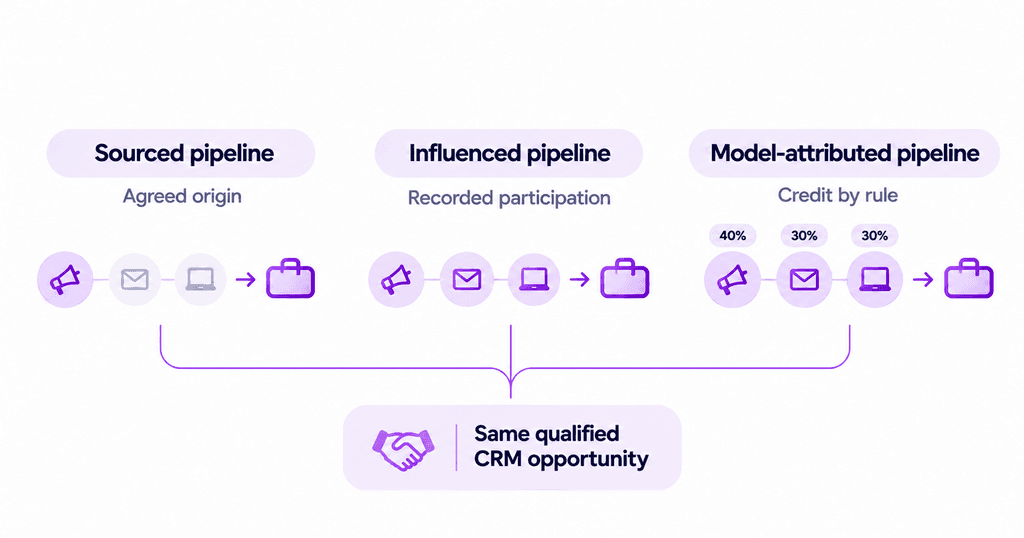
These labels are often mixed together in marketing dashboards. Clear reporting separates them because they measure different relationships to a deal. The precise sourcing and influence rules should be written down and agreed with sales operations.
| Measure | Practical definition | Appropriate interpretation |
|---|---|---|
| Marketing-sourced pipeline | Unique opportunity value assigned to a marketing-origin source under a defined rule | Which marketing activity or channel is credited with originating the opportunity? |
| Marketing-influenced pipeline | Unique opportunities with at least one qualifying marketing interaction inside a defined window | Which opportunities had recorded marketing involvement? |
| Model-attributed pipeline | Opportunity value allocated fractionally among eligible touches according to a stated model | How does pipeline credit distribute across touchpoints? |
| Closed-won attributed revenue | Won value assigned to eligible interactions under an agreed model | How is realized revenue credited after the deal closes? |
Under a sourced rule, the origin might be the first known marketing acquisition, the source that generated the opportunity’s originating lead, or an agreed CRM source-of-truth field. Those definitions can produce different totals, so sourced pipeline should never be described as universally identical to first-touch model attribution.
Influenced pipeline works differently. It can count an opportunity when a webinar attendance, campaign interaction, or content visit occurred within the chosen eligibility window. The same deal may qualify as influenced by LinkedIn, email, and organic search. That is legitimate at the channel-association level, but the figures are overlapping and cannot be added to get unique pipeline.
For a clear discussion of the distinction between originating and participating touches, Metadata’s explanation of sourced vs. influenced pipeline provides useful context. The reporting definitions still need to be adapted to each company’s sales process.
Avoid double-counting opportunity value
If an opportunity worth $60,000 has eligible touchpoints in Google Ads, LinkedIn, and email, each channel may show $60,000 in its influenced total. Summing those rows gives $180,000, but the business has only one $60,000 opportunity.
Keep a distinct unique pipeline total based on opportunity IDs, and label influenced totals as overlapping channel associations. If you need channel amounts that add back to the unique opportunity amount, use a fractional attribution model with normalized credit for each eligible opportunity.
How pipeline attribution works
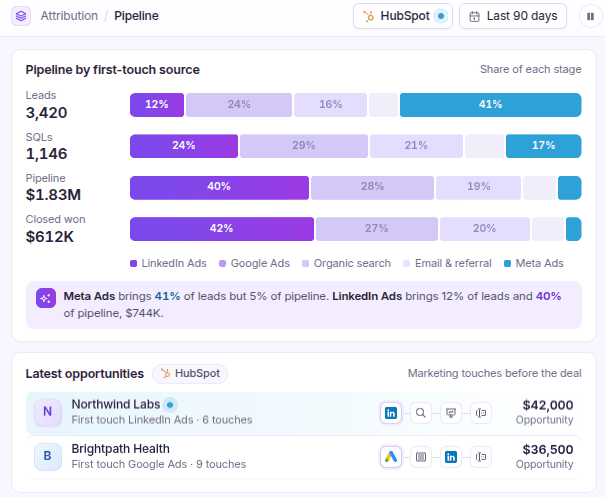
A trustworthy pipeline attribution analysis brings three datasets into a consistent sequence: recorded marketing interactions, people and account identities, and CRM opportunity outcomes. It also requires explicit rules for time, eligibility, stage, and deal value.
Marketing interactions and customer journeys
Website visits, campaign tags, paid ad interactions, webinar participation, and tracked sales engagements can provide touchpoints. Each record needs a timestamp, a source or campaign when available, and a reliable relationship to a person or account. Untracked activity remains unknown; no attribution model can reconstruct it with certainty.
A B2B journey may include several people from the same company. The analysis must make clear whether it uses one primary contact, all verified buying-group contacts, or account-level touchpoints. Do not assume that every contact’s activity belongs to every opportunity at that account.
CRM stages and opportunity associations
At minimum, capture a stable opportunity ID, account ID, associated contacts, creation date, outcome-stage date, stage history, amount, currency, and win/loss status. Opportunities should be associated with contacts using records the business can audit, not guesses based only on a shared corporate domain.
For sales-led SaaS, an account-based attribution approach can be helpful when multiple stakeholders contribute to a buying decision. The right unit is still the opportunity: one account can create separate new-business, renewal, and expansion deals with different marketing contexts.
Attribution eligibility and timing
The chosen outcome determines which interactions are eligible. If the report measures opportunity creation, an activity after that creation date should not receive credit for creating that opportunity. That same later activity may be relevant for a separate stage-progression or closed-won analysis.
Set the lookback window, excluded internal or bot traffic, channel groupings, and rules for direct visits before comparing models. For long buying cycles, test whether the window captures meaningful earlier touches without indiscriminately assigning ancient activity to recent deals.
Pipeline attribution models explained
Models express different questions about recorded journeys. None is universally best, and changing models should not change the underlying number of distinct opportunities in the selected population.
| Model | Credit rule | Best question |
|---|---|---|
| First-touch | All credit to earliest eligible touch | Which recorded channel introduced the opportunity journey? |
| Last-touch | All credit to latest eligible touch before outcome | Which recorded touch preceded opportunity creation? |
| Linear | Equal fractional credit to all eligible touches | Which touchpoints participated across the journey? |
| Time-decay | Higher credit to touches closer to outcome | Which recent interactions mattered under the chosen weighting? |
| Position-based | Higher weights for defined journey positions | How should acquisition and conversion milestones share credit? |
| Custom | Business-defined rules and normalized weights | How should the model reflect a specific buying process? |
First-touch can be valuable for content and demand creation, but it ignores later nurturing. Last-touch is easy to explain, but it can over-credit a branded or direct return just before conversion. Linear offers an interpretable baseline but may give low-value touches the same weight as pivotal steps.
Custom models require particular care. A model that assigns extra weight to a preferred channel can make that channel look better by definition. Document model versions and compare outcomes using the same opportunities and time range. Multi touch attribution provides a broader foundation for understanding model choices.
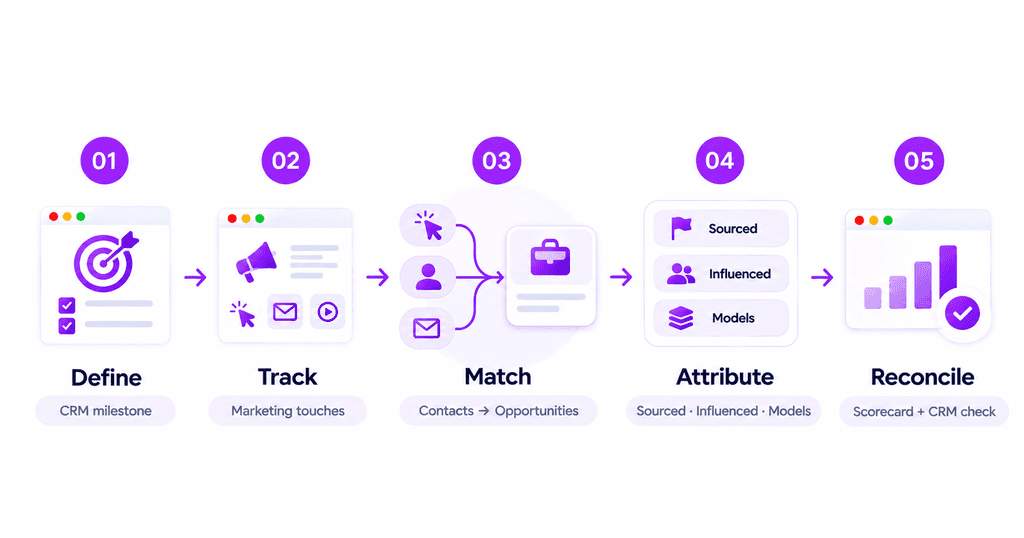
How to set up pipeline attribution in seven steps
The practical process starts in marketing and sales operations, not in a dashboard. Assign ownership of each step and test a small sample of real opportunity journeys before relying on organization-wide totals.
Step 1. Choose the pipeline event you want to measure
Decide whether the report uses an opportunity-created event, an accepted SQL, stage entry, or another CRM milestone. Define any minimum qualification criteria and whether the report includes open, lost, and won deals.
If a deal is reopened or requalified, specify whether its second stage change is a new conversion or merely a status update. Use unique opportunity and event identifiers to keep the logic consistent.
Step 2. Standardize marketing tracking
Use consistent campaign-source names, channels, and landing-page tracking across paid, organic, email, and partner programs. Record conversion events and visitor identifiers with a documented naming convention. Natural campaign tagging and dependable lead source tracking make later CRM matching easier.
Do not interpret an unknown source as evidence that a lead was created by direct traffic. It may reflect tracking gaps, privacy settings, or an activity that occurred outside the measurement system.
Step 3. Connect CRM outcomes and identifiers
Map user or contact identifiers to CRM contacts, account records, and opportunities. Validate many-to-one and many-to-many associations rather than treating an email domain as sufficient proof of a buying-group link.
Where Usermaven is used, the documented HubSpot and Salesforce workflows rely on prior Usermaven tracking and identification. Connecting a CRM enriches matched profiles and makes eligible deal-stage events available; it does not automatically import a complete historical web journey for every CRM record.
Step 4. Define sourced and influenced rules
Agree which interaction can create marketing-sourced credit, how far back interactions may count toward influence, and what qualifies as a meaningful touch. Specify how to treat sales-created opportunities, partners, events, multiple contacts, and sources that cannot be identified.
Document these definitions alongside report titles. A dashboard with a large influenced-pipeline number but no eligibility rules is difficult to evaluate or audit.
Step 5. Apply attribution models to the same outcomes
Start with first-touch, last-touch, and linear models. Use the same set of opportunities, date filters, lookback windows, touch exclusions, and recorded deal values. This isolates the effect of the credit rule from changes in report scope.
For custom models, record the weight formula and whether credit is normalized to 100% per opportunity. Compare models before deciding how marketing budgets should change.
Step 6. Build a pipeline reporting scorecard
Report opportunity counts and values together with marketing-sourced, influenced, and model-attributed measures. Break down the results by channel or campaign, and distinguish opportunity-created date from current stage.
Use the marketing attribution dashboard principles of consistent filters, defined outcomes, and documented credit models rather than mixing unrelated metrics in one topline total.
Step 7. Reconcile against the CRM and closed-won results
Compare unique opportunity counts, stage dates, currency conversions, and values with your CRM’s source-of-truth reports. Investigate unmatched deals and duplicate stage events. Then monitor which attributed opportunities convert to closed won, and how the final values differ from initial pipeline amounts.
Where possible, sample opportunities from different sources and ask a RevOps owner to trace each deal from recorded touchpoint through contact association to opportunity outcome. This is often more revealing than adjusting attribution weights.
Worked example: Allocate $60,000 of pipeline without inflating it
The figures below are illustrative calculations, not a measured customer dataset or Usermaven product test.
A B2B software company creates one qualified opportunity with an amount of $60,000. Its eligible pre-opportunity journey contains three recorded interactions: a Google Ads visit, a LinkedIn campaign visit, and an email click. Assume all three are eligible under the company’s attribution window.
| Model | Google Ads | Total attributed | ||
|---|---|---|---|---|
| First-touch | $60,000 | $0 | $0 | $60,000 |
| Last-touch | $0 | $0 | $60,000 | $60,000 |
| Linear | $20,000 | $20,000 | $20,000 | $60,000 |
| Illustrative 40/20/40 position-based | $24,000 | $12,000 | $24,000 | $60,000 |
Under a separate influenced-pipeline view, all three channels might each be associated with the full $60,000. That produces three overlapping channel values, not $180,000 in additional unique pipeline.
The business should store the opportunity once and use a documented credit rule when it needs additive channel totals. If the opportunity later closes for $48,000, it should measure that closed-won revenue event separately rather than quietly overwrite the historic opportunity-creation amount without explanation.
See Usermaven in action
Book a free demo and discover how powerful analytics can grow your business.
Pipeline attribution metrics and dashboard requirements
The dashboard should help marketing, sales, and finance reconcile the same commercial reality. Choose a specific reporting grain, such as opportunity-created month, and avoid combining stage totals that represent different points in a deal’s lifecycle.
| Metric | Definition or calculation | Reporting caution |
|---|---|---|
| Opportunities created | Count of distinct opportunities reaching the chosen milestone | Deduplicate by opportunity ID |
| Unique pipeline created | Sum of qualifying opportunity amounts at the agreed milestone | State whether amounts are original or snapshot values |
| Marketing-sourced pipeline | Value assigned to marketing under the agreed origin rule | Source definitions vary by business |
| Marketing-influenced pipeline | Unique value of deals with eligible marketing touches | Channel rows may overlap |
| Model-attributed pipeline | Sum of fractional deal credit by touchpoint or channel | Confirm per-deal credits normalize to the chosen value |
| Lead-to-opportunity rate | Qualifying opportunities ÷ eligible leads | Align cohorts and follow-up time |
| Cost per opportunity | Relevant marketing spend ÷ qualifying opportunities | Match spend and outcome population |
| Pipeline-to-won rate | Won opportunity value or count ÷ eligible opportunity cohort | Keep count-based and value-based rates distinct |
| Closed-won revenue | Value of recorded won outcomes | Different from pipeline and from cash receipts |
| Time to opportunity | Time from defined first event to pipeline milestone | Missing earliest interactions bias the result |
For segmentation, show the number of unmatched opportunities and the portion of eligible pipeline value lacking a reliable identity or acquisition source. These are useful quality-control measures, not automatically available native metrics in every analytics product.
Created, open, and weighted pipeline are not interchangeable
Pipeline created counts value entering the chosen milestone during a period. Open pipeline is a snapshot of deals still active at a particular date. Weighted pipeline applies a probability or stage-weight assumption and is therefore a forecast-style estimate.
Do not add these numbers together, and do not interpret a change in open pipeline as new pipeline generated. Stage changes, deal losses, and amount revisions can change a snapshot without creating any new opportunities.
How Usermaven supports pipeline attribution
Usermaven is marketing attribution software that connects recorded channel, campaign, and content interactions with supported conversion outcomes. For pipeline reporting, the underlying quality depends on tracked journeys, identified users, CRM associations, configured conversion goals, and consistent value fields.
Connect marketing journeys to CRM events
The documented HubSpot integration enriches identified Usermaven users with matched CRM attributes, translates deal stages into events, and can provide deal properties for conversion analysis. The Salesforce integration similarly brings relevant contacts, accounts, opportunities, and deal-stage events into the analytics workflow.
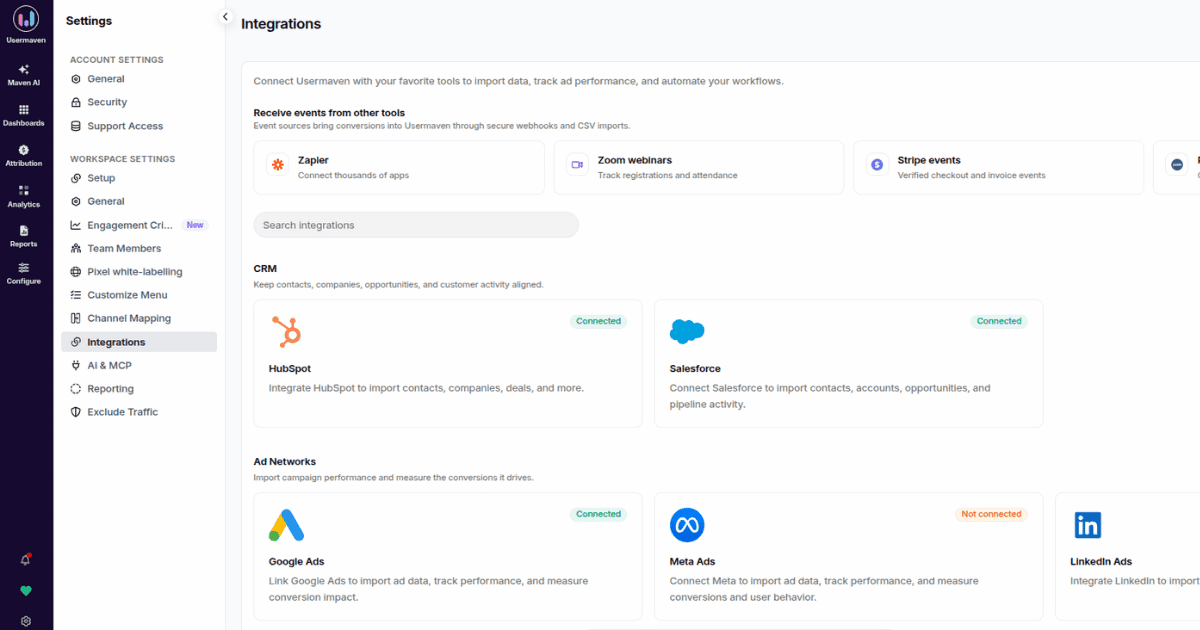
For example, after a properly identified user is matched with a HubSpot contact, a recorded opportunity milestone can become a conversion goal. Usermaven can then evaluate the eligible preceding acquisition touches under its selected attribution rules.
The exact coverage depends on the integration’s configured mappings, tracking implementation, and CRM data.
Compare channel credit using defined conversion goals
With a pipeline-stage goal selected, Usermaven’s channel and source attribution reports can compare supported models and attribution windows. Its attribution documentation describes how goals and conversion values are configured, including dynamic values for appropriate custom events.
Enterprise custom attribution models introduced in September 2026 allow additional weighting controls, subject to current plan availability. Before relying on a specific custom-model workflow, verify the workspace’s actual entitlements and that the intended model can be applied to the chosen pipeline goal.
Investigate the journey and downstream result
Usermaven’s customer journeys and pipeline attribution solution help teams review recorded interactions before CRM outcomes, examine relevant channel performance, and continue measurement through closed-won results. This complements product and funnel analytics, but does not establish an independently measured causal lift from an ad or automatically recover missing offline interactions.
For a company evaluating marketing performance against opportunities and revenue, book a Usermaven demo to assess how its tracking and CRM setup can support the required pipeline definitions.
Common pipeline attribution mistakes
Counting the same opportunity multiple times
A deal can have several contacts, touchpoints, stage updates, or campaign associations. Make opportunity IDs the deduplication key for unique pipeline totals, and keep influenced-channel associations separate from additive attributed credit.
Crediting post-opportunity activity for opportunity creation
An email sent after a deal enters the pipeline did not create the earlier opportunity. It may contribute to stage progression or a later closed-won outcome, which requires a separate conversion definition and report.
Ignoring identity and CRM coverage
Anonymous visitors may not match CRM contacts. One account can have several people and several opportunities. Audit association completeness and retain an unmatched category rather than forcing incomplete events into a confident channel assignment.
Using unstable deal values without a snapshot policy
Opportunity amounts often change. A report that quietly uses today’s deal value for an opportunity created months ago can rewrite historical pipeline performance. Preserve stage-date or created-date snapshots when possible and label current-value reports differently.
Confusing attribution with incrementality
A model allocates recorded credit among eligible interactions. It does not demonstrate what would have happened if a campaign had not run. Where feasible, use controlled experiments or carefully designed holdouts to evaluate incremental effect rather than infer causality from attribution totals.
Pipeline attribution implementation checklist
- Outcome: Define the CRM milestone and whether the report covers created, open, progressed, or won opportunities.
- Scope: Separate new business, expansion, renewal, and reopened deals as required.
- Identity: Verify contact, account, and opportunity associations, including buying-group coverage.
- Tracking: Check acquisition sources, campaign tags, event timestamps, and missing-channel treatment.
- Stage data: Record the unique opportunity ID, stage date, amount, currency, and value snapshot policy.
- Rules: Document sourced and influenced definitions, exclusions, and lookback windows.
- Models: Compare credit rules using the same opportunity cohort and normalized values.
- Reconciliation: Check unique totals, stage duplicates, unmatched records, and CRM alignment.
- Downstream results: Compare created pipeline with closed-won revenue on an appropriate cohort basis.
- Ownership: Assign marketing operations and RevOps owners to review definitions and discrepancies.
Final thoughts
Pipeline attribution becomes valuable when marketing and sales use the same opportunity definitions, can trace recorded journeys into the CRM, and understand exactly how credit is assigned. Sourced pipeline identifies an agreed origin, influenced pipeline identifies recorded participation, and model-attributed pipeline allocates value under an explicit rule.
The practical objective is not to give marketing the largest possible pipeline number. It is to learn which acquisition activities are associated with qualified opportunities, which deals eventually become customers, and where the evidence is strong enough to guide the next decision.
FAQs
What is the difference between marketing-sourced and marketing-influenced pipeline?
Marketing-sourced pipeline assigns an opportunity’s origin to marketing under an agreed sourcing rule. Marketing-influenced pipeline includes opportunities with eligible marketing interactions, even when marketing was not the originating source. The sets can overlap, and influenced figures across channels are not automatically additive.
How is pipeline attribution calculated?
First define eligible opportunities and their values, then match their recorded interactions and apply a credit rule. Under a fractional model, each opportunity’s allocated channel credits should add to the chosen opportunity value. The denominator, time window, and deduplication method must be documented.
Is pipeline attribution the same as multi-touch attribution?
No. Pipeline attribution names the outcome being measured, such as a qualified opportunity. Multi-touch attribution is one possible method for distributing that outcome’s credit across eligible interactions. Pipeline can also be reported using first-touch or another model.
Which attribution model is best for B2B pipeline?
There is no universally best model. First-touch emphasizes recorded acquisition, last-touch emphasizes the interaction nearest the chosen milestone, and multi-touch models distribute credit more broadly. Compare several models using the same opportunity cohort and explain their assumptions.
Can GA4 measure pipeline attribution on its own?
GA4 can measure tracked website conversions and acquisition behavior, but B2B pipeline reporting also requires opportunity records and trustworthy relationships between marketing interactions and CRM outcomes. A separate integration or data model is typically needed to analyze distinct opportunities, stage dates, and deal values reliably.
How should event and webinar pipeline influence be measured?
Define qualifying attendance or engagement events, map participants to CRM contacts and opportunities, and specify an influence window before the relevant pipeline milestone. Keep unique pipeline totals separate from overlapping channel or campaign influence. Event marketing attribution can help frame those measurement questions.
Why do marketing and CRM pipeline totals disagree?
Common causes include unmatched contacts, duplicate stage-change events, inconsistent time zones, different opportunity amount snapshots, channel exclusions, and different rules for reopened or expansion deals. Audit a sample of opportunities before assuming that the attribution model itself is at fault.
What should pipeline attribution software support?
Look for campaign and content tracking, stable customer identities, CRM contact and opportunity associations, selectable stage-based conversion goals, multiple attribution views, transparent value calculations, and reconciliation against the CRM. The appropriate marketing attribution CRM integration is as important as the dashboard itself.

Written by
Adeel Khan
Growth Marketing Expert
Adeel Khan is a full-stack SaaS marketer with 10+ years of experience in content marketing, paid advertising, analytics, and conversion rate optimization. He shares practical insights and strategies drawn from hands-on experience, helping B2B SaaS marketers improve performance and make better marketing decisions.
All articles by Adeel →