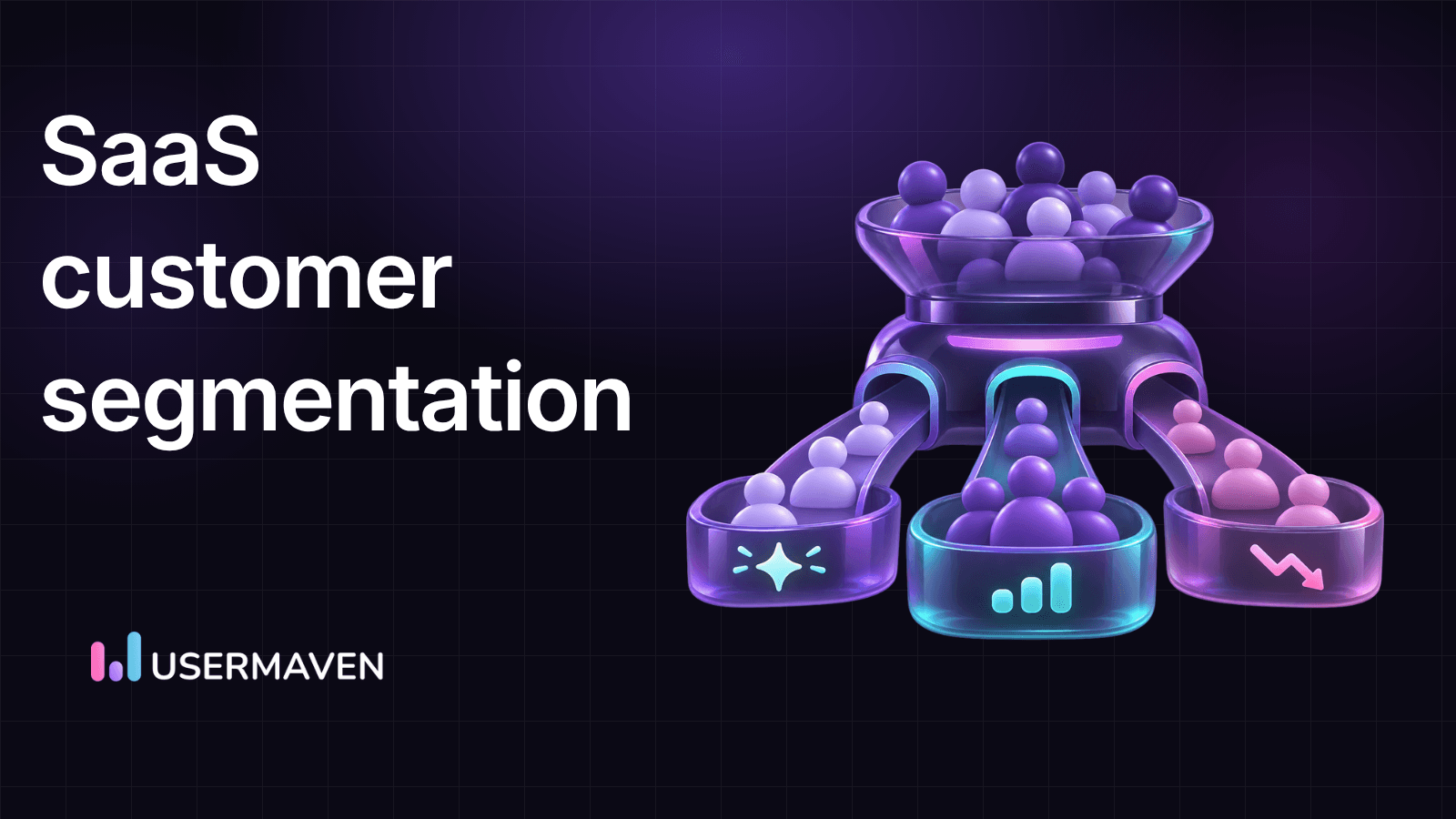
SaaS customers rarely need the same message at the same time. A new trial user may need help reaching their first meaningful outcome, while a long-standing customer may need advanced guidance or support before renewal. Treating both groups alike wastes opportunities to improve their experience.
SaaS customer segmentation groups people or accounts using shared characteristics, product behaviors, and lifecycle signals. The goal is not to create more dashboards. It is to make better decisions about onboarding, acquisition, retention, and expansion. Customer segmentation software makes these groups easier to define and evaluate as behaviors change.
This guide explains the types of SaaS segments worth building, how to define reliable rules, and what to measure after taking action. The examples are illustrative. Every SaaS team should adapt them to its product, customer journey, and data quality.
Key takeaways
- Start with a decision: Define the business action a segment will support before choosing its attributes.
- Use SaaS-specific signals: Trial stage, activation, feature adoption, account role, plan, and renewal status are often more actionable than demographics alone.
- Separate users from accounts: B2B SaaS teams need to distinguish an individual user’s activity from organization-level health and revenue.
- Make rules testable: Write clear inclusion criteria, time windows, and exclusions, then validate membership against real records.
- Measure results: Compare activation, conversion, retention, and revenue outcomes using consistent definitions and appropriate cohorts.
- Refine continuously: Customer needs and product usage change, so review segment definitions and the actions built around them.
What is SaaS customer segmentation?
SaaS customer segmentation is the process of dividing users, leads, or customer accounts into groups that share meaningful characteristics. Those characteristics can include plan type, company size, use case, trial stage, product activity, or subscription value. Each group should support a distinct decision or experience.
For example, a project-management SaaS might separate new trial teams that have created a workspace but not invited colleagues from teams already collaborating on projects. Both groups have signed up, but the next helpful action differs: onboarding assistance for the first and advanced workflow education for the second.
Segmentation is different from a static persona. A persona summarizes a hypothetical customer type; a segment is defined using identifiable records and explicit criteria. It can also change as a person activates, upgrades, disengages, or becomes part of a larger customer account.
The distinction between segmentation and customer segmentation analysis matters. Segmentation defines who belongs in each group and which action they receive. Analysis asks how those groups perform, whether differences are meaningful, and what may explain them.
Why does customer segmentation matter for SaaS?
A SaaS business depends on what happens after acquisition. Trial users need to discover value, paid customers need to keep receiving it, and account owners need reasons to renew or expand. Segmentation aligns communication and product decisions with these different stages.
More relevant onboarding: A self-serve user who has not completed setup needs different guidance from a technical administrator configuring an enterprise account. Segments can help teams avoid sending both the same onboarding sequence.
Stronger activation programs: Teams can distinguish people who performed a meaningful first-value action from those who only logged in. That makes onboarding experiments and intervention timing more specific.
Better retention support: A drop in usage, repeated errors, or a missed workflow may warrant investigation. Segmentation helps prioritize outreach, although reduced activity alone does not prove a customer will churn.
More selective expansion: Accounts with strong adoption, unmet use cases, and appropriate contract needs may be candidates for advanced features. The objective is useful timing, not an automatic upsell message to every active user.
Improved acquisition measurement: Comparing which sources bring activated or retained users, rather than only signups, can guide marketing investment. Marketing attribution software provides a wider view of how acquisition touchpoints relate to conversions and customer journeys.
What are the main types of SaaS customer segmentation?
Most useful SaaS segments combine two or more dimensions. A firmographic label helps explain who the customer is, while behavior and lifecycle stage show what is happening now. Choose dimensions that change the action, not every field available in your database.
1. Lifecycle segmentation
Lifecycle segments reflect where a person or account is in its relationship with the product. Common groups include visitor, lead, trial, activated trial, paying customer, renewal-stage account, and churned customer. These stages should be defined consistently across analytics, CRM, and billing systems.
A trial that has completed onboarding may need feature education, while a trial that has stalled may need troubleshooting. The boundary should be tied to actual events or statuses, not a subjective label such as “warm lead.”
2. Behavioral segmentation
Behavioral segmentation uses observed actions, such as creating a project, inviting a teammate, exporting a report, or repeatedly using a feature. In SaaS, these events can reveal which workflow a person values and where they may need assistance.
Use meaningful activity instead of treating every login as success. For a monthly reporting product, a customer who produces one useful report each month may be healthier than a user who logs in daily but never finishes a task.
3. Firmographic and account segmentation
B2B SaaS teams often group accounts by industry, company size, location, contract type, or number of seats. These attributes help tailor sales cycles, onboarding, support capacity, and messaging to how organizations buy and deploy software.
Firmographics should not be confused with product fit. Two companies of the same size can use software differently. Combine account characteristics with observed adoption, buying roles, and use cases before deciding what action is appropriate.
4. Value-based segmentation
Value-based segments use subscription metrics such as MRR, annual contract value, expansion history, or contribution margin. They help teams plan account coverage, revenue analysis, and customer success resources, while avoiding assumptions that every large account is satisfied.
The Pareto Principle is a reminder to examine concentration, not proof that exactly 20% of SaaS customers generate 80% of revenue. Calculate the actual distribution before setting priorities, and do not neglect smaller accounts with high growth potential.
5. Needs-based segmentation
Needs-based groups reflect the job a customer wants to accomplish. An analytics SaaS might distinguish agencies producing client reports, growth teams evaluating campaigns, and product teams investigating activation. Those groups may need different examples even when they share a subscription tier.
You can identify needs through onboarding responses, support conversations, interviews, and repeated workflows. Avoid inferring sensitive motivations or personal characteristics merely from a handful of clicks.
6. Technographic segmentation
Technographic segments describe a customer’s relevant environment: CRM, ecommerce platform, browser, mobile operating system, or integration stack. They are useful when setup instructions, compatibility, or feature adoption depend on the tools already in use.
Only collect attributes you need to support a legitimate customer experience. A device or integration field is valuable when it changes technical guidance, not because it makes a segment look more detailed.
7. Geographic and demographic segmentation
Geography may matter for language, time zones, billing, regulations, or regional support. Demographic categories can be relevant to certain consumer SaaS products, but they are usually less informative than actual product behaviors for a B2B workflow product.
Use location and personal attributes carefully. Minimize unnecessary personal data and evaluate whether an attribute is appropriate, reliable, and fair for the decision being made.
How to segment SaaS customers step by step
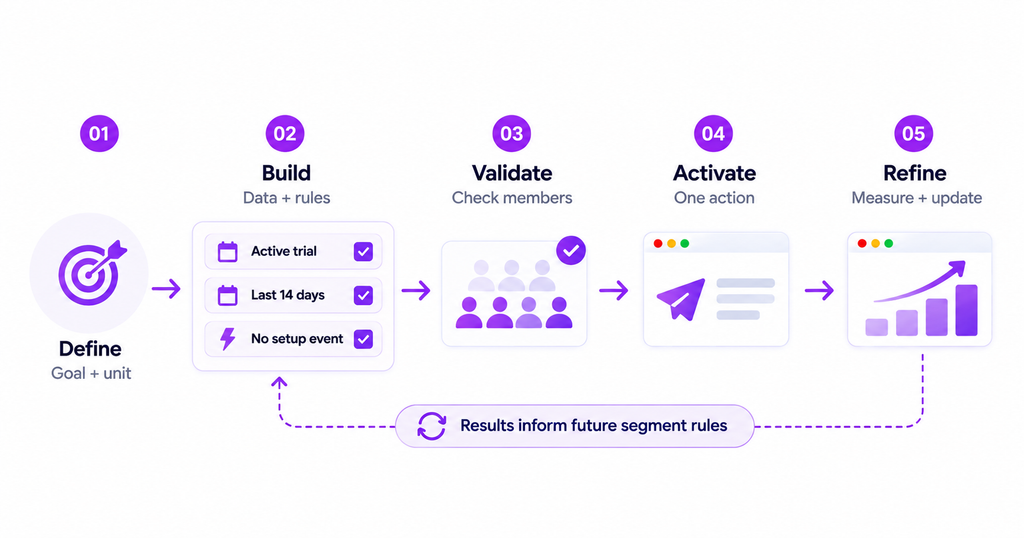
A workable segmentation program starts with one problem and ends with a measurable action. The steps below keep the process manageable without duplicating the deeper statistical procedures covered in our customer segmentation strategy and analysis resources.
Step 1. Define the business objective
Start with a specific question: Which trial users need help activating? Which accounts are nearing renewal with unresolved adoption issues? Which acquisition channels bring customers who continue to use the product? Each question requires a different segment definition.
Write down an owner, target outcome, and time horizon. “Improve trial activation within the first two weeks” is more actionable than “create better customer groups.”
Step 2. Choose the unit: user, lead, or account
Decide whether membership belongs to a person or an organization. A product user can be highly active even when the company has low overall adoption. A large account can also contain both engaged administrators and inactive seats.
For B2B reporting, specify how person-level events roll up to the account. Use stable user and company identifiers where available, and avoid treating two people at one company as a single individual.
Step 3. Identify and audit the data you need
Match each proposed rule to a dependable source. Product events can describe workflow completion; CRM records provide lead status; billing provides plan and renewal information; support records provide customer context. Document who maintains each field and how often it updates.
Check event names, missing IDs, duplicate records, date formats, and whether consent or privacy restrictions affect collection. A segment built from incomplete tracking may produce a compelling dashboard but an unreliable customer list.
Step 4. Define explicit eligibility rules
Translate the business question into conditions that another team member can reproduce. A trial-onboarding group might require an active trial, a signup within the last 14 days, and no completed setup event, while excluding already-converted customers.
Specify the event window and exclusions. If a group combines behavior and account attributes, document whether conditions use AND or OR. In tools with saved segments, those choices directly affect who appears in the audience.
Step 5. Validate the membership
Review a sample of individual records before launching campaigns or changing an in-product experience. Do the users actually meet the rule? Are recently upgraded customers still appearing in a trial group? Do company properties belong to the correct account?
Check the segment size, refresh behavior, and overlap with other groups. Small groups may be useful for personalized outreach but unsuitable for reliable statistical comparisons. Large groups may need a more specific criterion.
Step 6. Assign one primary action
Every important segment should have a next step and an accountable team. Marketing might change messaging, product might test an onboarding prompt, and customer success might initiate a support conversation. More segments are not useful if nobody acts on them.
The action should match observed needs. For example, a user who failed integration setup may benefit more from technical documentation than a discount offer. Document the proposed intervention before judging results.
Step 7. Measure, review, and refine
Measure outcomes with consistent denominators and time windows. Trial-to-paid conversion should compare eligible trials over an agreed period; account retention should use an account denominator rather than individual users. Compare similar acquisition or signup cohorts when possible.
Review groups as customer behavior changes. Dynamic segmentation is useful when membership should respond to new events, while a fixed historical cohort may be better for evaluating the long-term effect of a campaign or onboarding change.
SaaS customer segmentation examples that lead to action
The following examples show how to move from a segment label to an operational decision. They are sample rules, not data from Usermaven customers and not universal thresholds. Adapt the event names and windows to your own product’s value cycle.
| Segment | Illustrative criteria | Next action | Primary KPI |
|---|---|---|---|
| New, inactive trial | Active trial; setup incomplete after a defined period | Offer context-specific setup help | Activation rate |
| Activated trial | Core value action completed; not yet paid | Explain paid features relevant to usage | Trial-to-paid rate |
| Feature-focused user | Repeated use of one feature; related capability not adopted | Offer an advanced workflow tutorial | Relevant feature adoption |
| Collaboration gap | Workspace created; teammates not invited | Explain team setup when relevant | Team activation rate |
| At-risk account | Important activity declines versus its normal baseline | Investigate causes with customer success | Account retention |
| Expansion candidate | Sustained adoption; unmet seats or capability needs | Review fit with an account owner | Expansion MRR |
These segments may overlap unless rules deliberately exclude one another. That is not always wrong. One user might be both an activated trial and a heavy user of a particular feature; the organization still needs to decide which message or intervention takes priority.
Customer context matters as much as the rule. A usage decline after a customer’s seasonal reporting cycle may be normal. In another product, a missed daily workflow may indicate urgent friction. Segment definitions should reflect the way value is delivered.
B2B vs. B2C SaaS customer segmentation
B2B SaaS often sells to accounts with multiple participants. The buyer, administrator, champion, and day-to-day user may be different people. A person-level engagement segment is useful for in-product education; an account-level segment is more appropriate for renewals, seat growth, or pipeline analysis.
B2C SaaS more often focuses on the individual subscriber’s use case, frequency, plan, and lifecycle stage. Yet the underlying principle is the same: combine observed behavior with relevant context, then choose an action that serves that group.
| Dimension | B2B SaaS emphasis | B2C SaaS emphasis |
|---|---|---|
| Unit of analysis | User and account | Individual subscriber |
| Useful traits | Industry, seats, buying role, plan | Use case, plan, device, lifecycle |
| Key behaviors | Team adoption, deployment, shared workflows | Personal activation, habit, repeat use |
| Common outcome | Account retention and expansion | Subscriber retention and upgrades |
A shared identity layer matters in both models. The Usermaven Contacts Hub distinguishes visitors, leads, users, and companies, helping teams inspect the relevant profiles without pretending that all events automatically describe the same person or account.
How to measure SaaS segmentation performance
Measure whether actions taken for a segment improve an outcome, not merely whether the segment grows. A large “power user” group does not necessarily indicate a healthy business if activation is falling among new signups or higher-value accounts are leaving.
Activation rate: The share of eligible new users or accounts completing a meaningful first-value event within a defined window. Select a product-specific event rather than substituting logins for real value.
Trial-to-paid conversion: The share of eligible trials becoming paid customers over a consistent observation period. Compare acquisition sources and onboarding conditions without mixing trials of different ages.
Retention and churn: Track whether customers remain subscribed or continue valuable activity. Cohort analysis to measure user retention can help separate genuine improvement from differences in when groups joined.
Expansion revenue: Evaluate upgrades, seat growth, and expansion MRR for eligible customer accounts. Distinguish account-level commercial outcomes from user-level feature adoption.
Acquisition quality: Examine whether marketing channels bring customers who activate and stay, not simply those who complete a signup form. Attribution reports can show modeled conversion credit, but they do not by themselves prove an intervention caused incremental growth.
For causal claims, use randomized experiments or a credible comparison design where possible. Correlations between a segment’s behavior and renewal outcomes are useful for investigation, not proof that a single feature or campaign caused retention.
The importance of connecting customer evidence to business decisions has a longer history. Clive Humby helped develop Tesco’s Clubcard approach to understanding shopping behavior. SaaS products operate differently, but the lesson translates: customer data becomes useful when it informs a relevant action and that action is evaluated.
Common SaaS customer segmentation mistakes
Segmenting everything: Too many overlapping groups create maintenance work without clear decisions. Start with a small number tied to activation, retention, or expansion, then expand only when new evidence supports it.
Relying on logins alone: Login frequency can be a poor proxy for value. Prefer completed workflows and outcome events that reflect how customers actually use the product.
Ignoring time windows: A feature used once two years ago may not signal current interest. Define recency, frequency, and observation periods explicitly, and revisit them as product behavior changes.
Mixing users with accounts: A highly active champion does not guarantee broad company adoption. Keep person-level and account-level metrics distinct, and define how they relate when evaluating commercial health.
Treating correlation as prediction: A segment with lower retention is worth investigating, but small samples and pre-existing differences may explain the result. Test proposed interventions before claiming they reduce churn.
Overlooking privacy and data quality: Avoid collecting sensitive fields unnecessarily. Check identifiers, consent, retention settings, and data access before exporting or activating audiences in other systems.
How Usermaven supports SaaS customer segmentation
Usermaven’s customer segmentation software helps teams define groups using events, attributes, behavior, and acquisition data. Its documented Segments builder supports Visitor, User, Lead, and Company types, along with multiple conditions and groups for more precise filtering.
In the Segments documentation, teams can create saved groups from Contacts Hub filters or the Segments interface. AND/OR filters, event frequency and time-window refinements, and URL-based conditions support rules such as active trial users, plan-specific customers, and people who visited a particular page.
Usermaven also provides funnel analytics software for comparing conversion paths across segments. Teams can investigate whether certain groups drop out during signup or onboarding, then validate changes using the relevant conversion event instead of simply tracking segment membership.
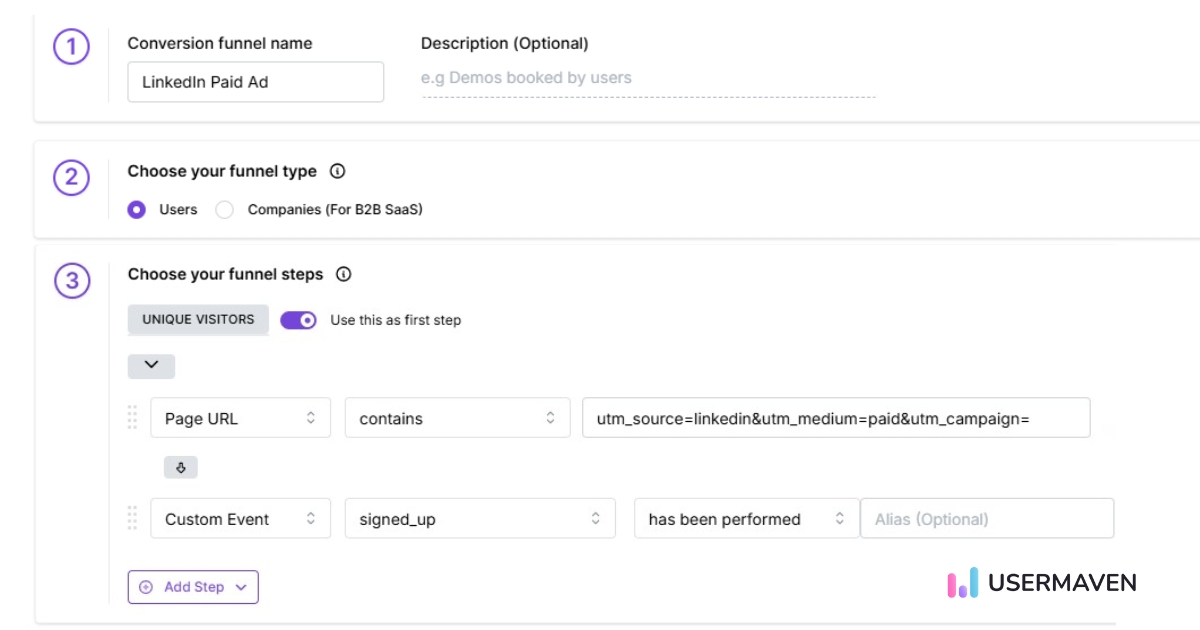
The broader platform combines product behavior with customer journeys and marketing measurement. This supports questions such as which acquisition channels attract activated users and which customer groups contribute to conversions, while remaining distinct from automated campaign delivery or causal lift testing.
For a practical starting point, define an active trial segment, a completed-activation segment, and a paid-customer segment. Validate membership, compare funnel progression, and use the findings to guide the next onboarding experiment. To discuss your measurement workflow, book a demo.
Make every segment earn its place
Effective SaaS customer segmentation is not about sorting every record into as many categories as possible. It is about choosing a meaningful customer question, building a reliable group, assigning a useful action, and checking whether the result improves.
Start with the moments that matter most to your SaaS business: first value, trial conversion, continued adoption, and renewal. As the evidence improves, refine the rules, add context, and use what you learn to guide product and marketing decisions.
FAQs
1. What are the most useful SaaS customer segmentation criteria?
Begin with lifecycle stage, a meaningful product behavior, plan or subscription status, and customer or account identifiers. Add firmographic, use-case, or revenue attributes when they change the decision you intend to make. The best criteria are reliable, actionable, and understandable to the teams using them.
2. How is SaaS customer segmentation different from user segmentation?
User segmentation usually groups individual people by traits or actions. SaaS customer segmentation can also include leads and paid accounts, with commercial attributes such as contract value, renewal stage, and expansion opportunity. In B2B SaaS, both person- and account-level views are often necessary.
3. How many customer segments should a SaaS business create?
There is no universal number. Start with a handful of groups connected to specific workflows, such as incomplete onboarding, activated trials, and at-risk paying accounts. Add more only when a new segment supports a different action and has enough reliable data to maintain it.
4. Can segmentation predict SaaS churn?
Segments can help flag customers whose activity differs from their usual patterns or from comparable customers. That is not the same as a validated churn prediction. To forecast risk, evaluate labeled historical outcomes, error rates, and model performance across relevant cohorts.
5. What is the difference between cohorts and customer segments?
A segment groups records that meet selected criteria, often changing as new events occur. A cohort generally groups records by a shared starting event or time period and follows them over time. Both approaches are useful, especially when measuring retention and onboarding improvements.
6. Which SaaS customer segmentation tools should teams consider?

Written by
Adeel Khan
Growth Marketing Expert
Adeel Khan is a full-stack SaaS marketer with 10+ years of experience in content marketing, paid advertising, analytics, and conversion rate optimization. He shares practical insights and strategies drawn from hands-on experience, helping B2B SaaS marketers improve performance and make better marketing decisions.
All articles by Adeel →