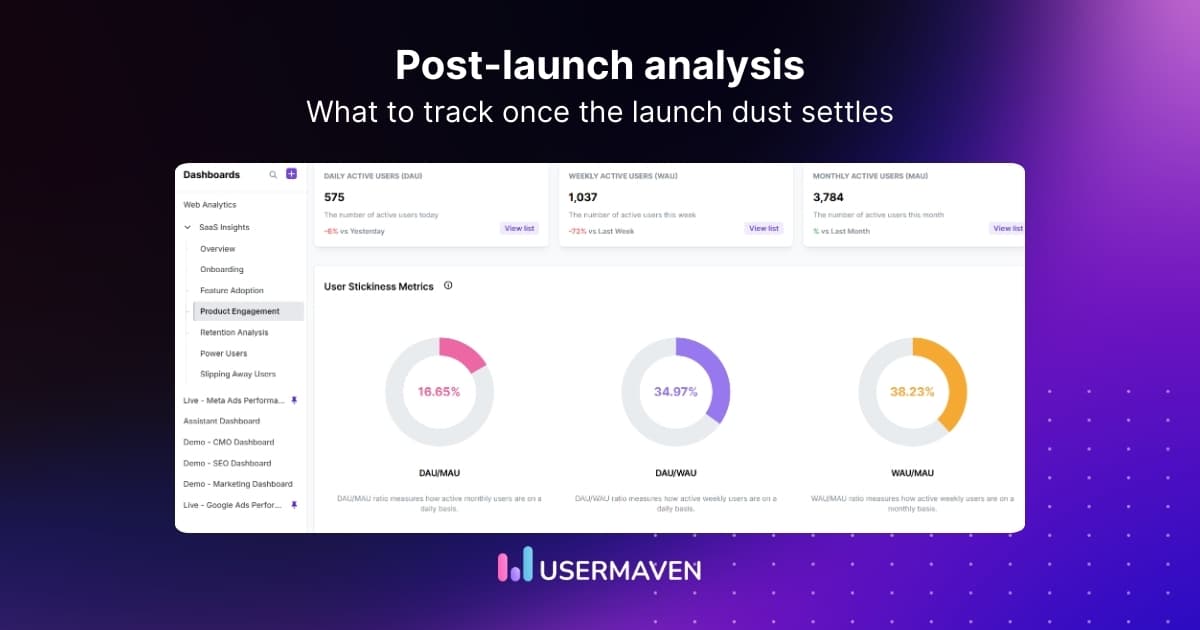
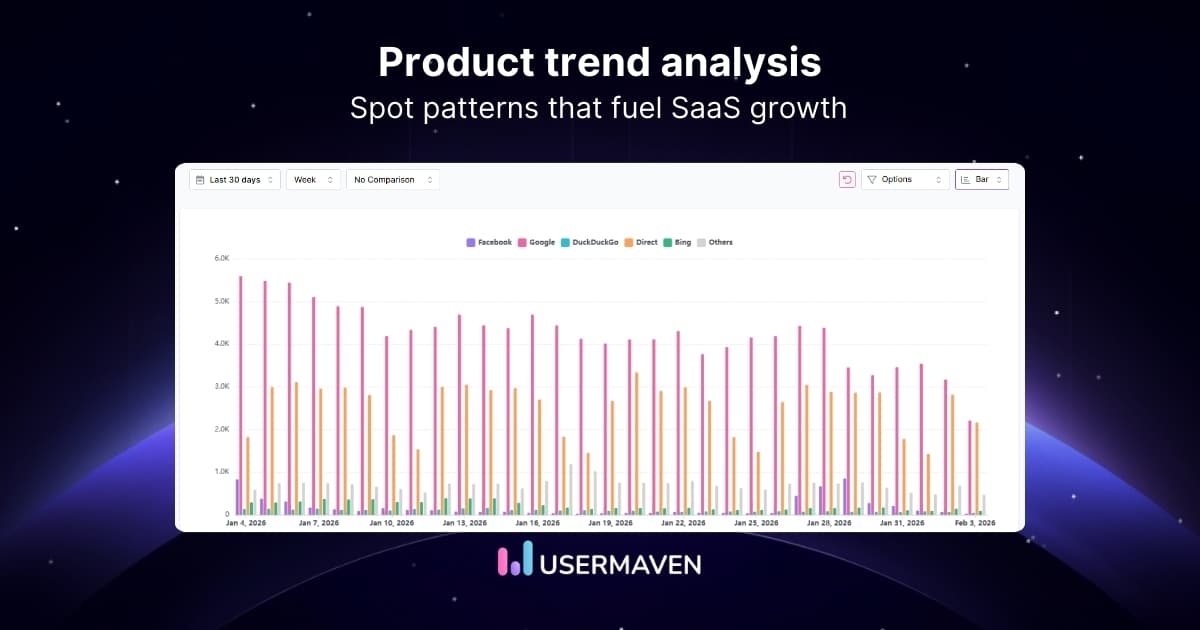
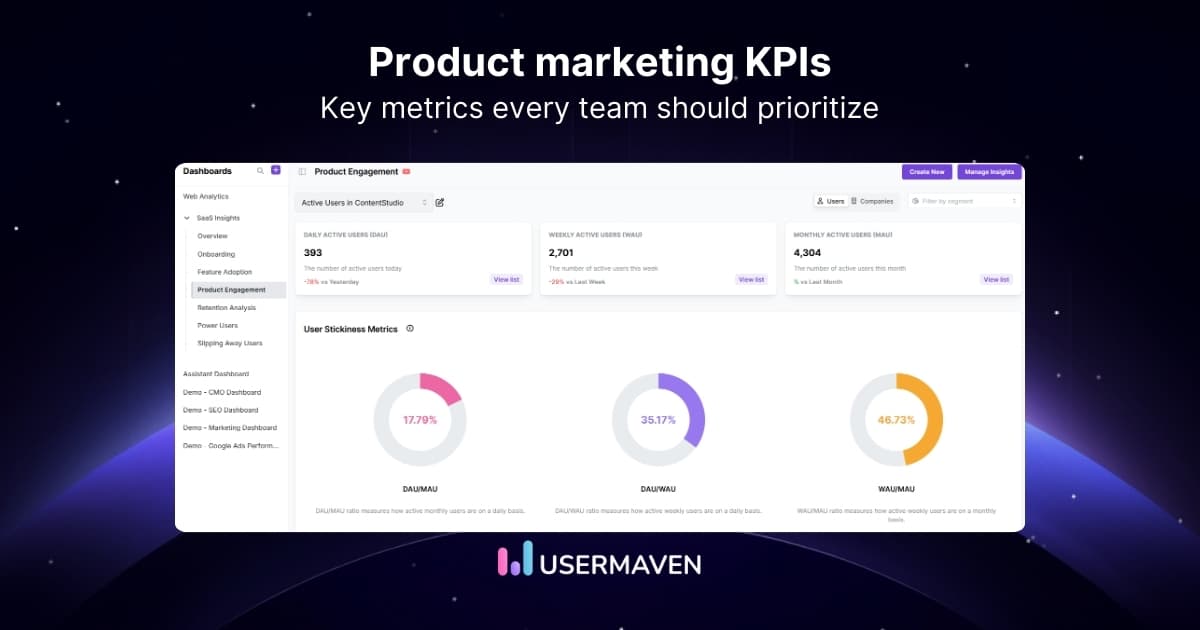
Signups can increase while fewer users reach their first meaningful product outcome. Without a clear activation goal, a SaaS team may celebrate acquisition growth while missing weaker onboarding, engagement, or retention.
Understanding goal tracking in SaaS means defining the outcomes that matter, mapping them to measurable user or account actions, and monitoring the metrics that show whether progress is moving in the right direction.
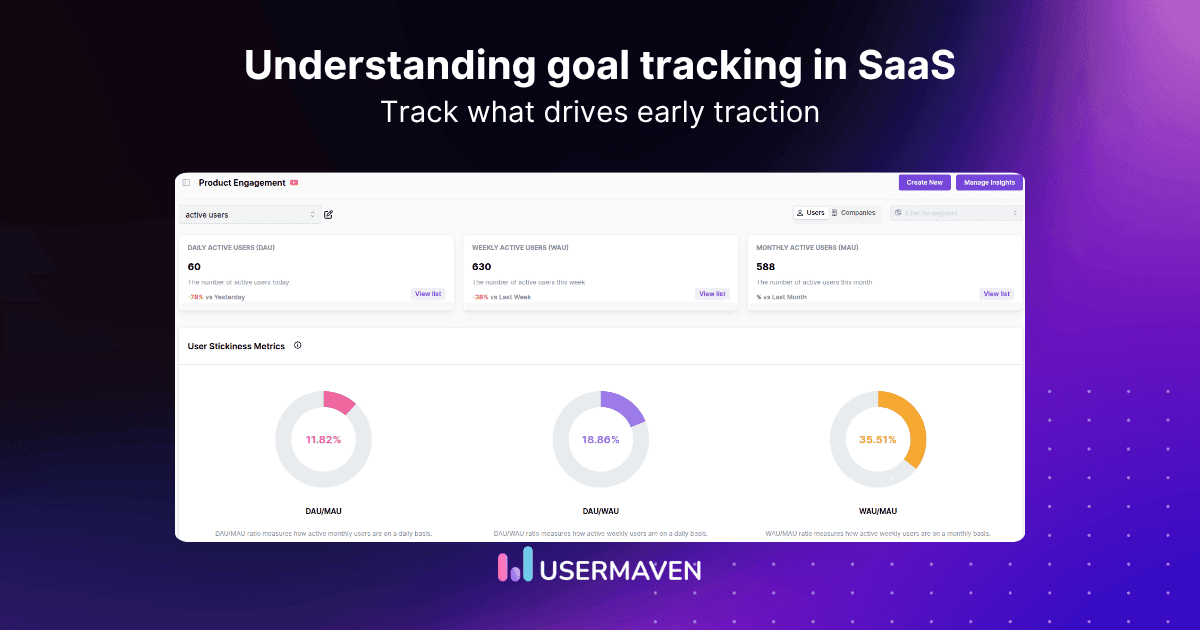
A complete setup connects product behavior with commercial context. It can combine product analytics with a marketing attribution software layer to show both what users do and which acquisition sources contribute to valuable outcomes.
SaaS goal tracking at a glance
| Lifecycle stage | Example goal | Trackable event | Primary metric |
|---|---|---|---|
| Acquisition | Generate qualified trials | Trial started | Trial conversion rate |
| Activation | Reach first product value | Core feature completed | Activation rate |
| Engagement | Use a core feature regularly | Feature used | Feature adoption |
| Retention | Keep customers active | Account remains active | Retention rate |
| Expansion | Upgrade or add seats | Plan upgraded | Expansion MRR |
| Revenue | Increase customer value | Purchase or renewal | MRR, ARR, LTV |
Key takeaways
- Goals connect actions to outcomes: SaaS goal tracking turns business objectives into measurable user or account behaviors.
- The lifecycle matters: Acquisition, activation, engagement, retention, expansion, and revenue need different goals and metrics.
- Events make goals measurable: Page visits, product actions, custom events, and account milestones can represent goal completion.
- KPIs need targets: A metric such as activation rate becomes actionable when it has a defined threshold, timeframe, and decision attached to it.
- Attribution is supporting context: It explains which channels contributed to a goal, but it does not replace product, retention, or revenue measurement.
- Data quality comes first: A precise goal is still misleading when events are missing, duplicated, or defined inconsistently.
What does goal tracking mean in SaaS?
Goal tracking in SaaS is the process of defining a desired business or product outcome, identifying the behavior that represents progress, and measuring how often that behavior occurs. A goal may be a signup, activation milestone, upgrade, renewal, or another meaningful outcome.
The goal is represented through measurable conditions such as a page visit, an event, a custom event, or an account-level milestone. This makes the outcome observable instead of leaving it as a vague statement such as “improve onboarding” or “increase retention.”
For example, a SaaS company may define “increase activation” as a goal. The trackable event could be completing a first project, while the KPI is activation rate and the target is increasing that rate from 30% to 40% within 90 days.
Goals, events, KPIs, and targets
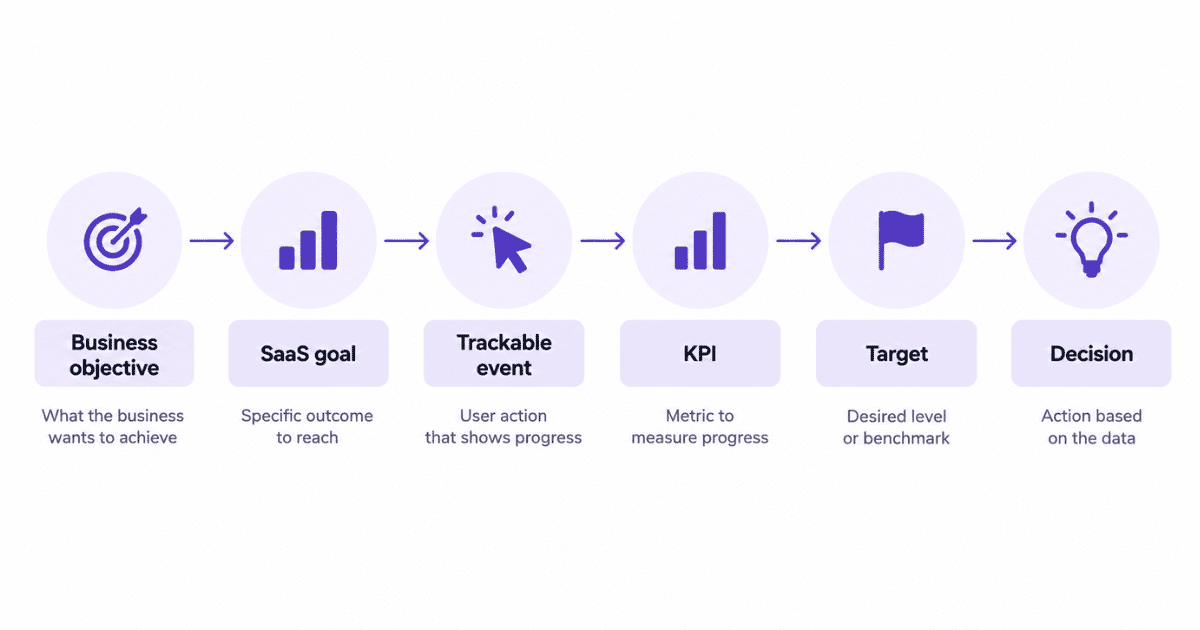
These terms work together but are not interchangeable. A business objective describes the larger outcome, a SaaS goal narrows that outcome, an event captures user behavior, a KPI measures progress, and a target defines the level the team wants to reach.
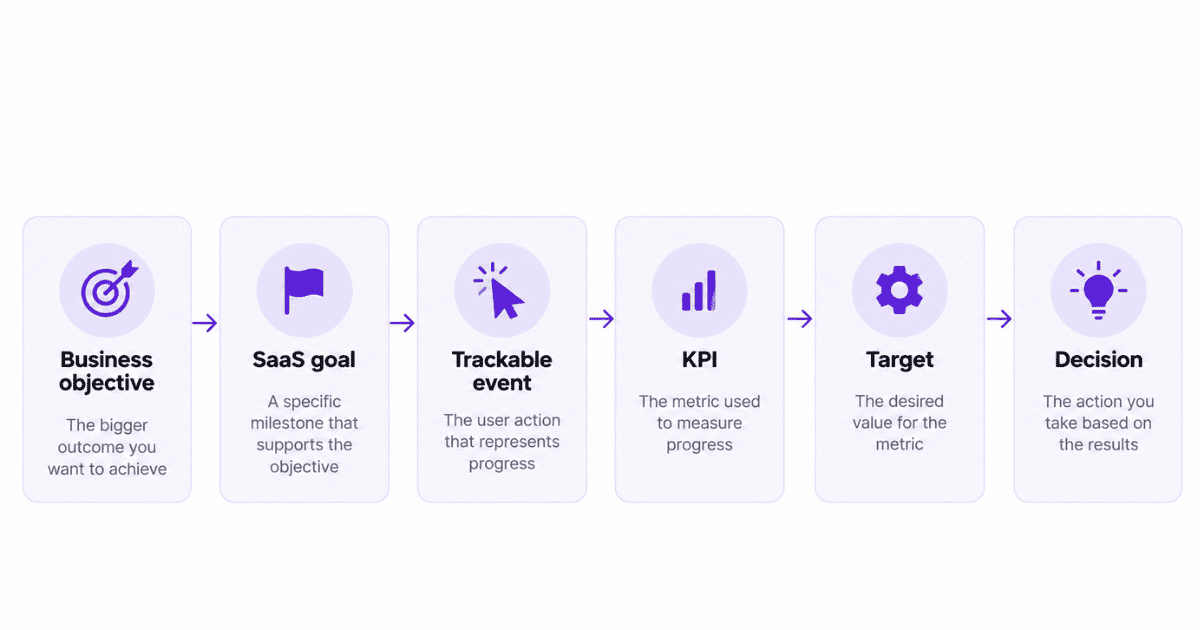
A useful hierarchy is: Business objective → SaaS goal → trackable event → KPI → target → decision. Connecting all six prevents teams from tracking numbers that look important but do not change what the business does next.
For activation specifically, the user activation definition should reflect the moment a new user experiences meaningful product value, not a low-value action that nearly every signup completes.
How SaaS goals fit the customer lifecycle
Different stages of the SaaS customer lifecycle answer different questions. Acquisition asks whether the right users arrive, activation asks whether they reach value, retention asks whether that value lasts, and expansion asks whether satisfied customers deepen the relationship.
Tracking goals across the full lifecycle reduces the risk of optimizing one stage while damaging another. Higher signup volume is not automatically healthy if activation falls, and higher MRR can hide a retention problem when churn is rising at the same time.
SaaS goals across the lifecycle
| Stage | Goal example | Useful metric | Business question |
|---|---|---|---|
| Acquisition | Increase qualified trials | Trial conversion rate | Are the right users arriving? |
| Activation | Reach first value faster | Activation rate, TTV | Do new users experience value? |
| Engagement | Increase core feature use | Feature adoption | Are users building habits? |
| Retention | Keep customers active | Retention, churn | Does value persist? |
| Expansion | Increase account value | Expansion MRR | Are customers growing? |
| Revenue | Increase durable revenue | MRR, ARR, LTV | Does growth create long-term value? |
This lifecycle view also improves the user journeys analysis. A team can inspect how acquisition, product usage, repeat visits, conversion, and later customer outcomes connect instead of treating each stage as a separate report.
Drive business growth
with AI-powered analytics
*No credit card required
How to set measurable SaaS goals
SaaS goal setting works best when the desired outcome is clear before the tracking plan is built. Frameworks such as SMART goals and OKRs help teams convert broad ambitions into measurable targets, while lifecycle frameworks help decide where those targets belong.
SMART goals for SaaS
SMART goals are specific, measurable, achievable, relevant, and time-bound. Atlassian’s SMART goals framework uses these five criteria to make goals easier to track and evaluate.
Instead of “improve onboarding,” a SMART SaaS goal could be: increase the share of new accounts that complete the core setup event from 32% to 42% within the next 90 days.
OKRs for SaaS teams
OKRs add strategic alignment above individual metrics. What Matters defines OKRs as objectives paired with measurable key results that track progress toward the outcome.
An objective might be “make activation a competitive advantage.” Key results could include raising activation to 45%, reducing median time to first value to one day, and improving 30-day retention for activated accounts.
AARRR, North Star, and guardrails
Introduction to AARRR pirate metrics explains how acquisition, activation, retention, referral, and revenue organize lifecycle measurement. A North Star metric provides one shared measure of customer value, while guardrail metrics make sure improving that number does not create a hidden cost elsewhere.
For example, a company may optimize weekly active teams as its North Star while using churn, support volume, and gross margin as guardrails. The combination keeps growth focused on durable value instead of maximizing activity at any cost.
User-level vs. account-level goals
User-level goals work well when one person can complete the outcome independently. Account-level goals are more useful in B2B SaaS when several users belong to the same customer and adoption depends on team behavior, roles, seats, or company-level milestones.
A user may be activated after completing a first project, while an account may be activated only after three teammates join and a shared workflow is used. Keeping these definitions separate prevents individual activity from overstating account health.
How to set up SaaS goal tracking
A reliable tracking setup starts with the outcome and works backward to the event. The objective is not to track every possible action, but to capture the smallest set of behaviors that meaningfully explain progress.
- Define the outcome: Choose the business or product result the team needs to improve.
- Choose the event: Select the page visit, product action, custom event, or account milestone that represents completion.
- Create the goal: Add the conversion rule and, when relevant, a static or dynamic monetary value.
- Validate the tracking: Test the event, identity rules, and filters before using the metric for decisions.
- Segment the result: Compare completion by source, plan, cohort, account type, device, or another useful dimension.
- Review the trend: Watch how the goal changes after campaigns, onboarding changes, pricing updates, or product releases.
The educational setting up conversion goals walkthrough covers the configuration process in more detail, while the event tracking guide explains how individual interactions become analytics data.
Which SaaS goal-tracking metrics matter?
The best metric depends on the goal being measured. Activation, conversion, retention, expansion, and lifetime value describe different parts of the customer relationship, so using one metric as a universal health score usually hides important trade-offs.
Metrics used for SaaS goals
| Goal | Metric | How to measure |
|---|---|---|
| Improve activation | Activation rate | Activated users ÷ new users × 100 |
| Improve conversion | Conversion rate | Converters ÷ eligible users × 100 |
| Reduce churn | Customer churn | Customers lost ÷ starting customers × 100 |
| Improve retention | Retention rate | Retained customers ÷ eligible cohort × 100 |
| Accelerate value | Time to value | Time from signup to value event |
| Grow expansion | Expansion MRR | Added recurring revenue from existing customers |
| Improve customer quality | LTV | Customer value across the relationship |
These SaaS KPIs become more useful when they are connected. Usermaven’s SaaS metrics you should care about article covers the wider metric set, while this goal-tracking framework focuses on tying each metric to a specific outcome and decision.
Funnels are useful when a goal depends on several steps. Connected funnels can show where users move from visit to signup, activation, upgrade, or another conversion milestone and where the largest drop-offs occur.
How to analyze SaaS goal performance
A single completion rate shows what happened, but not why. Goal analysis becomes more useful when the result is broken down by segment, cohort, path, source, or account so the team can identify the conditions associated with better or worse outcomes.
Segment goal performance
Segmentation can reveal that the overall average is hiding two very different populations. Segments can compare goal completion across acquisition source, plan, company size, behavior, geography, or other attributes that matter to the product.
Use attribution as a supporting layer
Goal tracking explains whether an outcome happened. Marketing attribution adds the acquisition context by showing which channels, sources, campaigns, and touchpoints contributed to that outcome.
This distinction matters because changing an attribution model changes credit, not the underlying conversion. A multi-touch view can explain how several interactions participated in a completed goal, but it cannot replace activation, retention, or customer-value analysis.
When several interactions influence conversion, multi-touch attribution is useful for understanding contribution without turning the entire goal-tracking system into a last-click report.
Diagnose conflicting goal signals
Healthy SaaS growth rarely means every metric rises at the same time. When goals move in different directions, the next step should be diagnostic analysis rather than a quick judgment based on one headline KPI.
Unlock insights that drive growth
*No credit card required
When SaaS goals move in different directions
| Observed signal | Possible interpretation | Next analysis |
|---|---|---|
| Signups, ↑activation ↓ | Lower-quality acquisition or onboarding friction | Segment by channel |
| Activation ↑, retention ↓ | Early value is not durable | Cohort retention |
| Trials ↑, paid conversion flat | Qualification or pricing friction | Funnel analysis |
| MRR ↑, churn ↑ | Acquisition is masking retention weakness | Cohorts and LTV |
| Conversions ↑, revenue flat | Lower-value customers | Revenue by source |
Common SaaS goal-tracking mistakes
- Tracking too many goals: A large event catalog is not a strategy. Prioritize the behaviors most closely tied to value and business outcomes.
- Using weak activation events: Logging in, opening a page, or clicking a navigation item may be common but not meaningful enough to represent activation.
- Changing definitions silently: If a goal or event changes, document the change so historical comparisons do not mix incompatible definitions.
- Ignoring account context: B2B SaaS can look healthy at the user level while an account is inactive, under-adopted, or at risk of churn.
- Trusting broken data: Missing campaign parameters, identity mismatches, duplicate events, and stale integrations can make a precise KPI misleading.
- Stopping at conversion: A signup or purchase is not the end of a recurring-revenue journey. Retention, expansion, and LTV show whether the goal created durable value.
How Usermaven tracks SaaS goals
Usermaven connects website and product behavior with goals, journeys, segments, funnels, attribution, and customer outcomes. The useful part is the measurement workflow, not a long feature checklist.
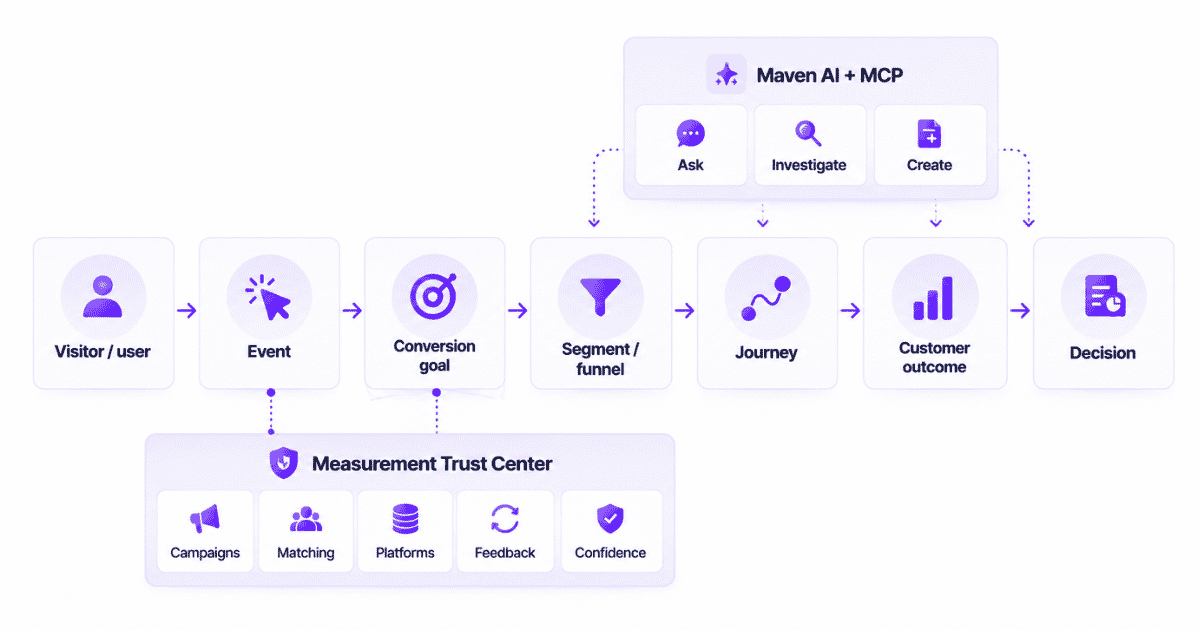
A practical flow is: visitor or user → event → conversion goal → segment or funnel → journey → customer outcome → decision. Each layer adds context without changing the underlying event that represents goal completion.
From events to conversion goals
Usermaven can create conversion goals from page visits, pinned events, or custom events. Its event tracking layer captures user actions, while goal definitions turn selected actions into measurable outcomes such as signups, demos, upgrades, or purchases.
For pinned events, teams can define important actions from already captured interactions. Custom events add business-specific actions such as plan upgrades or workflow completions when the required behavior is not represented by a simple page visit.
Validate the measurement layer
Goal accuracy depends on the surrounding measurement setup. Usermaven’s Measurement Trust Center checks campaign tracking, customer matching, connected platforms, conversion feedback, and data confidence so teams can fix high-impact measurement issues before relying on reports.
Investigate goals with AI and MCP
Maven AI can speed up questions such as which segment has the weakest activation, which funnel step lost the most users, or which cohort retained best after an onboarding change.
Usermaven MCP extends that analysis to compatible AI clients. Read actions can query conversion goals, funnels, journeys, segments, dashboards, and attribution, while write actions such as creating a conversion goal require the user’s explicit request and approval.
Shared analytics dashboards then keep the selected SaaS KPIs visible across product, marketing, growth, and leadership without rebuilding the same definitions in separate spreadsheets.
SaaS goal tracking in practice: PostNitro
The strongest way to judge a goal-tracking system is by whether it changes decisions. In the live PostNitro case study, behavioral analysis was used to understand onboarding, activation, demo engagement, and signup conversion.
PostNitro found that users who experienced the product demo before signing up converted at a much higher rate. The demo flow generated 576 clicks and converted to signups at about 70%, turning the demo into a core activation lever.
PostNitro goal-tracking evidence
| Evidence | Result | Why it matters |
|---|---|---|
| Demo engagement | 576 clicks | High-intent behavior became measurable |
| Demo-to-signup conversion | ~70% | The demo became a strong activation driver |
| Product decisions tied to behavior | ~30% | Behavioral data influenced product direction |
| Reporting time | ~50% less | Faster analysis supported faster iteration |
The important lesson is not that one metric won. PostNitro connected product behavior to a clear outcome, found a high-intent action, measured its conversion impact, and used the evidence to refine onboarding and growth decisions.
Final verdict
Understanding goal tracking in SaaS is ultimately about turning strategy into observable behavior. A strong system defines the outcome, captures the event that represents progress, measures the right KPI, and attaches a target that can guide a decision.
The best SaaS goal tracking does not stop at signup or conversion. It follows acquisition through activation, engagement, retention, expansion, and revenue so teams can see whether growth is creating durable customer value.
Start a free 14-day Usermaven trial to track activation, conversion goals, user behavior, and the metrics that connect product usage to growth.
Faqs
1. What is goal tracking in SaaS?
Goal tracking in SaaS is the process of defining a desired business or product outcome, mapping it to measurable user or account behavior, and monitoring the KPI that shows progress toward the target.
2. What is the difference between a SaaS goal and a KPI?
A SaaS goal is the outcome the business wants to achieve, while a KPI is the metric used to measure progress. For example, improving activation is the goal and activation rate is the KPI.
3. Which SaaS goals should be tracked first?
Start with goals closest to customer value and business outcomes. For most SaaS products, that means a small set across activation, conversion, retention, expansion, and revenue rather than tracking every available event.
4. How often should SaaS goals be reviewed?
Operational goals such as signup, activation, and funnel conversion can be reviewed weekly. Strategic goals such as retention, expansion, and OKRs are usually better reviewed monthly or quarterly because they need more time to develop a meaningful trend.
5. How do SMART goals and OKRs work together?
SMART makes an individual goal specific, measurable, achievable, relevant, and time-bound. OKRs connect broader objectives with measurable key results, so teams can use SMART criteria to improve the quality of the targets inside an OKR system.
6. What is the Rule of 40, and does it replace goal tracking?
The Rule of 40 is a SaaS benchmark that compares growth rate with profitability. It can be one high-level business metric, but it does not replace product and lifecycle goals such as activation, retention, conversion, or expansion.
7. Can small SaaS teams track goals without a dedicated analyst?
Yes. A small team can start with a short tracking plan, clearly defined events, a few conversion goals, and shared dashboards. No-code and AI-assisted analytics can reduce manual reporting, but the team still needs to validate its event definitions and data quality.
8. How does attribution fit into SaaS goal tracking?
Goal tracking measures whether an outcome happened. Attribution explains which channels and touchpoints receive credit for contributing to that outcome. Attribution adds acquisition context, but it does not replace product, retention, or revenue measurement.
9. Can Usermaven use previously captured events for new goals?
Yes, in cases where the relevant interaction was already auto-captured and can be defined as a pinned event. This lets teams promote an existing captured action into an important event and use it in analysis and goals without starting the data collection from zero.

Written by
Adeel Khan
Growth Marketing Expert
Adeel Khan is a full-stack SaaS marketer with 10+ years of experience in content marketing, paid advertising, analytics, and conversion rate optimization. He shares practical insights and strategies drawn from hands-on experience, helping B2B SaaS marketers improve performance and make better marketing decisions.
All articles by Adeel →