Attribution software can look affordable on a pricing page and become expensive once a team adds multi-touch reporting, CRM connections, extra users, implementation support, longer data history, and usage overages.
The more useful comparison is not the lowest advertised price. It is the lowest plan that provides the attribution capabilities the business actually needs, along with the cost of connecting, operating, and scaling the system.
This guide compares nine affordable attribution tools for SaaS, ecommerce, B2B, lead generation, and performance marketing.
It focuses on usable attribution pricing, practical coverage, and the value created when marketing attribution software replaces several disconnected reporting tools.
Key takeaways
Usermaven offers the strongest overall value for teams that need marketing attribution, website analytics, product analytics, customer journeys, and revenue reporting in one platform.
Google Analytics 4 is the best free starting point for website and app attribution, especially for teams already using Google Ads.
The cheapest advertised plan is not always the plan that includes multi-touch attribution, CRM reporting, conversion paths, or revenue analysis.
AnyTrack and RedTrack provide accessible options for teams focused on paid-media tracking, conversion APIs, and ad-platform feedback.
The right affordable tool depends on the business model, required outcomes, data volume, integrations, and whether the platform can replace other software.
Best affordable attribution tools
The tools below combine practical attribution capabilities with accessible pricing for SaaS, ecommerce, B2B, lead generation, and performance marketing teams.
1. Usermaven: Best overall affordable attribution tool

Overview
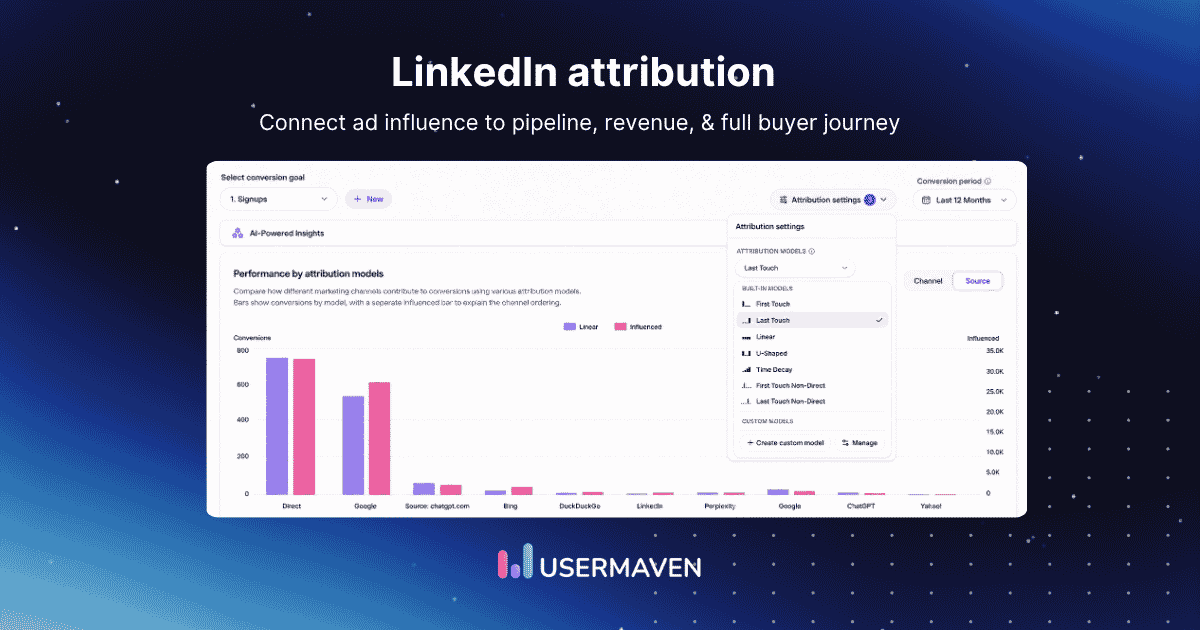
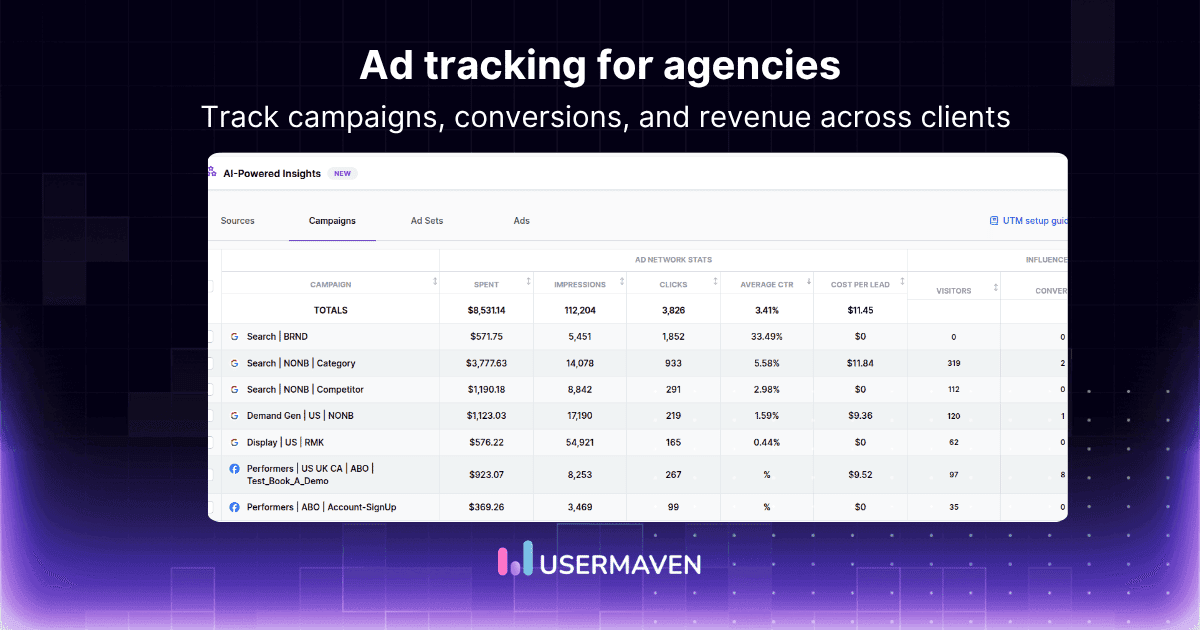
Usermaven is an AI-powered marketing attribution and analytics platform connecting campaigns with website behavior, product activity, customer journeys, CRM pipeline, and revenue.
Best for
SaaS companies
Product-led growth teams
B2B marketing and revenue teams
Agencies and growing businesses that need several workspaces
Teams consolidating attribution, website analytics, and product analytics
Pricing
The Usermaven pricing page publishes self-service plans. Growth costs $84 per month and covers website, product, and ecommerce analytics. Scale costs $199 per month, or $169 per month with annual billing, and is the attribution-capable plan for paid ads, channels, content, CRM deals, and conversion paths. Both self-service plans include a 14-day free trial.
Key attribution capabilities
Paid ads attribution across connected networks
Channel, source, campaign, and content attribution
CRM, deal, pipeline, and closed-revenue attribution
First-touch, last-touch, linear, time-decay, U-shaped, and other reporting perspectives
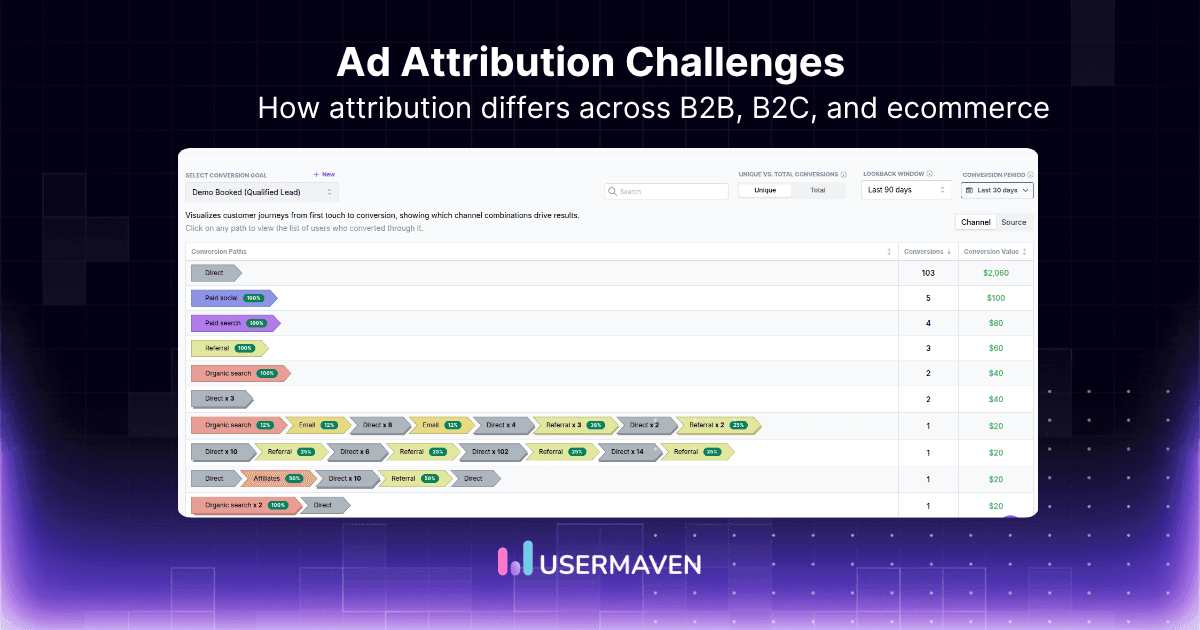
Conversion paths and customer journeys across sessions
Google, Meta, LinkedIn, and Microsoft Ads connections
Conversion synchronization back to advertising platforms
Website, product, funnel, cohort, retention, and dashboard analysis
Why it is affordable
Usermaven combines conversion tracking, website analytics, product analytics, user journeys, and analytics dashboards in one platform. The value comes from replacing several point solutions while keeping campaign, behavioral, CRM, and revenue data connected.
Verdict
Usermaven is the strongest overall choice for teams that need affordable attribution without reducing the customer journey to ad clicks or form submissions. It is particularly useful when marketing performance must be evaluated through activation, pipeline, revenue, retention, and expansion.
2. Google Analytics 4: Best free attribution starting point

Overview
Google Analytics 4 is Google’s free website and app analytics platform for tracking events, traffic sources, campaigns, conversion paths, and attribution within the Google marketing ecosystem.
Best for
Small businesses
Early-stage startups
Teams with no attribution-software budget
Website and app analytics
Businesses already using Google Ads
Pricing
Google Analytics 4 is available without a software subscription fee, making it the natural baseline for teams beginning with acquisition, event, and conversion analysis.
Key attribution capabilities
Source, medium, campaign, and channel reporting
Attribution paths and model-comparison reporting
Data-driven and paid-and-organic last-click models
Website and app event collection
Google Ads integration
Custom key events and audience creation
Why it is affordable
The platform provides a broad analytics foundation at no subscription cost. Google documents how its attribution models and attribution paths distribute credit across eligible touchpoints in the Google Analytics attribution reports.
Verdict
GA4 is the best free option for establishing a shared acquisition and conversion baseline. Teams that later need deeper CRM, account, product, or revenue context can compare Usermaven vs. Google Analytics 4 or evaluate a broader Google Analytics 4 alternative.
3. AnyTrack: Best affordable server-side attribution option

Overview
AnyTrack is a conversion tracking and attribution platform that collects first-party data and sends verified conversion events back to advertising platforms through server-side integrations.
Best for
Performance marketers
Affiliate marketers
Lead-generation businesses
Ecommerce stores
Teams sending verified conversions back to ad platforms
Pricing
AnyTrack offers a free plan for one property and lower data volume. The Starter plan costs $100 per month and includes up to 100,000 monthly sessions, one property, all supported ad-platform integrations, and unlimited conversion-source integrations. Annual billing is also available.
Key attribution capabilities
Server-side conversion tracking
First- and last-ad-click attribution
Customer journey logs
Cross-domain tracking
Conversion API integrations
Ad-platform conversion feedback
ROAS and campaign reporting
Why it is affordable
AnyTrack packages conversion collection, identity matching, and ad-platform synchronization into self-service ad tracking software. The free plan creates an accessible entry point, while the Starter tier supports meaningful paid-media volume without an enterprise contract.
Verdict
AnyTrack is a strong choice for teams whose main priority is improving conversion signal quality across advertising platforms and keeping paid-media optimization connected with verified outcomes.
4. RedTrack: Best affordable tool for ecommerce and paid media

Overview
RedTrack is a performance marketing attribution platform connecting campaign costs, customer journeys, conversions, revenue, and server-side conversion feedback across paid channels.
Best for
Ecommerce brands
DTC businesses
Media buyers
Affiliate marketers
Teams running campaigns across several advertising networks
Pricing
RedTrack lists its Builder plan from $79 per month, with a lower effective monthly price on annual billing. Brand bundles add ecommerce-focused features, ad-spend synchronization, and optional additional stores while maintaining published self-service pricing.
Key attribution capabilities
Ad-level conversion tracking
Server-side conversion APIs
Customer journey and conversion-path reporting
Ad-spend and cost synchronization
Rules for campaign monitoring and optimization
Revenue and lifetime-value reporting
Multi-platform performance dashboards
Why it is affordable
RedTrack combines attribution, conversion APIs, cost data, and campaign-management features in one paid-media platform. This can reduce the need for separate tracking, CAPI, cost-sync, and optimization products.
Verdict
RedTrack is a practical value choice for ecommerce and performance-marketing teams that want detailed paid-ad measurement, fast conversion feedback, and published entry pricing.
5. WhatConverts: Best affordable attribution tool for lead generation

Overview
WhatConverts is a lead tracking and attribution platform that connects calls, forms, chats, and appointments with their marketing journeys, qualification status, and resulting revenue.
Best for
Service businesses
Marketing agencies
Call-driven companies
Local and multi-location businesses
Teams evaluating lead quality as well as lead volume
Pricing
WhatConverts places customer journeys and multi-click marketing attribution on its Elite single-account plan, listed at $160 per month. The plan includes $30 in monthly usage credit and a 14-day free trial.
Key attribution capabilities
Call tracking
Form and chat tracking
Customer journeys and pages visited
Multi-click marketing attribution
Lead qualification and lead intelligence
Revenue attribution
Agency and account reporting
Why it is affordable
The platform combines call tracking, form tracking, lead qualification, and attribution. For lead-generation teams, that consolidation can be more economical than buying a call tracker, form tracker, lead-management layer, and attribution tool separately.
Verdict
WhatConverts is the best fit when phone calls, quote requests, forms, chats, and qualified leads are the commercial outcomes that marketing must explain.
6. Triple Whale: Best affordable ecommerce analytics and attribution platform

Overview
Triple Whale is an ecommerce analytics and attribution platform combining channel performance, post-purchase surveys, customer insights, product reporting, and store metrics.
Best for
Shopify and DTC brands
Small ecommerce teams
Performance marketers managing several channels
Businesses connecting attribution with store and product metrics
Pricing
Triple Whale offers a free plan with first- and last-click attribution, cross-channel performance tracking, and a post-purchase survey. The Triple Whale pricing structure scales according to annual GMV and adds multi-touch attribution, advanced survey data, broader reporting, and workflow automation.
Key attribution capabilities
First-click and last-click attribution
Multi-touch attribution on paid plans
Post-purchase survey measurement
Influencer and affiliate analysis
Ecommerce revenue and product reporting
Cross-channel dashboards
First-party data activation
Why it is affordable
The free tier gives ecommerce teams useful attribution and store visibility before they commit to a paid platform. Paid plans combine attribution with ecommerce analytics, dashboards, surveys, and activation, which can replace several Shopify reporting products.
Verdict
Triple Whale is the strongest affordable option for ecommerce teams that want attribution connected with store performance, products, customers, subscriptions, and paid-media decisions. Teams comparing broader website, product, CRM, and revenue coverage can review the Triple Whale alternative.
7. Attribution App: Best low-cost attribution option for Shopify

Overview
Attribution App is a multi-touch attribution platform that connects advertising costs and customer-level journeys with revenue, CAC, and ROAS across ecommerce and connected marketing systems.
Best for
Early-stage Shopify stores
Ecommerce teams starting with multi-touch attribution
Businesses using Shopify, HubSpot, Salesforce, or Segment
Teams that want traceable user-level attribution
Pricing
Attribution App lists a Shopify Starter plan at $19 per month with first-touch, last-touch, and linear models, Google Ads and Meta Ads connectors, up to 1,000 monthly tracked users, and one seat. Shopify Pro costs $199 per month, while plans for HubSpot, Salesforce, Twilio, and Segment begin at higher published tiers.
Key attribution capabilities
First-touch, last-touch, and linear attribution
Google Ads and Meta Ads connectors
Customer-level cost and revenue tracking
ROAS and CAC reporting
Shopify, HubSpot, Salesforce, Twilio, and Segment options
Monthly tracked-user pricing
Why it is affordable
The $19 Shopify entry plan is one of the lowest published prices for genuine attribution modeling. It gives smaller stores a direct path into first-touch, last-touch, and linear analysis without a large implementation project.
Verdict
Attribution App is an attractive choice for smaller Shopify stores that want to move beyond platform-reported conversions while keeping the initial software commitment low.
8. SegMetrics: Best for revenue and customer lifetime value

Overview
SegMetrics is a marketing attribution and revenue analytics platform that connects advertising, email, funnels, subscriptions, repeat purchases, and customer lifetime value.
Best for
Subscription businesses
Course creators and funnel-based businesses
SaaS and information-product teams
Marketers using email automation and paid advertising
Teams prioritizing customer lifetime value
Pricing
SegMetrics uses contact-based pricing and offers a 14-day free trial. Public pricing scales with the number of active contacts, allowing smaller databases to begin at lower monthly rates and larger businesses to expand as their audience grows.
Key attribution capabilities
Multi-touch attribution
Revenue attribution
Customer lifetime-value reporting
Ad and email attribution
Funnel reporting
Cohort analysis
Cross-channel campaign performance
Why it is affordable
SegMetrics connects advertising and funnel activity with long-term revenue and LTV. For businesses where value develops over several purchases or subscription periods, that connection can replace manual exports and recurring spreadsheet analysis.
Verdict
SegMetrics is a strong value option for teams that need to compare acquisition sources by long-term customer economics rather than immediate lead or purchase counts.
9. Dreamdata: Best free starting point for B2B analytics

Overview
Dreamdata is a B2B revenue attribution platform that connects website activity, accounts, advertising spend, CRM opportunities, pipeline, and revenue across long buying journeys.
Best for
B2B companies
Account-based marketing teams
Companies with long buying cycles
Teams measuring pipeline and revenue by account
Businesses testing company-level analytics before a paid rollout
Pricing
Dreamdata offers a free plan for smaller B2B companies. The free product includes website and account analytics, pipeline and revenue reporting, audience building, intent data, and attribution capabilities. Advanced activation and attribution packages use customized pricing.
Key attribution capabilities
B2B website and account analytics
Company identification
Account-level customer journeys
CRM-connected pipeline and revenue reporting
Ad-spend and campaign analysis
Audience creation and activation
Customizable attribution for advanced plans
Why it is affordable
Dreamdata Free gives B2B teams an accessible way to connect web activity, accounts, CRM opportunities, and revenue before committing to an enterprise platform. The free foundation is especially valuable for organizations whose journeys involve several people from the same company.
Verdict
Dreamdata is the best free B2B starting point for account-level measurement, pipeline visibility, and revenue analysis across longer sales cycles.
Table 1: Affordable attribution tools compared
| Tool | Best for | Pricing position | Main strength |
|---|---|---|---|
| Usermaven | SaaS, B2B, product-led teams | Scale: $199/month; $169/month annually | Attribution plus website and product analytics |
| Google Analytics 4 | Free website and app baseline | Free | Source, campaign, path, and model reporting |
| AnyTrack | Server-side conversion tracking | Free; Starter $100/month | Conversion APIs and ad-platform feedback |
| RedTrack | Ecommerce and paid media | Builder from $79/month | Ad-level tracking, CAPI, and cost sync |
| WhatConverts | Lead generation and calls | Elite $160/month | Calls, forms, lead journeys, and revenue |
| Triple Whale | Shopify and DTC ecommerce | Free; paid attribution scales by GMV | Ecommerce attribution and business reporting |
| Attribution App | Low-cost Shopify attribution | Shopify Starter $19/month | Simple multi-touch models at a low entry price |
| SegMetrics | Revenue and customer LTV | Contact-based pricing; trial available | Revenue and LTV across ads and funnels |
| Dreamdata | B2B account and revenue analytics | Free plan; advanced plans custom | Account-level journeys, pipeline, and revenue |
Which affordable attribution tool is best for each use case?
Price alone cannot identify the right platform because the tools solve different measurement problems. The table below matches each common use case with the option that provides the clearest value.
Table 2: Best affordable tools by business type
| Use case | Recommendation | Why |
|---|---|---|
| SaaS, B2B attribution and analytics | Usermaven | Combines attribution, website, product, journey, and revenue reporting |
| Free website attribution | Google Analytics 4 | No subscription cost and strong Google ecosystem connections |
| Server-side conversion tracking | AnyTrack | Accessible conversion APIs and ad-platform synchronization |
| Ecommerce paid-media attribution | RedTrack | Ad-level tracking, CAPI, cost sync, and campaign controls |
| Calls and lead generation | WhatConverts | Connects calls, forms, lead quality, journeys, and revenue |
| Shopify analytics and attribution | Triple Whale | Ecommerce attribution plus store, product, and channel reporting |
| Low-cost Shopify attribution | Attribution App | Very low published entry price for basic multi-touch models |
| Revenue and customer LTV | SegMetrics | Connects campaigns with long-term customer value |
| Free B2B analytics | Dreamdata | Account, pipeline, and revenue reporting without an initial subscription |
What makes an attribution tool affordable?
Affordability depends on what the software costs across its useful life, not only the number shown beside the cheapest plan. A practical comparison includes the attribution-capable tier, implementation work, integrations, usage growth, user access, and the number of other tools the platform can replace.
1. The price of the usable attribution plan
A $20 entry plan is not automatically cheaper than a $200 platform if the lower tier only provides basic dashboards. Compare the lowest plan that includes the required models, conversion paths, CRM data, revenue reporting, and channel integrations.
2. Predictable pricing as usage grows
Attribution vendors may price by events, sessions, active contacts, tracked users, ad spend, revenue, calls, properties, or a flat subscription. Forecast the bill at current usage and at two or three times that volume so normal growth does not create an unexpected jump.
Although designed for variable technology costs, the FinOps Foundation forecasting framework recommends combining cost and usage data to create forecasts and compare them with actual spending, a useful principle for usage-based software plans.
3. Implementation and operating effort
Self-service installation can lower the initial cost, but implementation still includes campaign naming, event design, CRM mapping, identity rules, conversion validation, and staff training. These internal hours belong in the buying decision.
4. Included integrations and data history
A low monthly price can become expensive when essential advertising, CRM, ecommerce, or warehouse connections require a higher tier. Data retention matters too: long buying cycles and seasonal analysis need enough history to support reliable comparisons.
5. Total cost of ownership
The New Zealand Government Procurement guide describes best value as the lowest whole-of-life cost rather than the lowest purchase price. Its total cost of ownership framework recommends accounting for initial and future costs and benefits.
The same principle applies to attribution software: subscription, setup, integrations, user access, overages, support, and tool consolidation all affect the real price.
6. Tool consolidation
A platform that combines attribution with website analytics, product analytics, customer journeys, dashboards, CRM reporting, or conversion sync may cost more than a narrow tracker but reduce the total software stack.
The detailed guide to marketing attribution software cost explains how feature tiers, seats, usage, ad spend, and implementation influence the final bill.
See Usermaven in action
Book a free demo and discover how powerful analytics can grow your business.
*No credit card required
Free vs. paid attribution tools
Free tools provide an effective baseline when the measurement problem is still simple. Paid software becomes valuable when the journey extends across more systems, people, channels, and commercial stages.
When a free tool is enough
Website or app conversions are the main outcome.
Customer journeys are relatively short.
Google is the primary advertising and analytics ecosystem.
CRM pipeline and closed-revenue attribution are not yet required.
The team mainly needs directional source, campaign, and conversion reporting.
When paid attribution becomes useful
Several paid and organic channels influence the same journey.
Marketing must connect campaigns with CRM opportunities and closed revenue.
The business needs multi-touch models, customer-level paths, or account-level attribution.
Product activation, feature adoption, retention, or lifetime value affect acquisition quality.
Verified conversions must be synchronized back to advertising platforms.
Manual reporting and data reconciliation consume significant team time.
Table 3: Free vs. paid attribution tools
| Requirement | Free tools | Paid tools |
|---|---|---|
| Basic source and campaign reporting | Usually available | Available with more customization |
| Multi-touch models | Limited or basic | Broader model support |
| CRM and account attribution | Basic or unavailable | Common in B2B platforms |
| Revenue reporting | Basic or manual | Connected to campaigns and journeys |
| Identity resolution | Limited | More advanced across sessions and systems |
| Product analytics | Usually separate | Included in some platforms |
| Support and onboarding | Documentation or community | Direct support and guided setup |
Hidden costs that make cheap tools expensive
An attribution platform can remain affordable only when its pricing structure matches how the business will use it. Review the following costs before treating the headline subscription as the final number.

Attribution feature gates: Confirm which plan includes the required models, CRM attribution, conversion paths, revenue reporting, and ad integrations.
Usage overages: Estimate sessions, events, contacts, calls, tracked users, stores, and revenue at future growth levels.
Paid onboarding: Include implementation, data mapping, migration, training, and validation in the first-year cost.
Integration charges: Check whether advertising, CRM, ecommerce, warehouse, and API connections are included.
Short data retention: Ensure the plan preserves enough history for the buying cycle, seasonality, and year-over-year analysis.
Additional users and workspaces: Account for marketing, sales, product, finance, leadership, and agency access.
Data export restrictions: Review whether API access, raw data, scheduled exports, and warehouse connections require an upgrade.
Overlapping analytics products: Calculate the cost of any separate website, product, call-tracking, survey, dashboard, or reporting software that remains necessary.
Choosing an affordable attribution tool by budget
Free or near-free
Google Analytics 4 is the broadest free website and app baseline. AnyTrack Free adds a low-volume path into server-side conversion tracking. Dreamdata Free provides B2B account, pipeline, and revenue reporting. Triple Whale Free gives ecommerce teams first- and last-click attribution. Attribution App creates a low-cost Shopify entry point at $19 per month.
Lower monthly budget
AnyTrack Starter and RedTrack Builder suit paid-media teams. WhatConverts Elite combines lead tracking and multi-click attribution. Usermaven Scale provides the broadest all-in-one coverage for SaaS and B2B teams. Triple Whale paid tiers extend ecommerce reporting into multi-touch attribution.
Higher but still below enterprise pricing
SegMetrics becomes valuable when revenue and LTV are central to acquisition decisions. Attribution App’s HubSpot, Salesforce, Twilio, and Segment configurations serve more complex stacks.
More advanced ecommerce and B2B setups can also move into higher RedTrack, Triple Whale, or Dreamdata packages while remaining below traditional enterprise attribution contracts.
When affordable attribution software is no longer enough
A growing organization may need an enterprise platform when attribution becomes part of a larger data, security, governance, or measurement architecture. Common triggers include:
Custom attribution models and organization-specific revenue definitions
Marketing mix modeling and incrementality testing
Several brands, regions, websites, products, or business units
Very high event, customer, transaction, or advertising volume
Data warehouse and business-intelligence architecture
SAML SSO, role-based access, audit logs, and advanced governance
Private cloud, on-premise deployment, data residency, or custom retention
Dedicated implementation, service levels, and strategic support
At that stage, compare specialist and enterprise options in the guide to enterprise marketing attribution platforms.
Teams that remain focused on customer journeys and fractional credit can also review the broader comparison of multi-touch attribution tools.
Affordable attribution tool best practices
A lower-priced platform creates value only when the setup supports consistent decisions. Use these practices to keep the system accurate and financially sustainable.
Define the required outcome: Decide whether the platform must measure leads, purchases, qualified opportunities, revenue, retention, or customer lifetime value.
Compare usable plans: Evaluate the lowest tier that contains the required attribution capabilities, not the cheapest advertised price.
Estimate future usage: Model the cost at two or three times the current traffic, event, contact, call, store, or advertising volume.
Review integration coverage: Confirm that the CRM, ad networks, ecommerce systems, payment tools, and data exports are included.
Check data retention: Match the available history with the full buying cycle and the reporting periods the team uses.
Assess implementation effort: Include developer time, campaign cleanup, event mapping, onboarding, migration, and validation.
Test real customer journeys: Use the trial to confirm that sources, campaigns, identities, conversions, pipeline stages, and revenue connect correctly.
Avoid unnecessary complexity: Choose the measurement depth the team will use rather than paying for enterprise features that remain inactive.
Connect acquisition with commercial value: Compare sources and campaigns by qualified pipeline, revenue, retention, and LTV instead of lead volume alone.
Revisit the stack as the business grows: Review usage, integrations, overlapping tools, and reporting needs before every renewal.
Final verdict
The best affordable attribution tool is the one that provides the required measurement depth at a predictable total cost. That means comparing attribution-capable plans, implementation effort, data volume, integrations, users, retention, and the other analytics products the business may still need.
Google Analytics 4 is the strongest free baseline. AnyTrack and RedTrack provide accessible paid-media measurement. WhatConverts is ideal for calls and lead generation. Triple Whale and Attribution App give ecommerce teams practical entry points.
Usermaven ranks first overall because it connects campaigns with website behavior, product activity, customer journeys, CRM pipeline, revenue, and retention in one platform. Teams can compare it with other marketing attribution tools, SaaS attribution platforms, and revenue attribution tools before choosing the best fit.
Start a free 14-day Usermaven trial and evaluate attribution with real campaign, customer, product, pipeline, and revenue data.
See what's working. Fix what's not. Grow faster.
*No credit card required
FAQs
1. What is the most affordable attribution tool?
Usermaven provides the strongest overall value for teams that need attribution, website analytics, product analytics, customer journeys, and revenue reporting in one platform.
2. Is there a free marketing attribution tool?
Yes. Google Analytics 4 is free and includes source, campaign, attribution-path, and model reporting. AnyTrack, Triple Whale, and Dreamdata also provide free plans for specific server-side, ecommerce, or B2B use cases.
3. Is GA4 enough for marketing attribution?
GA4 can be enough for website and app teams that need a free acquisition and conversion baseline. Dedicated software becomes more useful when attribution must include CRM accounts, pipeline, revenue, product activation, conversion synchronization, or customer lifetime value.
4. How much does attribution software cost?
Pricing ranges from free tools and very low-cost ecommerce plans to around $100–$400 per month for many self-service attribution products. Enterprise contracts can reach several thousand dollars per month depending on data volume, implementation, integrations, security, and measurement requirements.
5. What is the best affordable attribution tool for SaaS?
Usermaven is the strongest affordable SaaS option because it connects marketing attribution with website analytics, product activity, funnels, customer journeys, CRM opportunities, revenue, retention, and expansion.
6. What is the best affordable attribution tool for ecommerce?
Triple Whale is a strong ecommerce analytics and attribution option, RedTrack is well suited to paid-media tracking and conversion APIs, and Attribution App provides a low-cost Shopify entry plan.
7. Which attribution tool is best for lead-generation businesses?
WhatConverts is designed for lead-generation businesses that need calls, forms, chats, customer journeys, lead qualification, multi-click attribution, and revenue reporting in one system.
8. Can affordable tools provide multi-touch attribution?
Yes. Usermaven, WhatConverts, Triple Whale, Attribution App, SegMetrics, Dreamdata, RedTrack, and other self-service platforms provide multi-touch or multi-interaction reporting at different price points.
9. What hidden costs should be considered?
Review usage overages, implementation, onboarding, paid integrations, additional users, workspaces, data retention, exports, support, and the cost of any separate analytics products the platform does not replace.
10. When should a business move to enterprise attribution software?
Enterprise software becomes useful when the organization needs custom models, MMM, incrementality testing, warehouse architecture, several brands or regions, advanced security, data residency, dedicated implementation, or very high data volume.
11. Why is Usermaven an affordable attribution option?
Usermaven combines attribution, website analytics, product analytics, customer journeys, funnels, CRM context, dashboards, and revenue reporting. This consolidation can reduce the total cost of maintaining several separate measurement tools.
Updated

Written by
Ryan Mitchell
Marketing Analytics Strategist
Ryan Mitchell is a marketing analytics strategist specializing in campaign measurement, customer journeys, and marketing performance. He writes about analytics, reporting, and data-driven marketing strategies, helping SaaS and B2B teams measure what matters across every stage of the customer journey.
All articles by Ryan →