Customer retention software helps businesses understand why customers stay, identify friction that causes them to leave, and take appropriate action. But a platform that predicts renewal risk is not the same as one that sends win-back emails or fixes failed subscription payments. Choosing the wrong category can leave the real problem untouched.
This guide compares 16 customer retention software tools across customer success, analytics, onboarding, subscription recovery, lifecycle engagement, service, and ecommerce loyalty. It also explains how to evaluate each category, compare prices fairly, and use retention data to judge whether your investment is working. For teams connecting acquisition with ongoing engagement, marketing attribution software adds context that stand-alone retention tools may miss.
Shortlisted candidates
Start with these three platforms based on the retention challenge your team needs to solve.
| Usermaven | Gainsight | Userpilot |
|---|---|---|
| Retention analytics, cohorts, and paid ads attribution. | Enterprise customer success, account health, and renewals. | Product onboarding and in-app adoption. |
Key takeaways
- Best for enterprise customer success: Gainsight, ChurnZero, Vitally, and Planhat support account health, renewals, and organized customer-success workflows.
- Best for retention measurement: Usermaven, Mixpanel, Amplitude, and PostHog help teams understand cohort behavior, product adoption, and where users disengage.
- Best for onboarding: Appcues and Userpilot help guide customers toward meaningful activation and ongoing feature use.
- Best for subscription churn: Churnkey and Chargebee Growth address cancellation experiences, payment recovery, or subscription-led retention workflows.
- Best for ongoing engagement: Customer.io, Klaviyo, Zendesk, and Smile.io serve different needs, from lifecycle messaging to support and repeat purchases.
- Most important buying rule: Choose software based on the cause of lost customers and the action your team can realistically take, not just the longest feature list.
What is customer retention software?
Customer retention software is a category of tools that helps organizations keep customers engaged, satisfied, active, or subscribed over time. It may analyze product behavior, monitor accounts, coordinate outreach, improve service, recover subscriptions, or run loyalty programs.
The category is broad because retention problems happen at different points in the customer lifecycle. A B2B SaaS company may need renewal forecasts and customer health scores, while an online store may benefit more from targeted repeat-purchase campaigns and a loyalty program.
Software is only part of the solution. Meaningful retention depends on product value, customer expectations, service quality, pricing, and the business’s ability to act on what the software reveals. A structured customer retention analysis helps teams identify where customers disengage and evaluate the actions they take.
Types of customer retention software
Customer success platforms: Consolidate account health, relationship activity, onboarding milestones, renewals, and playbooks for customer success teams. They fit recurring B2B contracts and larger account portfolios.
Retention and product analytics: Track cohorts, behaviors, activation milestones, feature adoption, and recurring engagement. These tools help teams diagnose retention problems but do not necessarily deliver interventions themselves.
Product onboarding tools: Deliver walkthroughs, contextual prompts, checklists, and in-app messages. Their value is highest when customers leave before discovering the product’s core benefit.
Subscription recovery platforms: Improve cancellation flows, offer pauses or downgrades, and recover failed payments. They work best when subscription cancellation and involuntary churn are measurable problems.
Lifecycle engagement platforms: Use event-triggered messages to re-engage customers, support onboarding, or encourage repeat purchases. They require reliable customer data, thoughtful consent practices, and a clear messaging strategy.
Support and loyalty tools: Support desks reduce friction from unresolved issues; loyalty platforms encourage repeat purchasing through rewards and referrals. Neither should be mistaken for a complete customer success system.
Customer retention software compared at a glance
The following comparison is grouped by the problem each platform addresses, not by an overall quality ranking. Prices are public starting points where available, checked in November 2026. Usage-based products, custom contracts, implementation charges, and optional features can change the final cost.
| Software | Category | Best for | Pricing indication |
|---|---|---|---|
| Gainsight | Customer success | Enterprise renewals and health | Custom quote |
| ChurnZero | Customer success | Proactive B2B SaaS interventions | Request quote |
| Vitally | Customer success | Flexible digital and high-touch CS | Custom quote |
| Planhat | Customer success | Account management and revenue teams | Contact sales |
| Usermaven | Analytics and attribution | Cohorts plus acquisition context | Custom quote |
| Mixpanel | Product analytics | Retention and usage analysis | Free tier; 1M events/month |
| Amplitude | Product analytics | Product behavior and experimentation | Free tier; 2M events/month |
| PostHog | Product analytics | Engineering-led product teams | Free tier; 1M analytics events/month |
| Appcues | Product onboarding | In-app adoption experiences | MAU-based, request pricing |
| Userpilot | Product onboarding | SaaS activation and product guidance | From $299/month |
| Churnkey | Subscription recovery | Cancel flows and payment recovery | From $250/month, billed yearly |
| Chargebee Growth | Subscription retention | Subscriber lifecycle offers | Plan-dependent; check quote |
| Customer.io | Lifecycle engagement | Event-driven customer messaging | From $100/month |
| Klaviyo | Ecommerce engagement | Email/SMS repeat purchase journeys | Free entry plan |
| Zendesk | Customer service | Support friction and resolution | From $19/agent/month, yearly |
| Smile.io | Loyalty | Ecommerce rewards and referrals | Free; Essential $15/month |
16 best customer retention software tools for 2026
The best choice depends on whether you need a system to measure retention, coordinate customer success, or intervene when customers are likely to leave. Each profile includes the most relevant capabilities, publicly available pricing context, and a practical buying consideration.
1. Gainsight
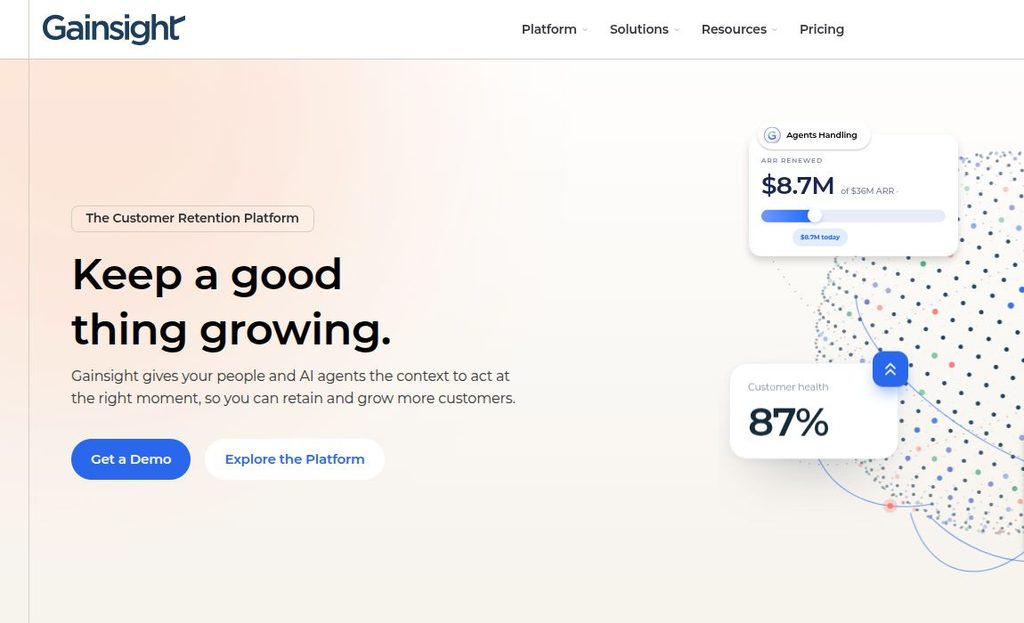
Gainsight is an enterprise customer success platform built for teams managing customer health, adoption, renewals, and expansion. It combines account information with playbooks and success plans so customer success managers can prioritize interventions. It is most relevant when a business manages many ongoing customer relationships and needs consistent processes across CSM teams.
Key features:
- Customer health: Account scorecards help organize signals such as usage, sentiment, and renewal risk.
- Success workflows: Playbooks, tasks, and customer success plans coordinate team actions.
- Renewal visibility: Forecasting and account management capabilities support recurring-revenue planning.
Pricing: Essentials and Enterprise are offered through request-for-pricing plans. Gainsight has also announced a future value-based pricing direction, so confirm the applicable 2026 contract with sales.
When it is best: Enterprise B2B SaaS organizations with dedicated customer success operations, complex accounts, and recurring renewals.
Important consideration: A sophisticated CS deployment requires dependable account data, process ownership, and implementation time. It may be excessive for small teams trying to solve a single onboarding issue.
2. ChurnZero
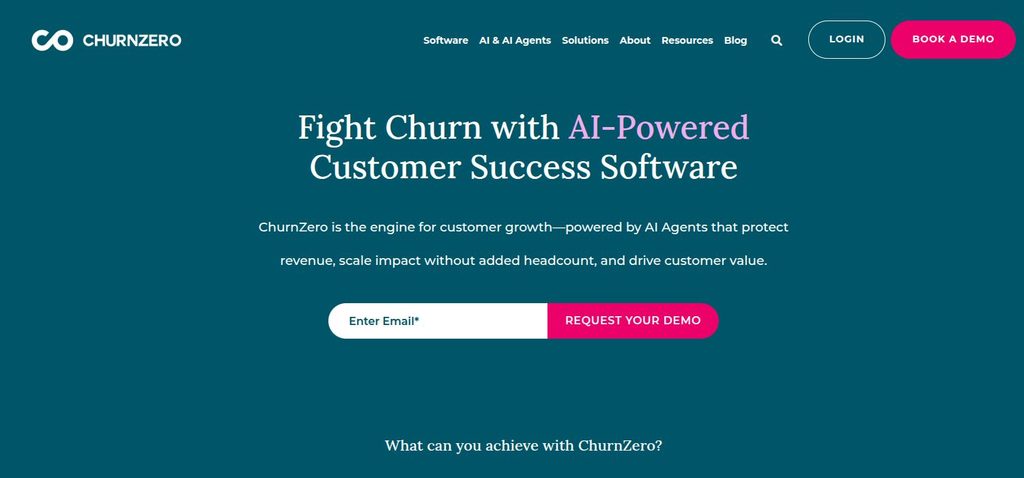
ChurnZero focuses on customer success for subscription businesses, combining customer engagement data, account health, automation, and proactive communication. Its strength is turning signals about customer activity into repeatable CSM workflows. This makes it appealing to B2B SaaS organizations that need to notice usage changes before renewal conversations become urgent.
Key features:
- Account monitoring: Health scores and customer activity help flag accounts needing attention.
- Journey orchestration: Plays and automated engagement help standardize onboarding and follow-up.
- Success visibility: Teams can coordinate account plans, retention initiatives, and renewal work.
Pricing: Sales-led, quote-based pricing. Confirm the scope of integrations, accounts, automation, and services in the proposal.
When it is best: Mid-market and enterprise SaaS teams that already have customer success resources and want more proactive account coverage.
Important consideration: Signals need to match the product’s actual usage rhythm. Treating every decline in logins as churn risk can create false alerts and unnecessary outreach.
3. Vitally
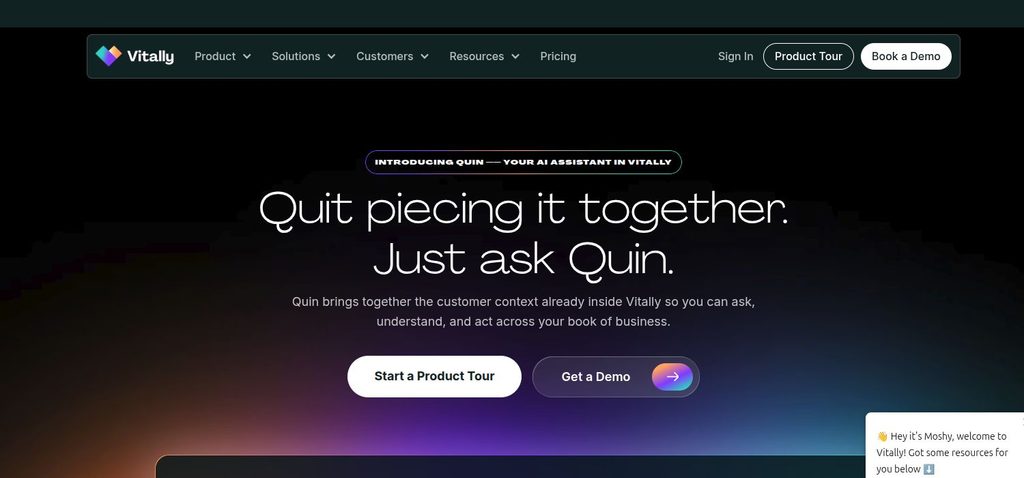
Vitally is a customer success platform that combines customer data, collaboration, and workflows in a flexible workspace. Its Tech-Touch, Hybrid-Touch, and High-Touch plans are organized around how a company serves customers. That makes it especially relevant for SaaS teams balancing automated digital programs with personal account management.
Key features:
- Customer workspace: Centralized profiles and account context support team collaboration.
- Automations: Workflows, tasks, and success processes can be standardized across accounts.
- Flexible CS model: Plans accommodate digital, hybrid, and high-touch engagement.
Pricing: Custom quote across Tech-Touch, Hybrid-Touch, and High-Touch plans.
When it is best: SaaS teams that want customer success operations to evolve as their account base and service model grow.
Important consideration: Evaluate the quality of the data integration and the team’s willingness to maintain consistent lifecycle definitions. A flexible workspace still needs disciplined ownership.
4. Planhat

Planhat brings customer success, account management, workflow automation, and revenue-related activity into a shared platform. It is designed for customer-facing teams that need a common account record rather than separate spreadsheets for success, renewals, and expansion. It can be a strong fit when post-sale operations involve multiple departments.
Key features:
- Account views: Connect customer information with workflows and relationship activity.
- Revenue management: Support renewal, account planning, and commercial visibility.
- Automation: Coordinate follow-ups and recurring processes across teams.
Pricing: Contact sales for package and implementation pricing; the public website does not provide one universal starting price.
When it is best: Growing B2B businesses coordinating customer success and account-management responsibilities.
Important consideration: Check which account, workflow, and AI capabilities are included in your selected package. Broader enterprise coverage can mean a more complex rollout.
5. Usermaven
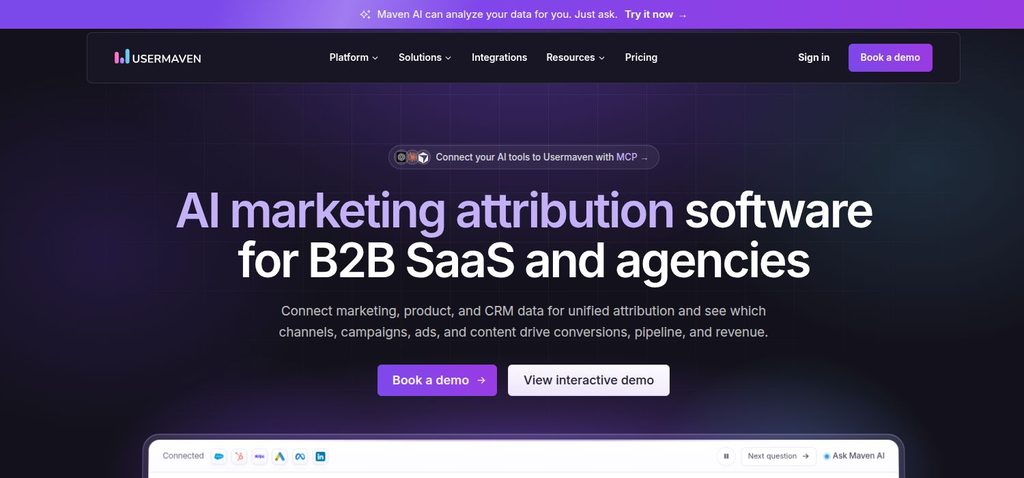
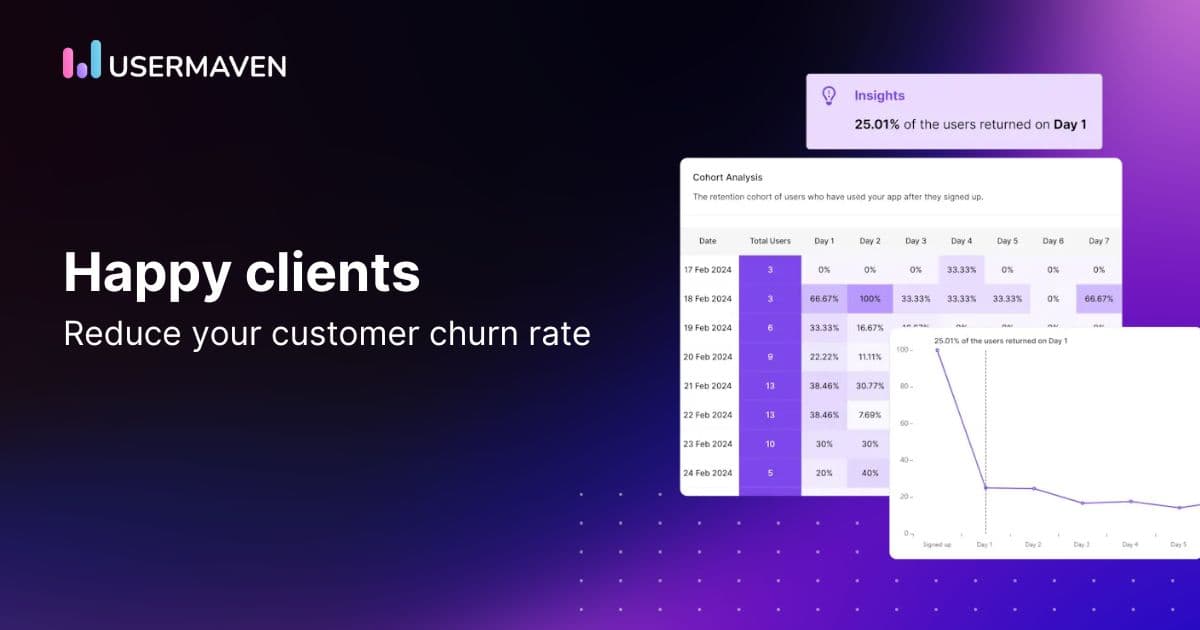
Usermaven is primarily a marketing attribution platform with website and product analytics capabilities. Its role in retention is to help teams understand how users and accounts behave after acquisition, which cohorts return, and how engagement differs across customer journeys and sources. Teams can connect this behavioral context with paid ads attribution to examine which campaigns bring customers who continue to engage and contribute revenue.
Key features:
- Retention cohorts: Configure start and return events, compare daily, weekly, or monthly cohorts, and analyze users or companies.
- Product behavior: Review funnels, segments, events, and customer journeys to investigate activation and engagement.
- Acquisition context: Connect retention analysis with marketing channels, campaigns, and conversion attribution.
- Maven AI: Explore changes through analysis and recurring Agent reports, with findings that can be saved or shared.
Pricing: Business and Enterprise plans use custom pricing through sales. Older fixed-price claims should not be reused.
When it is best: SaaS and growth teams that want to understand which acquired customers remain active, where engagement breaks down, and which marketing efforts bring valuable users.
Important consideration: Usermaven combines attribution and product analytics software to help teams investigate retention across the customer journey. Teams needing CSM task management, help desk workflows, or cancellation flows should assess the relevant integrations alongside their measurement requirements.
6. Mixpanel
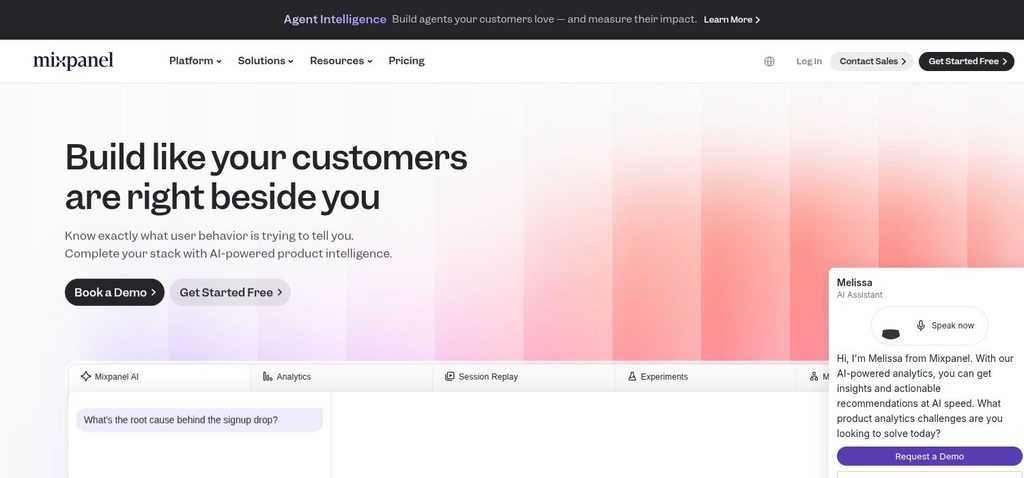
Mixpanel is a product analytics platform for studying event-based behavior and retention. Teams use it to inspect user flows, build funnels, and compare cohorts based on what people actually do inside an application. It is valuable when a product team needs to determine whether users are reaching meaningful milestones rather than merely logging in.
For teams comparing acquisition-to-revenue measurement with product-focused analysis, the Usermaven and Mixpanel comparison explains how the platforms approach those workflows.
Key features:
- Retention reports: Compare the return behavior of groups over time.
- Funnels and flows: Inspect where users abandon a journey or take unexpected paths.
- Behavioral segmentation: Explore engagement differences by event and user properties.
Pricing: A free plan supports up to 1 million events a month; paid plans add scale and expanded limits.
When it is best: Product-led SaaS teams with sufficient event instrumentation and a strong need for behavioral analysis.
Important consideration: Mixpanel can reveal patterns but does not independently manage customer success outreach. Plan for event taxonomy and data quality work before drawing conclusions.
7. Amplitude
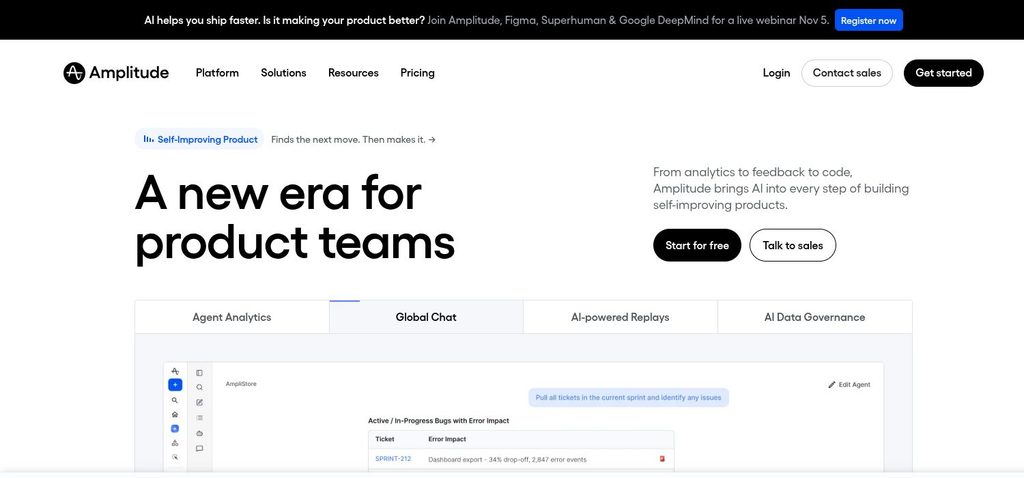
Amplitude combines product analytics with experimentation and digital experience capabilities. It helps businesses understand feature usage, compare retention by behavior, and evaluate changes to product journeys. Its broad ecosystem can appeal to organizations that want to connect product questions with controlled experiments and engagement improvements.
The Usermaven and Amplitude comparison examines how marketing attribution and product analytics support different growth decisions.
Key features:
- Behavior analysis: Funnel, path, and cohort insights show how usage patterns differ.
- Experimentation: Product teams can test changes rather than relying exclusively on correlations.
- Activation tooling: Additional capabilities support audience workflows and digital experiences.
Pricing: Free plan includes up to 2 million events per month; Growth and Enterprise are custom-priced, with additional paid capabilities depending on plan.
When it is best: Product organizations with a measurement culture and ongoing roadmap experiments.
Important consideration: Check plan-specific eligibility for advanced cohorts, governance, and other features. The free event allowance alone does not describe everything a team can access.
8. PostHog
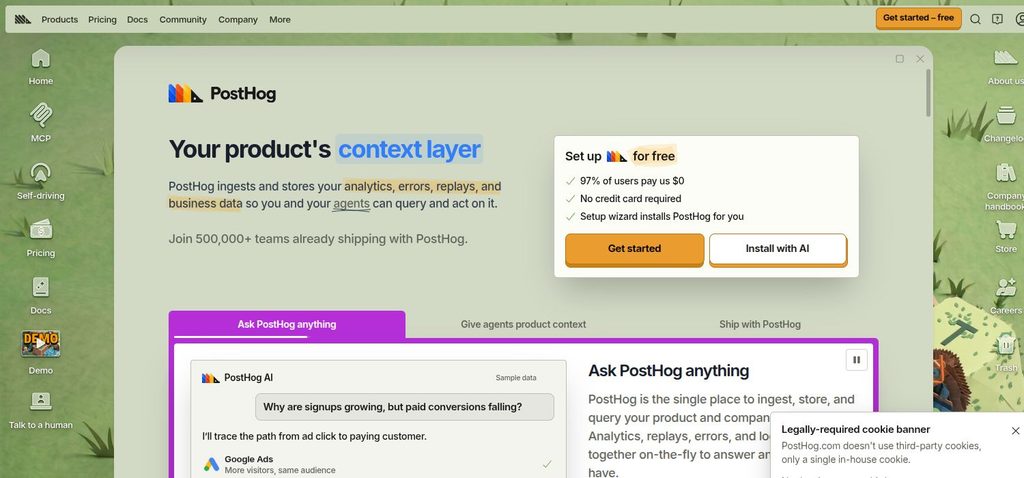
PostHog is a developer-friendly platform bringing product analytics, session replay, feature flags, experimentation, and additional engineering-oriented tools together. It is particularly attractive to teams that want behavioral insights close to their development workflow. Retention analysis can be paired with replay and release context to investigate where users become frustrated.
The Usermaven and PostHog comparison describes the trade-offs between marketing measurement and an engineering-oriented product stack.
Key features:
- Product analytics: Event trends, lifecycle views, funnels, and user paths.
- Session replay: Review the context behind difficult or abandoned user experiences.
- Experiments and flags: Evaluate product changes and control rollout exposure.
Pricing: The first 1 million analytics events are free monthly, with usage-based charges beyond free allowances and for other products.
When it is best: Engineering-led SaaS companies that want flexible instrumentation and experiment workflows.
Important consideration: Pricing is spread across multiple usage meters. Teams should forecast analytics events, replay volumes, and other paid features separately.
9. Appcues
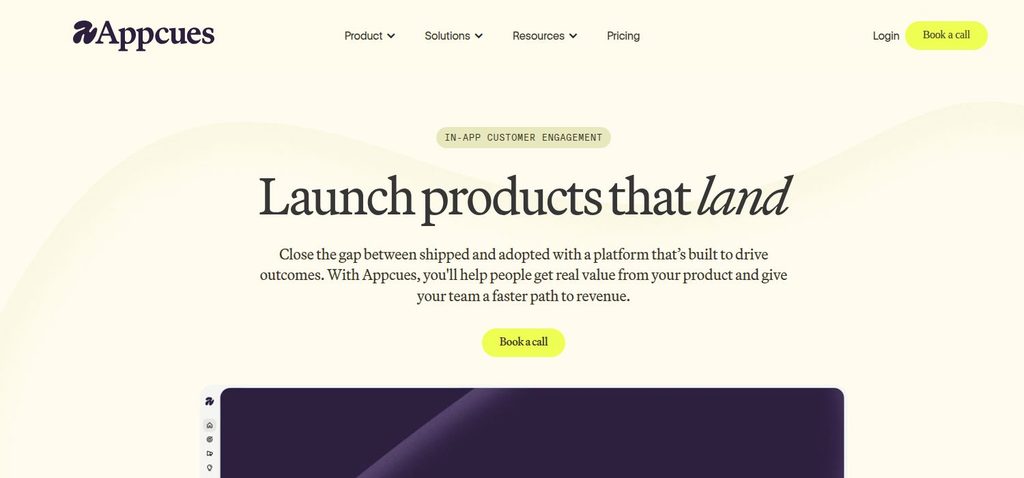
Appcues helps companies build in-app onboarding and engagement experiences without recreating every guide in product code. Teams can use it to introduce workflows, nudge customers toward relevant features, and respond to lifecycle signals. It is best understood as an intervention tool for adoption rather than a general retention analytics platform.
Key features:
- In-app experiences: Guides, checklists, and contextual messages support activation.
- Audience targeting: Deliver different experiences to users based on appropriate context.
- Experience reporting: Assess how users interact with onboarding and engagement prompts.
Pricing: Public plans are organized around monthly active users, installations, and published experiences. Request a current quote for the appropriate tier.
When it is best: SaaS businesses with good product-market fit but measurable onboarding or feature-discovery friction.
Important consideration: Too many pop-ups can undermine the experience. Test whether the prompts improve real activation and sustained use, not just click-throughs.
10. Userpilot
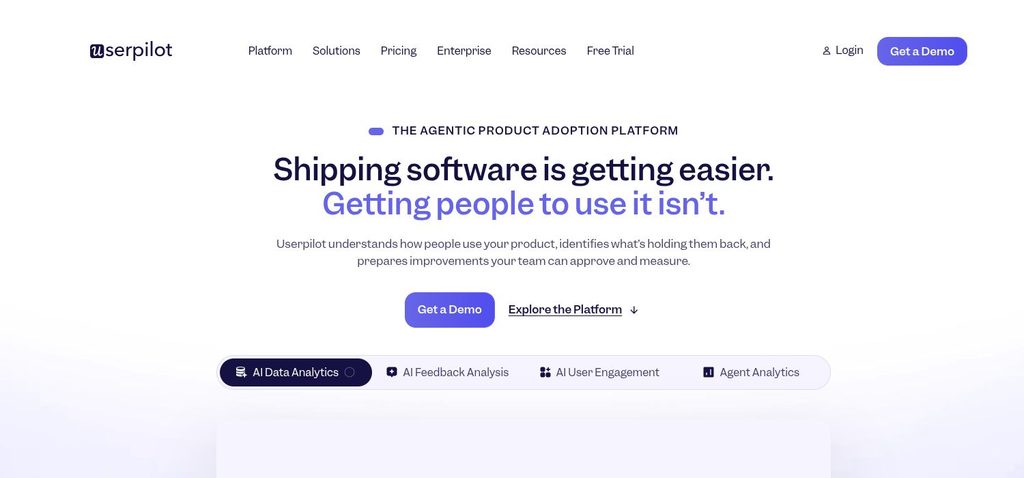
Userpilot is a SaaS product adoption platform covering in-app onboarding, behavior-triggered experiences, user feedback, and usage analysis. It helps growth and product teams build contextual journeys for different user groups. Its retention contribution is strongest when better guidance can help customers reach value earlier or adopt overlooked features.
Key features:
- Onboarding flows: Build interactive tours, checklists, and contextual hints.
- Segmentation: Target product experiences by user behavior and attributes.
- Feedback and analytics: Combine in-app survey responses with usage and adoption data.
Pricing: Starter begins at $299/month, with an advertised allowance of up to 2,000 monthly active users; larger plans cost more.
When it is best: Product-led SaaS teams that need fast iteration on onboarding and feature adoption.
Important consideration: Confirm how active users are counted and which reports or experiences are included. Adoption tooling cannot compensate for a product that fails to deliver expected value.
11. Churnkey
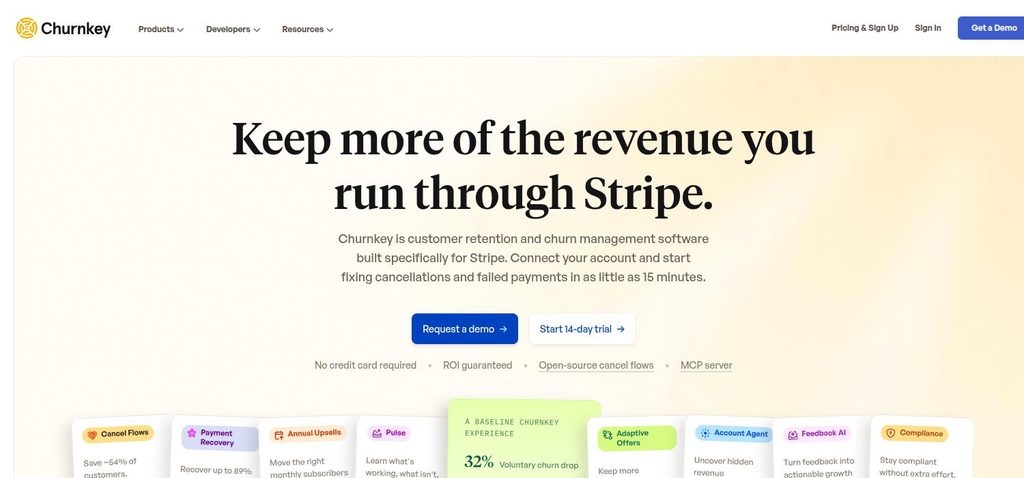
Churnkey concentrates on subscription churn at the moment customers cancel or when payments fail. Instead of only warning about churn, it gives subscription businesses workflows to respond to cancellation reasons, offer alternatives, and pursue failed-payment recovery. It addresses a narrower and more transactional retention problem than traditional customer success software.
Key features:
- Cancellation flows: Present contextual choices such as pauses or offers before a subscriber leaves.
- Payment recovery: Support dunning and retry workflows for failed payments.
- Testing and reporting: Evaluate cancellation experiences and recovery outcomes.
Pricing: Starter is listed at $250/month billed annually for teams with under $5,000 monthly churn volume. Higher-volume plans are quote-based.
When it is best: Subscription businesses with measurable voluntary cancellations or involuntary payment churn.
Important consideration: Validate the billing integration and your revenue-at-risk baseline. Saving a customer through a discount is not automatically profitable if the discount exceeds future contribution margin.
12. Chargebee Growth
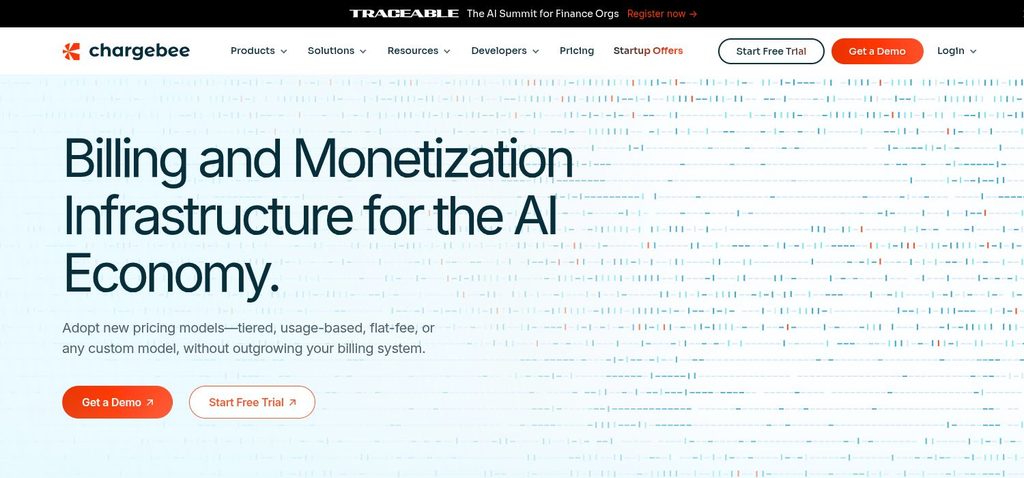
Chargebee Growth addresses subscriber retention within a broader subscription monetization workflow. It combines customer context, offers, cancellation experiences, and experimentation designed around the subscriber lifecycle. The offering is particularly relevant to businesses already using Chargebee billing or evaluating integrated subscription operations.
Key features:
- Cancel experiences: Tailor cancellation journeys, offers, pauses, and alternatives.
- Subscriber targeting: Use lifecycle and subscription signals to select relevant treatments.
- Experimentation: Evaluate offers and cancellation interventions instead of applying identical incentives to every subscriber.
Pricing: Chargebee publishes different Growth and Billing plan structures. Confirm the applicable Growth edition and retention capabilities in the official quote; do not assume all functionality is included in entry plans.
When it is best: Subscription businesses connecting billing data with retention and monetization experiments.
Important consideration: Distinguish subscription billing features from Growth features during procurement. Teams on another billing stack should verify integration scope and implementation effort.
13. Customer.io
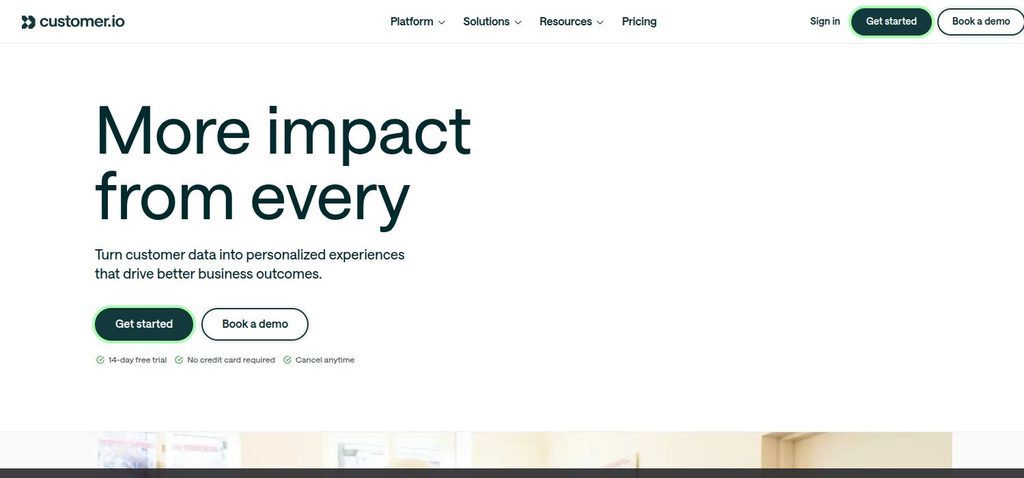
Customer.io specializes in behavior-triggered customer messaging. It supports lifecycle journeys such as onboarding reminders, feature education, reactivation, and subscription communications using customer events and profiles. It is a retention execution system: its strongest results depend on sending timely, relevant communications based on trustworthy event data.
Key features:
- Visual workflows: Build multi-step journeys triggered by behavior or lifecycle events.
- Audience data: Target communications using customer profiles and event context.
- Cross-channel strategy: Support coordinated communication as teams scale beyond simple emails.
Pricing: Essentials starts at $100/month and includes 5,000 profiles under published entry terms. Premium starts at $1,000/month billed yearly.
When it is best: SaaS or digital businesses with a clear retention messaging strategy and event instrumentation.
Important consideration: Separate message delivery from business outcomes. More opened emails do not necessarily mean stronger retention; evaluate activation and customer behavior after outreach.
14. Klaviyo
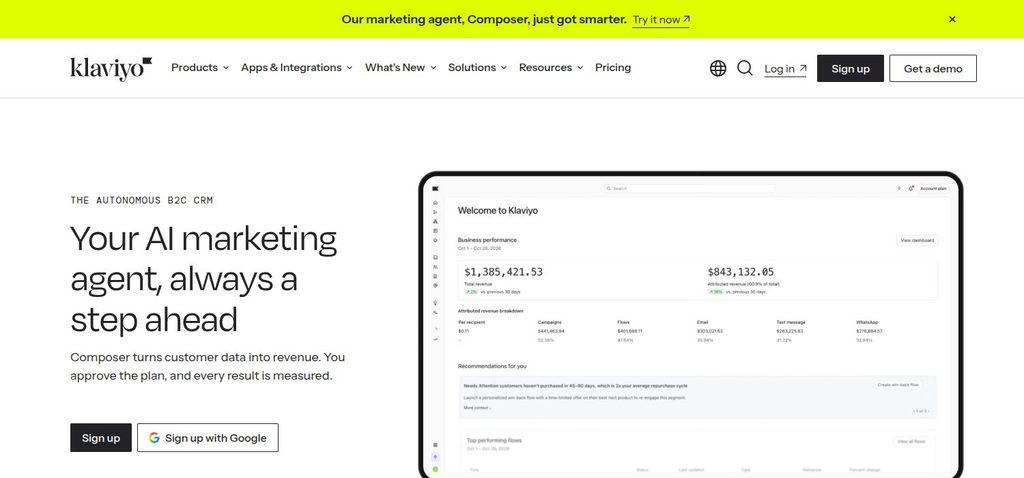
Klaviyo is an ecommerce customer engagement platform focused on email, SMS, shopper data, and repeat-purchase journeys. It lets brands segment customers around purchasing and engagement behavior, then personalize lifecycle campaigns. Its retention role is usually most direct in ecommerce rather than B2B contract renewals.
Key features:
- Customer segmentation: Group shoppers by purchase activity and engagement.
- Automated messaging: Build post-purchase, replenishment, reactivation, and loyalty-related flows.
- Commerce reporting: Relate campaign performance to purchasing activity.
Pricing: The free plan supports up to 250 active profiles and 500 email sends per month; paid pricing depends on profiles, message volumes, and products.
When it is best: Ecommerce stores aiming to improve repeat purchase frequency and returning-customer revenue.
Important consideration: Monitor subscription costs as the contact database grows, and use controlled tests when evaluating the incremental value of discounts and campaigns.
15. Zendesk
Zendesk is a customer service platform designed to help teams resolve customer issues consistently across support channels. Reliable service can influence retention by reducing frustration and increasing confidence after purchase. It is especially relevant when unresolved requests, slow responses, or inconsistent service quality contribute to customer loss.
Key features:
- Ticket management: Centralize, route, and prioritize customer inquiries.
- Support workflows: Use triggers, automations, and knowledge resources to reduce repetitive effort.
- Service reporting: Monitor resolution times, support volume, and experience indicators.
Pricing: Support Team starts at $19 per agent per month billed annually; Suite Team starts at $55 per agent per month on annual billing.
When it is best: Support teams looking to improve service consistency and resolve friction before it damages customer relationships.
Important consideration: High ticket closure rates are not themselves proof of retention. Connect service outcomes to customer satisfaction and future renewals or purchases.
16. Smile.io
Smile.io helps ecommerce businesses encourage repeat purchases through loyalty points, rewards, and referral programs. It is designed around customer incentives rather than in-app SaaS adoption. For retailers, a loyalty program can support repeat engagement when rewards reinforce value without eroding margins.
Key features:
- Points and rewards: Recognize repeat purchases and selected shopper actions.
- Referrals: Encourage existing customers to introduce others to the brand.
- Loyalty experience: Manage branded loyalty surfaces and reward redemption.
Pricing: Free plan is available for qualifying small stores; Essential starts at $15/month, with higher tiers for greater order volume and features.
When it is best: Ecommerce stores with repeat-purchase potential and an existing customer base to engage.
Important consideration: Calculate reward liability, redemption economics, and incremental repeat orders. Loyalty points should support profitable habits rather than reward purchases customers would have made anyway.
Other retention tools worth considering
The 16-tool shortlist is not exhaustive. Some businesses will already have a strong CRM, messaging platform, or service desk and need only one additional capability. These related options are worth evaluating against the same retention problem, rather than treating them as universally inferior alternatives.
For lifecycle email and marketing automation, ActiveCampaign and Brevo may fit teams already using their contact, campaign, and segmentation tools. For feedback collection, Qualaroo can help teams ask targeted questions about customer friction. An enterprise customer engagement platform such as Netcore Cloud may fit businesses coordinating more complex cross-channel journeys.
A CRM or service operation may also depend on integrated case workflows. For teams evaluating Salesforce-related service processes, Case management in Salesforce is a separate consideration from a full customer retention platform.
Communications can complement these tools. Businesses may use business SMS for service updates or timely reminders, while real examples of SMS show how short messages can fit customer engagement. Message frequency, permission, and relevance still matter, and sending texts does not automatically reduce churn.
How to choose customer retention software
Start by identifying when customers leave and the behavior or event that precedes departure. For a subscription service, look at failed payments and cancellations. For SaaS, compare trial-to-activation and recurring usage. For ecommerce, examine repeat orders and time between purchases. This avoids buying a broad platform to address a problem that needs a specific intervention.
1. Define the retention problem
Write one measurable statement, such as “trial users who do not complete setup by day seven rarely activate” or “a substantial share of subscriptions end after payment failures.” Use actual internal data to quantify it before purchasing. If the issue cannot be measured, establish tracking first.
2. Match the platform to the intervention
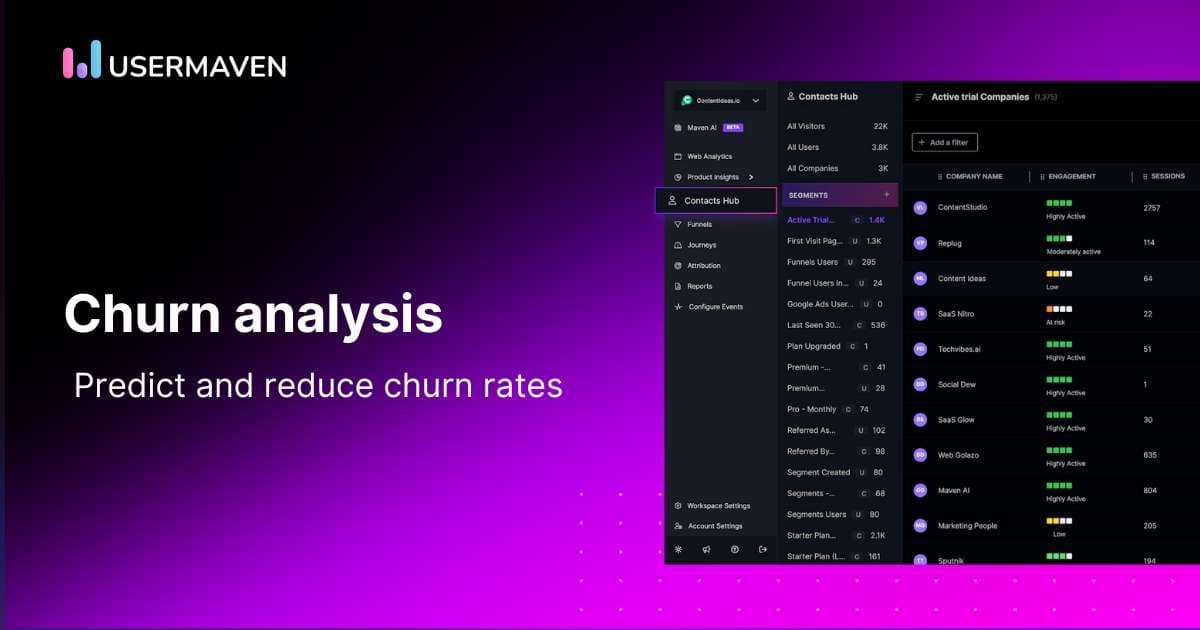
Analytics can reveal a segment with high churn risk, but someone still needs to improve onboarding or contact the customer. Customer success software coordinates account actions, while lifecycle messaging and in-app guidance deliver interventions. Subscription recovery products work closer to payment and cancellation events.
3. Check integrations and identity logic
Verify whether the platform can use the identifiers your business actually has: anonymous visitor IDs, logged-in user IDs, CRM contacts, account IDs, subscriptions, and purchase events. For B2B SaaS, account-level reporting is essential when renewals happen by organization rather than individual seat.
4. Compare ownership and implementation requirements
Consider who will maintain event definitions, message journeys, health scores, or support processes. A platform that is easy to buy but hard to maintain can produce misleading alerts. Ask vendors about onboarding, training, technical support, data export, security, and implementation responsibilities.
5. Model the full cost
Do not compare only starting prices. Event ingestion, monthly active users, contacts, customer accounts, agents, implementation services, and add-ons are different billing units. Ask for an estimate based on current usage and a realistic twelve-month growth scenario.
6. Pilot a measurable use case
Choose one segment and intervention, set the baseline, and agree on the success metric before launch. Where feasible, compare the treatment with a comparable holdout group. A controlled approach helps avoid mistaking seasonality, account mix, or promotions for a software-driven improvement.
Which customer retention software is best by business type?
| Business or team | Strong starting options | Primary question |
|---|---|---|
| Enterprise B2B SaaS | Gainsight, ChurnZero, Vitally, Planhat | Which accounts need coordinated success work? |
| Product-led SaaS | Usermaven, Mixpanel, Amplitude, PostHog | Where do users disengage after acquisition? |
| SaaS with onboarding friction | Appcues, Userpilot | How do new customers reach value sooner? |
| Subscription service | Churnkey, Chargebee Growth | Why do subscribers cancel or payments fail? |
| Lifecycle marketing team | Customer.io | Which triggered message supports re-engagement? |
| Ecommerce store | Klaviyo, Smile.io | What drives profitable repeat purchases? |
| Customer support organization | Zendesk | Which service issues undermine customer confidence? |
This table is a starting point, not a substitute for product trials. Some companies will need a combination, such as retention analytics to identify disengagement and an in-app guidance tool to test a better onboarding journey.
How to measure the ROI of retention software
Retention software should be evaluated against the business outcome it is meant to influence. A useful measurement framework begins with a clear definition of retained customers and a comparable time window. For B2B SaaS, distinguish account retention from seat usage; for ecommerce, distinguish repeat purchase rate from one-time promotion spikes.
| Metric | What it answers | Common mistake |
|---|---|---|
| Customer retention rate | How many eligible customers remain? | Mixing changing cohort definitions |
| Customer churn rate | How many customers are lost? | Comparing logo churn with revenue churn |
| Net revenue retention | Does existing recurring revenue grow or shrink? | Ignoring expansions and contractions |
| Activation rate | Do new users reach initial product value? | Counting superficial sign-ins as activation |
| Repeat purchase rate | Are customers making additional purchases? | Ignoring profitability or discount dependence |
| Payment recovery rate | How much failed-payment revenue returns? | Treating retries as net new demand |
| Support resolution quality | Are important issues resolved well? | Optimizing only for closure speed |
A cohort-based view helps separate early-stage customer loss from later renewal problems. Usermaven’s cohort analysis to measure user retention guide explains how to track groups over time, while customer retention metrics provides a broader measurement foundation.
Attribution provides another useful perspective: teams may discover that two acquisition channels generate similar signups but very different retention. That finding can inform budget priorities, although observed correlations do not establish that a channel caused the retention difference.
For a practical related workflow, use saas customer segmentation to create actionable groups, then compare their outcomes. When evaluating a vendor, ask whether you can export data and reproduce its calculations independently.
Final recommendation
Choose customer retention software for a clearly defined job. Use customer success platforms when teams need account coordination, analytics when they need to understand behavior, onboarding tools when users fail to reach value, and recovery or messaging products when an actionable customer event calls for intervention.
For teams that need to connect retention behavior with the channels and campaigns that originally acquired customers, Usermaven adds the marketing measurement layer. Explore how it connects product behavior, cohorts, and attribution, or book a demo to discuss your measurement needs.
FAQs
1. What is the best customer retention software for SaaS?
The answer depends on the problem. Gainsight or ChurnZero fits organized account-renewal operations; Usermaven, Mixpanel, or Amplitude fits retention analysis; Appcues or Userpilot addresses onboarding friction; and Churnkey addresses subscription cancellations. A SaaS company can reasonably use more than one category.
2. Is customer retention software the same as CRM software?
No. A CRM usually manages contacts, sales relationships, and account records. Retention platforms may incorporate CRM information, but can specialize in customer success workflows, product behavior, onboarding, support, messaging, or subscription recovery. A CRM alone may not provide all those capabilities.
3. What is proactive customer retention software?
Proactive retention tools help teams act before a customer leaves. They might flag declining engagement, detect incomplete onboarding, trigger a customer-success play, or send an appropriate reminder. A useful system connects the warning signal to an action and a measurable outcome.
4. What should small businesses prioritize?
Start with the main source of churn and current staff capacity. A small ecommerce store may benefit from lifecycle messaging or loyalty before enterprise customer-success software. A small SaaS team may start with product analytics and onboarding improvements before adopting a dedicated CSM platform.
5. How much does customer retention software cost?
Costs vary by category and billing unit. Several analytics and ecommerce tools offer free tiers, while some onboarding and recovery products begin in the hundreds of dollars monthly. Enterprise customer success tools often use custom contracts. Include implementation, integrations, add-ons, and future usage in total-cost estimates.
6. Can retention analytics predict customer churn automatically?

Written by
Adeel Khan
Growth Marketing Expert
Adeel Khan is a full-stack SaaS marketer with 10+ years of experience in content marketing, paid advertising, analytics, and conversion rate optimization. He shares practical insights and strategies drawn from hands-on experience, helping B2B SaaS marketers improve performance and make better marketing decisions.
All articles by Adeel →