Getting customers to buy once is only half the job.
The real challenge is giving them enough value to stay, return, and keep choosing your business. Without a clear retention strategy, even successful acquisition campaigns can turn into a cycle of replacing customers who leave.
That’s where retention marketing comes in. It helps businesses strengthen existing customer relationships, reduce churn, and encourage repeat purchases or continued product usage.
But effective retention marketing goes beyond sending occasional emails or offering discounts. It requires understanding customer behavior, recognizing when engagement drops, and responding with something genuinely useful.
Power up your SaaS
with perfect product analytics
Key takeaways
- Retention marketing focuses on existing customers. It uses relevant communication, customer experiences, and lifecycle campaigns to encourage continued engagement and repeat business.
- Customer retention starts immediately after acquisition. Onboarding, activation, and the first successful experience can influence whether someone stays.
- Different customers need different retention strategies. New, active, loyal, and at-risk customers should not receive identical messages.
- Retention requires more than email campaigns. Product education, customer support, personalized experiences, feedback, and loyalty programs all contribute.
- Retention rate alone doesn’t tell the whole story. Track churn, repeat purchase rate, customer lifetime value, and revenue retention alongside customer counts.
- Acquisition quality matters for retention. Understanding which marketing channels bring customers who stay can help businesses make better investment decisions.
What is customer retention marketing?
Retention marketing is the process of keeping existing customers engaged, satisfied, and willing to continue doing business with a company.
Instead of focusing primarily on attracting new buyers, it strengthens relationships with people who have already purchased, subscribed, or started using a product.
The goal is to increase the value customers receive over time, encouraging behaviors such as repeat purchases, subscription renewals, continued product usage, and referrals.
For example, an ecommerce brand might send personalized product recommendations after someone’s first purchase. A SaaS company might provide onboarding emails, feature tutorials, and proactive support to help new users get value from their subscriptions.
Both are retention marketing, even though the customer journeys look different.
Retention marketing is closely connected to customer journey strategy because the experience after conversion can be just as important as the experience before it.
Why is retention marketing important?
Retention marketing affects more than customer loyalty. It influences revenue stability, acquisition efficiency, and the long-term value of customer relationships.
1. It helps reduce customer churn
Customer churn occurs when customers stop buying, cancel subscriptions, or otherwise end their relationship with a business.
Retention marketing helps businesses recognize disengagement and address problems before customers leave.
For example, a SaaS company might notice that customers who haven’t completed onboarding are more likely to cancel. Instead of waiting for cancellation requests, it can offer tutorials or personalized assistance.
These interventions work best when the business understands the underlying reasons for churn.
2. It can increase customer lifetime value
Customer lifetime value (CLV or LTV) estimates the value a customer generates throughout their relationship with a business.
Customers who continue subscribing, renew contracts, or make additional purchases can contribute more revenue over time.
For a subscription business, extending the customer relationship by several months can meaningfully change expected customer value, although the financial benefit also depends on margins and service costs.
3. It supports more predictable revenue
A company with strong repeat purchasing or subscription renewals may be less dependent on constantly acquiring new customers.
That doesn’t eliminate revenue uncertainty, but it gives the business a more established customer base to plan around.
For SaaS companies, retention is especially important because recurring revenue depends on customers continuing to find value in the product.
4. It improves customer relationships
Relevant communication can make customers feel understood rather than repeatedly sold to.
Helpful onboarding, responsive support, personalized recommendations, and timely updates all contribute to a better experience.
Customer loyalty develops when the business consistently delivers value, not simply when it offers rewards.
5. It helps marketing teams make better investment decisions
Two acquisition channels might generate the same number of customers but produce very different long-term results.
For example, customers from one channel may purchase once and never return. Customers from another may renew, upgrade, or make several additional purchases.
Looking at acquisition performance alongside customer retention analysis can reveal differences that initial conversion reports miss.
How does retention marketing work?
Retention marketing follows a simple cycle:
- Understand customer behavior. Identify how customers use your product, purchase, or engage.
- Group customers by their needs. Separate new, active, loyal, and at-risk customers.
- Deliver relevant experiences. Use education, support, recommendations, and timely campaigns.
- Measure the response. Track repeat engagement, retention, churn, and revenue.
- Improve the experience. Adjust campaigns based on what customers actually do.
The cycle continues throughout the customer relationship.
Retention marketing vs. acquisition marketing
Acquisition marketing and retention marketing support different stages of business growth.
Acquisition brings new customers into the business. Retention helps those customers continue finding value after their first conversion.
| Factor | Acquisition marketing | Retention marketing |
|---|---|---|
| Primary audience | Prospective customers | Existing customers |
| Main objective | Generate new customers | Keep customers engaged |
| Typical campaigns | Paid ads, SEO, lead generation | Onboarding, loyalty, reactivation |
| Key metrics | CAC, new customers, conversion rate | Retention rate, churn, repeat purchases |
| Customer relationship | Before or during initial purchase | After initial purchase |
| Long-term impact | Expands the customer base | Extends customer relationships and value |
Neither approach replaces the other.
A business needs acquisition to grow its customer base, but weak retention can reduce the value of that growth.
For example, imagine a subscription company acquires 200 customers every month but loses 180 existing customers during the same period. Its marketing team is generating demand, yet the customer base grows by only 20.
Improving retention can help the company benefit more from the customers it already acquires.
That’s why customer acquisition strategy and retention planning should be evaluated together.
What are the key customer retention marketing strategies
Retention marketing is about creating meaningful experiences that keep customers engaged long after their first purchase. Implementing the right customer retention marketing strategies helps businesses build trust, increase lifetime value, and foster long-term relationships.
Here are the key approaches to improving customer retention:
Personalized communication
Customers expect brands to understand their preferences and needs. Personalized messaging – based on past purchases, browsing behavior, and interactions – makes customers feel valued. Businesses can use dynamic content, tailored product recommendations, and targeted promotions to enhance product engagement, especially when collecting zero-party data directly from customers to understand their preferences better.
Conversations are the most candid data a brand collects: what a customer says on a call or in a chat disappears unless something writes it down. AI employees such as XBert by Nextiva transcribe and summarize every conversation they handle and add it to that customer’s record, so the next message is built on what the person actually said.
By leveraging customer data effectively, brands can deliver relevant content across email, SMS, and in-app notifications, increasing the chances of repeat purchases.
Loyalty programs
A well-designed loyalty program encourages customers to return by offering rewards for their engagement. Whether through points-based systems, exclusive discounts, or VIP perks, loyalty programs managed through the best loyalty management software make it easier to track rewards, automate incentives, and deliver personalized experiences at scale. Businesses that gamify rewards or offer experiential benefits, such as early access to new products, create stronger emotional connections with their audience.
Email marketing campaigns
Regular communication through email helps brands stay connected with their customers. Businesses can craft automated campaigns for welcome sequences, abandoned cart recovery, re-engagement emails, and special promotions. Segmented email lists ensure that customers receive content tailored to their interests, making email marketing an effective tool for nurturing long-term relationships.
Exceptional customer service
Outstanding customer service goes beyond resolving issues – it builds trust and loyalty. Quick response times, proactive support, and a seamless experience across multiple channels (live chat, email, phone, and social media) create a positive perception of the brand. Businesses that prioritize customer satisfaction and invest in AI-driven chatbots, self-service portals, and knowledgeable support teams gain a competitive advantage in retention.
Behind that level of service, employee recognition also matters because support teams are more likely to deliver consistent, thoughtful customer experiences when their work is noticed and valued.
Feedback and continuous improvement
Customer feedback provides invaluable insights for business growth. Brands that actively seek reviews, conduct surveys, and analyze support interactions can identify pain points and make necessary improvements. Implementing changes based on customer feedback demonstrates a commitment to their experience, increasing trust and loyalty. Continuous optimization of products, services, and marketing strategies ensures that businesses remain relevant and competitive.
Retention marketing is an ongoing process that requires data-driven decision-making and strategic execution. With tools like Usermaven, businesses can track customer engagement, identify potential churn risks, and refine their retention strategies to build stronger customer relationships.
Power up your SaaS
with perfect product analytics
How to build a retention marketing strategy in six steps
A retention marketing strategy works best when it starts with a specific customer problem rather than a collection of disconnected campaigns.
Step 1. Establish your retention baseline
Start by understanding how many customers stay, when they leave, and how behavior changes over time.
Review:
- Customer retention and churn rates.
- Repeat purchase or renewal rates.
- Time to first value.
- Engagement frequency.
- Customer lifetime value.
- Revenue retained from existing customers.
Use consistent time periods and customer definitions so your results are comparable.
Step 2. Identify where customers disengage
Examine the stages where customer activity or retention declines.
For SaaS, this might be the period between signup and activation. For ecommerce, it might be the gap between the first and second purchase.
A customer journey analysis can help reveal where customers encounter friction.
Step 3. Prioritize one customer segment
Avoid launching campaigns for every segment at once.
Choose a group with a clear problem and measurable opportunity.
For example, customers who completed signup but never activated a core feature may be a useful starting point.
Step 4. Choose the right intervention
Match the campaign to the problem.
| Retention problem | Possible intervention | Primary metric |
|---|---|---|
| Incomplete onboarding | Setup assistance | Activation rate |
| Low feature adoption | Product education | Feature adoption |
| Declining engagement | Personalized re-engagement | Returning active users |
| Missed repeat purchases | Replenishment reminder | Repeat purchase rate |
| Renewal uncertainty | Proactive success outreach | Renewal rate |
| Previous customer inactivity | Win-back campaign | Reactivation rate |
Step 5. Launch and test the campaign
Set a clear goal before launching.
For example: Increase the percentage of new customers who complete onboarding within 14 days.
Where practical, compare results against a suitable control group. This helps distinguish campaign effects from normal changes in customer behavior.
Step 6. Measure outcomes and improve
Review whether customers actually stayed longer, renewed, purchased again, or became more active.
If engagement improves but retention doesn’t, investigate why.
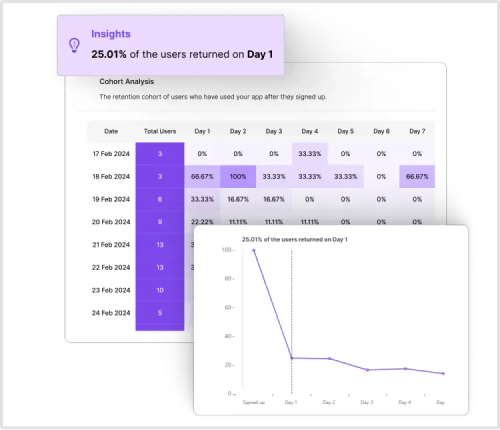
Use cohort analysis to compare customers who joined during different periods and observe whether improvements persist.
Retention marketing examples for different businesses
Retention marketing looks different depending on what customers purchase and how frequently they need the product.
Example 1. SaaS onboarding and feature adoption
A SaaS company notices that many new customers stop using its platform during the first month.
The team discovers that customers who complete a particular setup workflow tend to remain active longer.
It introduces guided onboarding, contextual tutorials, and support outreach for customers who haven’t completed that workflow.
What to measure: Setup completion, activation rate, 30-day retention, and later subscription renewals.
Example 2. Ecommerce repeat purchase campaigns
An ecommerce brand sells products that customers typically replenish.
It segments customers by purchase history and sends reminders near the expected replenishment period.
Customers who already purchased again are excluded from the reminder.
What to measure: Repeat purchase rate, revenue per returning customer, campaign contribution margin, and unsubscribe rate.
Example 3. Subscription renewal campaigns
A subscription business identifies customers approaching renewal who haven’t recently used important features.
Instead of sending only a renewal reminder, it offers relevant training and assistance.
The campaign focuses on helping customers realize value before they decide whether to continue.
What to measure: Renewal rate, retained recurring revenue, engagement after outreach, and cancellation reasons.
These are illustrative examples, not reported customer case studies.
How to measure retention marketing performance
Retention rate is an important starting point, but it shouldn’t be the only metric.
A business can retain many customers while losing revenue if customers downgrade or reduce spending. Similarly, strong repeat purchasing may be unprofitable if incentives cost too much.
The right metrics depend on your business model.
| Metric | What it measures | Best suited for |
|---|---|---|
| Customer retention rate | Percentage of starting customers retained | Most businesses |
| Customer churn rate | Percentage of starting customers lost | SaaS and subscriptions |
| Repeat purchase rate | Share of customers making multiple purchases | Ecommerce |
| Customer lifetime value | Expected customer value over the relationship | Most businesses |
| Gross revenue retention | Recurring revenue retained, excluding expansion | Subscription businesses |
| Net revenue retention | Recurring revenue retained, including expansion | Subscription businesses |
| Reactivation rate | Share of inactive customers who return | Win-back programs |
| Cohort retention | Retention of customers acquired in the same period | SaaS, apps, subscriptions |
1. Customer retention rate
Customer retention rate measures the percentage of customers from the beginning of a period who remain at the end.
Customer retention rate = ((Customers at end − New customers acquired) ÷ Customers at start) × 100
For example:
- Customers at the start: 1,000
- New customers acquired: 200
- Customers at the end: 1,050
Retention rate = ((1,050 − 200) ÷ 1,000) × 100 = 85%
The company retained 85% of its starting customer base.
This formula assumes customer counts are defined consistently and that new customers are excluded appropriately. For more complex account changes, directly tracking the original customer cohort is more reliable.
You can also use Usermaven’s customer retention rate calculator.
2. Customer churn rate
Customer churn rate measures the percentage of customers lost during a period.
Customer churn rate = (Customers lost during period ÷ Customers at start) × 100
If a business starts with 1,000 customers and loses 150, its churn rate is 15%.
When measured on the same starting cohort with consistent definitions, retention and churn are complementary.
For practical ways to address customer loss, examine the factors behind your customer churn rate.
3. Repeat purchase rate
Repeat purchase rate measures how many customers buy more than once during a defined period.
Repeat purchase rate = (Customers with multiple purchases ÷ Total purchasing customers) × 100
If 240 out of 800 purchasing customers place at least two orders, the repeat purchase rate is 30%.
Always specify the period because a 30-day repeat purchase rate isn’t directly comparable with a 12-month rate.
4. Customer lifetime value
Customer lifetime value estimates the revenue or profit a customer is expected to generate throughout the relationship.
For a simplified subscription example:
Estimated revenue LTV = Average monthly revenue per customer × Expected customer lifetime in months
If average monthly revenue is $100 and expected lifetime is 24 months:
Estimated revenue LTV = $2,400
This is a simplified revenue estimate, not a profit calculation. More advanced models account for retention curves, gross margin, changing revenue, and discounting.
5. Gross and net revenue retention
For subscription businesses, customer counts can hide changes in recurring revenue.
Gross revenue retention (GRR) measures how much starting recurring revenue remains after churn and contraction, excluding expansion.
Net revenue retention (NRR) includes expansion from existing customers.
Suppose a company begins with $100,000 in monthly recurring revenue from an existing customer cohort:
- Churned revenue: $5,000
- Contraction: $3,000
- Expansion: $12,000
GRR = ($100,000 − $5,000 − $3,000) ÷ $100,000 × 100 = 92%
NRR = ($100,000 − $5,000 − $3,000 + $12,000) ÷ $100,000 × 100 = 104%
The company retained 92% of its starting revenue before expansion, but existing-customer growth increased net retained revenue to 104%.
These measures are particularly relevant when reviewing SaaS metrics.
How to identify customers at risk of churn
Not every decline in activity means a customer is about to leave.
A seasonal customer, for example, may naturally purchase less often during certain months. A business customer may use a product heavily during reporting periods and less frequently between them.
Churn signals should therefore be evaluated against normal behavior.
| Warning signal | Possible explanation | What to investigate |
|---|---|---|
| Fewer sessions | Declining interest | Changes in normal usage |
| Reduced feature adoption | Unclear product value | Onboarding or training gaps |
| Longer gaps between purchases | Changing needs | Expected purchase frequency |
| Repeated support issues | Unresolved friction | Common complaints |
| Declining account activity | Reduced organizational adoption | Team-level engagement |
| Negative customer feedback | Unmet expectations | Specific product or service problems |
A practical approach is to compare each customer’s recent activity with their previous behavior and with similar customers.
For example, a weekly user who becomes inactive for three weeks may warrant attention. A quarterly user with the same gap probably doesn’t.
Retention analytics can help identify these patterns, but the next step should be understanding the reason behind them.
Important: Predictive churn scores are estimates, not proof that a customer will cancel. They should guide investigation and prioritization rather than automatically trigger aggressive campaigns.
Common retention marketing mistakes to avoid
Even well-funded retention programs can underperform when they focus on the wrong signals or overlook the customer experience.
1. Waiting until customers are already leaving
A last-minute discount rarely fixes months of poor product experience.
What helps: Improve onboarding, monitor engagement, and address problems earlier in the lifecycle.
2. Sending the same campaigns to everyone
Generic messages often ignore what customers actually need.
What helps: Use relevant customer segmentation strategies to tailor communication by behavior and lifecycle stage.
3. Treating discounts as the main retention strategy
Discounts may encourage short-term purchases without creating lasting loyalty.
What helps: Prioritize useful experiences, product value, customer education, and appropriate rewards.
4. Measuring campaign engagement instead of retention
Email clicks and message opens are useful diagnostics, but they don’t necessarily indicate that customers stayed longer.
What helps: Connect campaign reporting to renewals, repeat purchases, retention, and revenue.
5. Ignoring customer feedback
A marketing team cannot solve every retention problem with better messaging.
What helps: Share customer feedback with product, support, and customer success teams, and address recurring sources of friction.
6. Failing to distinguish acquisition quality
Some campaigns attract customers who are unlikely to remain active or become profitable.
What helps: Evaluate acquisition channels using customer cohorts and downstream outcomes, not just initial conversions or customer acquisition cost.
How Usermaven helps improve retention marketing decisions
Retention marketing creates an important question for growth teams:
Which marketing channels bring customers who continue generating value after their first conversion?
A campaign can generate affordable signups without producing customers who stay. Another campaign may cost more initially but attract customers who remain active, renew, or expand their subscriptions.
Usermaven is an AI-powered marketing attribution platform that helps businesses connect marketing spend and customer journeys with conversions, CRM outcomes, pipeline, and revenue.
It can support retention analysis by helping teams understand customer behavior and evaluate acquisition quality over time.
Understand retention across customer cohorts
Retention is easier to interpret when customers are grouped by when they joined or by meaningful characteristics.
Usermaven’s retention and cohort analysis capabilities help teams examine how customer engagement changes over time.
For example, a SaaS business could compare customers acquired during different months and investigate whether newer cohorts remain active longer than earlier ones.
This can reveal whether changes to onboarding or acquisition are associated with better retention.
Investigate the journeys behind long-term engagement
Some customers activate quickly, while others take longer to discover value.
Using user journeys and funnels, teams can examine the interactions customers complete before important conversion or activation events.
For example, a business might find that customers who complete a setup process are more likely to return.
That insight can help the team prioritize onboarding improvements, although the observed relationship doesn’t establish causation.
Compare customer behavior across meaningful segments
With segments, teams can group users based on relevant characteristics and behavior.
This can help distinguish highly engaged customers from those showing declining activity and support more focused analysis.
The resulting insights can inform campaigns managed through appropriate marketing automation or customer engagement tools.
Connect acquisition campaigns with downstream revenue
The strongest retention insights are not limited to product activity.
Businesses also need to understand whether marketing campaigns contribute to customers who create lasting revenue.
Usermaven’s full-funnel revenue attribution connects marketing interactions with downstream business outcomes.
For SaaS companies, this can help marketing teams investigate which acquisition channels are associated with customers who become valuable accounts.
For ecommerce businesses, the same principle helps shift attention from first purchases toward longer-term customer value, provided the necessary conversion and revenue data is available.
Power up your SaaS
with perfect product analytics
A practical 30-day retention marketing plan
If you’re starting from scratch, focus on one measurable problem before expanding into multiple campaigns.
| Timeline | Priority | Deliverable |
|---|---|---|
| Week 1 | Audit retention performance | Baseline metrics and churn analysis |
| Week 2 | Identify a priority segment | Customer segment and problem definition |
| Week 3 | Launch a focused campaign | Onboarding, education, or reactivation workflow |
| Week 4 | Review early results | Initial performance report and next test |
Week 1. Understand your current retention
Calculate retention and churn for a consistent period. Identify when customers tend to leave and whether certain cohorts perform differently.
Week 2. Choose one improvement opportunity
Select a segment with a clear problem.
For example, new customers who fail to complete onboarding may be easier to help than customers who have been inactive for several months.
Week 3. Launch one targeted campaign
Create a relevant intervention and define the desired outcome.
Avoid launching several unrelated campaigns simultaneously, because that makes results harder to interpret.
Week 4. Review results and plan the next test
Measure immediate behavior changes and establish when longer-term retention outcomes will be available.
A 30-day project can establish the process, but it may take several months to evaluate renewals or long-term retention reliably.
Final thoughts
Retention marketing works when customers continue getting value from your business.
That means helping them succeed early, recognizing when their needs change, and responding with relevant experiences instead of relying on repeated promotions.
Start with one customer segment, one clear retention problem, and one measurable improvement. Then build on what you learn.
With Usermaven, marketing teams can connect acquisition activity with customer journeys, retention insights, and downstream revenue to better understand which efforts support long-term growth.
Want to see how your marketing channels contribute to valuable customer relationships? Book a demo.
Power up your SaaS
with perfect product analytics
FAQs
What is retention marketing?
Retention marketing is the practice of keeping existing customers engaged and encouraging them to continue purchasing or using a product. It includes onboarding, personalized communication, customer education, loyalty initiatives, and reactivation campaigns. Its purpose is to strengthen customer relationships and reduce avoidable churn.
What is the difference between retention marketing and loyalty marketing?
Retention marketing focuses on keeping customers active and maintaining the relationship over time. Loyalty marketing focuses more specifically on encouraging preference, repeat business, and advocacy. Loyalty programs can be part of a broader retention marketing strategy, but retention also includes onboarding, support, and customer education.
What are the best retention marketing channels?
The best channels depend on customer preferences and the business model. Email, in-app messages, push notifications, SMS, customer success outreach, and personalized website experiences can all support retention. Choose channels based on the customer’s needs and measure whether they improve meaningful outcomes rather than message engagement alone.
How do you measure retention marketing ROI?
Retention marketing ROI compares the incremental financial benefit of retention activities with their costs. Ideally, businesses measure additional contribution margin or profit generated by the campaign, subtract campaign costs, and divide by those costs. A suitable control group can help estimate the campaign’s incremental impact instead of assuming every retained customer was saved by marketing.
How often should businesses run retention campaigns?
Retention campaigns should follow customer behavior and lifecycle needs rather than a fixed promotional schedule. Onboarding messages may be frequent during the first few days, while renewal reminders or replenishment campaigns should reflect the relevant buying cycle. Excessive messaging can reduce engagement and lead to unsubscribes.

Written by
Lauren Brooks
Lifecycle Marketing Strategist
Lauren Brooks is a lifecycle marketing strategist with 4+ years of experience helping SaaS businesses create meaningful customer experiences. She specializes in user engagement, retention, and conversion optimization, helping brands build stronger customer relationships beyond acquisition.
All articles by Lauren →