Cheap leads can be the most expensive leads in your funnel. A campaign can win on CPL and still create weak qualification, slow opportunities, and little Closed Won revenue.
Useful lead attribution goes beyond recording where a form came from. It connects marketing interactions with known leads, CRM stages, opportunities, pipeline, and revenue so teams can judge lead quality as well as lead volume.
This guide compares 10 lead attribution platforms by tracking depth, customer journeys, CRM connection, attribution models, revenue visibility, pricing, and best-fit use case so you can choose the right system for your sales cycle.
Key takeaways
- Best overall: Usermaven is the strongest all-around choice for SaaS and B2B teams that want acquisition, behavior, CRM, pipeline, and revenue in one attribution workflow.
- Paid acquisition: Cometly is a strong fit when paid-media tracking, full-funnel attribution, and conversion feedback dominate the workflow.
- Complex B2B journeys: HockeyStack and Dreamdata are designed for longer sales cycles, account journeys, and pipeline-level measurement.
- Calls and offline leads: Ruler Analytics and WhatConverts stand out when phone calls, forms, chats, and offline conversion steps are central to lead generation.
- CRM-first teams: HubSpot is a natural option when attribution needs to stay inside the HubSpot CRM and marketing ecosystem.
- Choose by outcome: The best platform depends less on how many attribution models it lists and more on whether it connects leads with qualification, pipeline, and revenue.
Best lead attribution software at a glance
If you already know your main use case, this table gives you the fastest shortlist. Pricing reflects publicly available entry points or current sales-led access as of August 2026.
| Tool | Best for | Lead attribution strength | Pricing snapshot |
| Usermaven | SaaS + B2B | Journeys + CRM + revenue | $84 Growth; $199 Scale |
| Cometly | Paid acquisition | Ad-to-lead + pipeline + revenue | Quote-based / usage-based |
| HockeyStack | Enterprise B2B | Buyer journeys + pipeline | Sales-led / custom |
| Dreamdata | Account-based B2B | Account journeys + revenue | Free plan; advanced custom |
| Ruler Analytics | Lead generation | Forms + calls + offline revenue | From $400/mo monthly |
| WhatConverts | Call-heavy businesses | Calls + forms + multi-click attribution | $160/mo Elite |
| HubSpot Marketing Hub | CRM-native teams | Contact + deal + revenue attribution | $3,600/mo Enterprise for MTA revenue |
| Attribution | Model flexibility | Multi-touch + CRM lifecycle | $399/mo Pro |
| Adobe Marketo Measure | Enterprise B2B | Opportunity + revenue attribution | Custom / Marketo packaging |
| Hyros | Direct response | Paid funnels + calls + LTV | From $230/mo annual |
What is lead attribution software?
Lead attribution software tracks the marketing interactions that create or influence leads and connects those interactions with known lead, CRM, pipeline, and revenue outcomes.
It sits inside the broader category of marketing attribution software, but the buying question is more specific: can the platform follow a lead from acquisition through qualification and commercial outcome?
A lead-source field usually records one origin. Lead attribution can evaluate several interactions before or after the form. Revenue attribution goes further by linking those interactions with opportunities, customers, deal values, and closed revenue.
Best lead attribution software 2026
We evaluated the tools around the workflow that matters most for lead-generation teams: acquisition → visitor → lead → qualified lead → opportunity → customer → revenue. The strongest platforms differ in whether they prioritize paid media, account journeys, calls, CRM depth, or broader analytics.
1. Usermaven: Best overall for SaaS and B2B

Overview
Usermaven is an AI marketing attribution platform that connects campaign acquisition with website and product behavior, known contacts, CRM pipeline, revenue, and customer journeys. That makes it especially useful when the business needs to understand why leads become valuable, not simply where a form was submitted.
A typical workflow moves from an ad, search result, content page, or referral into tracked behavior, a demo or signup, an identified contact, a CRM opportunity, and finally closed revenue.
Usermaven’s funnel analytics software can measure progression from visit to form, demo, activation, and later commercial stages, helping teams see where high-volume sources lose lead quality.
Best for
B2B SaaS, product-led companies with sales-assisted conversion, growth teams, marketing teams, and businesses that use HubSpot or Salesforce and want lead attribution connected with behavioral context.
Pricing
Growth starts at $84 per month for 250,000 events and covers website, product, and ecommerce analytics. Scale starts at $199 per month and adds paid-ad attribution, CRM pipeline and revenue attribution, multi-touch paths, conversion sync, Maven AI, and MCP access. Both plans include a 14-day free trial.
Key lead attribution capabilities
- Paid and organic acquisition tracking
- Auto-captured, pinned, custom, revenue, server-side, and off-site Events
- Anonymous-to-known customer profiles
- Customer journeys and funnels
- CRM revenue and pipeline attribution
- Multi-touch conversion paths
- Google, Meta, and LinkedIn Ads integrations
- Conversion sync to ad platforms
- Measurement Trust Center
- Maven AI and MCP for analysis
Usermaven’s event tracking can capture the behaviors that sit between acquisition and lead conversion, such as content engagement, demos, signups, activation, or other meaningful actions.
The Contacts Hub connects known leads and companies with their earlier website and campaign activity, helping preserve attribution context after identification.
Why it stands out
Usermaven is strongest when marketing needs to connect CPL with qualified lead rate, lead-to-opportunity rate, pipeline by source, CAC, attributed revenue, and Closed Won revenue. Those outcomes can be analyzed inside the same lead journey instead of across disconnected reports.
For lead attribution, Maven AI can investigate questions such as which campaigns create the most qualified leads, which sources have low CPL but weak opportunity rates, or which touchpoints appear before high-value demos.
Usermaven MCP extends that analysis into compatible AI clients using authorized workspace data. The value here is lead-specific investigation across journeys, CRM stages, pipeline, and revenue rather than a generic chatbot layered on top of analytics.
Before those results guide budget, the Measurement Trust Center helps teams check campaign tracking, customer matching, platform connections, conversion feedback, and data confidence.
Verdict
Best overall for SaaS and B2B teams that want lead attribution to continue beyond the form into customer behavior, CRM progression, pipeline, revenue, and AI-assisted analysis.
2. Cometly: Best for paid acquisition

Overview
Cometly is a B2B SaaS attribution platform built around first-party and server-side tracking, multi-touch attribution, account journeys, dashboards, Conversion API feedback, audiences, and paid-media optimization.
Its strongest use case starts with paid campaigns and follows the journey through lead creation, CRM pipeline, and revenue, giving performance teams a more independent view than native ad-platform reporting.
Best for
B2B SaaS and performance-marketing teams with meaningful spend across Google, Meta, LinkedIn, TikTok, Microsoft, Reddit, or Snapchat and a need to connect ad spend with pipeline and revenue.
Pricing
Cometly uses usage-based, sales-led pricing rather than a single published entry price. Teams evaluating the cost can use Usermaven’s Cometly pricing guide for additional buying context.
Key lead attribution capabilities
- First-party pixel and server-side tracking
- Multi-touch attribution
- Account journeys
- CRM and warehouse sync on Enterprise
- Conversion API feedback
- Unlimited major ad-platform connections
- Audiences and dashboards
- AI Ads Manager and attribution analysis
Why it stands out
Cometly sits close to the paid-media workflow. That is valuable when the core question is not only which source created the lead, but which campaign, ad, or paid channel ultimately produced pipeline and revenue.
Verdict
A strong paid-media-first choice. Teams comparing that specialization with a broader analytics and attribution workflow can review the Cometly alternative comparison.
3. HockeyStack: Best for enterprise B2B journeys

Overview
HockeyStack is a B2B GTM intelligence and attribution platform designed to unify marketing, sales, CRM, website, intent, and revenue data around account and buyer journeys.
It is especially relevant when several marketing and sales interactions can influence the same enterprise opportunity over a long cycle.
Best for
Enterprise B2B, ABM programs, complex buying committees, RevOps teams, and organizations that want attribution embedded in broader GTM intelligence.
Pricing
HockeyStack currently uses a sales-led pricing process on its main pricing page. For a deeper view of packaging and buying considerations, see the HockeyStack pricing guide.
Key lead attribution capabilities
- Account and user journeys
- Multi-touch attribution
- CRM and GTM integrations
- Account scoring and intent analysis
- Pipeline and closed-deal reporting
- Incrementality and lift views
- AI-assisted GTM analysis
- Enterprise dashboards and support
Why it stands out
HockeyStack is built for the complexity described in B2B marketing attribution: multiple people, long cycles, account-level engagement, sales activity, opportunity stages, and revenue.
Verdict
Strong for enterprise B2B teams that want attribution as part of a larger GTM intelligence layer. The HockeyStack alternative page compares that approach with Usermaven more directly.
4. Dreamdata: Best for account-based attribution

Overview
Dreamdata is a B2B activation and attribution platform that brings web activity, CRM records, advertising, and revenue signals into account-level journeys.
Instead of treating every form submission as an isolated lead, Dreamdata is designed for buying committees where several contacts and channels can influence the same opportunity.
Best for
B2B companies with account-based marketing, long sales cycles, multiple stakeholders per deal, and teams that want lead and contact activity rolled up into account-level attribution.
Pricing
Dreamdata offers a free plan for foundational B2B analytics, including web analytics, company identification, engagement scoring, and audience building. Advanced Activation & Attribution uses custom pricing and a guided trial.
Key lead attribution capabilities
- B2B web analytics and company identification
- Account and buyer journeys
- Multi-touch B2B attribution
- Pipeline-stage and revenue attribution
- Engagement scoring
- Audience building and activation
- Ad spend reporting
- CRM and GTM data connections
Why it stands out
Dreamdata is particularly useful when the commercial unit is the account rather than the individual lead. That makes it easier to connect multiple contacts and touchpoints with the same pipeline opportunity.
Verdict
A strong specialist for account-based B2B attribution. Teams comparing that focus with broader website and product analytics can use the Dreamdata alternative page for a direct comparison.
5. Ruler Analytics: Best for forms, calls, and offline revenue

Overview
Ruler Analytics is a marketing measurement platform that connects first-party tracking with forms, phone calls, live chat, CRM opportunities, offline conversions, pipeline, and revenue.
Its lead-generation strength is the ability to close the loop when the customer journey continues away from the website and into a phone or sales process.
Best for
Professional services, high-value lead generation, appointment businesses, sales-led companies, agencies, and teams where calls or CRM follow-up are central to conversion.
Pricing
Ruler’s Small plan starts at $400 per month on monthly billing for up to 10,000 monthly visits, with lower effective pricing on annual payment. The Ruler Analytics pricing guide breaks down the current tiers and traffic allowances.
Key lead attribution capabilities
- First-party tracking
- Form and dynamic call tracking
- Live-chat and offsite conversion tracking
- CRM opportunity and revenue stages
- Multi-touch attribution
- Data-driven and impression attribution on higher plans
- Cross-domain and multi-device reporting
- Marketing mix modelling on Advanced
Why it stands out
Ruler fits businesses where a lead may become valuable only after a sales call, consultation, or offline step. It can connect the original marketing source with the later revenue outcome rather than stopping at the form.
Verdict
Best for form, call, and offline-heavy lead generation. The Ruler Analytics alternative comparison is useful for teams deciding between call-focused attribution and a broader SaaS analytics workflow.
6. WhatConverts: Best for call-heavy lead generation

Overview
WhatConverts is a lead tracking and attribution platform that captures phone calls, forms, chats, appointments, and transactions with marketing data attached.
Its workflow is very lead-centric: identify the source, see the customer journey, qualify the lead, assign value, and report which campaigns generate useful inquiries rather than only raw volume.
Best for
Agencies, local and multi-location businesses, professional services, call-driven marketing teams, and organizations that want lead quality reporting alongside source tracking.
Pricing
The Elite single-account plan is $160 per month and includes customer journeys, pages visited, multi-click marketing attribution, and lead-intelligence rules. A 14-day free trial is available. Lower plans start at $30 per month for basic call tracking, but they do not include the full attribution workflow.
Key lead attribution capabilities
- Phone-call tracking and recordings
- Forms, chats, appointments, and transactions
- Campaign and keyword reporting
- Customer journeys
- Multi-click marketing attribution
- Lead qualification rules
- Lead value and revenue reporting
- Agency plans with unlimited accounts
Why it stands out
WhatConverts is one of the clearest choices when the team literally needs to answer “which campaign created this call, form, or inquiry?” and then distinguish good leads from low-quality ones.
Verdict
Best for call-heavy and service-based lead generation where source clarity, lead quality, and multi-click journeys matter more than deep product or account analytics.
7. HubSpot Marketing Hub: Best for CRM-native teams

Overview
HubSpot Marketing Hub combines marketing automation, contact records, lifecycle stages, deal data, campaign reporting, customer journeys, and attribution inside the HubSpot ecosystem.
For teams already standardized on HubSpot, the attraction is continuity: marketing interactions, lead records, lifecycle stages, and revenue can stay inside the same CRM-centered environment.
Best for
Inbound marketing teams, HubSpot-first B2B companies, and organizations that want attribution to remain close to contact, deal, and lifecycle reporting.
Pricing
Marketing Hub Professional starts at $800 per month and includes advanced reporting. Marketing Hub Enterprise starts at $3,600 per month and adds multi-touch revenue attribution and customer journey analytics, with required onboarding fees for Professional and Enterprise.
Key lead attribution capabilities
- Contact-create attribution
- Deal and revenue reporting
- Multi-touch revenue attribution on Enterprise
- Customer journey analytics on Enterprise
- Lifecycle stages and CRM records
- Campaign reporting
- Ad conversion events
- Marketing automation and lead scoring
Why it stands out
HubSpot is strongest when CRM ownership is the priority. The refreshed guide on why HubSpot users need Usermaven explains how teams can keep HubSpot as the system of record while adding deeper behavioral and attribution context around it.
Verdict
Best for teams that want lead attribution tightly integrated with the same CRM used for marketing automation, sales handoff, deals, and lifecycle management.
8. Attribution App: Best for flexible attribution modeling

Overview
Attribution app is a multi-touch attribution platform built around deterministic cost and touchpoint tracking, CRM lifecycle sync, model comparison, and revenue measurement.
Its Pro plan is designed for teams using HubSpot, Salesforce, or Twilio Segment, while the Custom tier adds warehouse tooling, account-based attribution, custom data sources, and offline channels.
Best for
Growth and marketing teams that want a dedicated attribution layer with clear model comparison and CRM stage mapping.
Pricing
Pro starts at $399 per month for up to 10,000 monthly tracked website visitors and includes all five standard attribution models, ad connectors, CRM lifecycle and closed-won mapping, and a 14-day trial. Custom pricing applies to enterprise data and account-based requirements.
Key lead attribution capabilities
- First touch, last touch, linear, time decay, and position-based models
- ROAS comparison by model
- HubSpot lifecycle and deal-stage sync
- Salesforce opportunity and closed-won mapping
- Major ad connectors
- MCP / AI integration
- Custom lookback windows on Custom
- Account-based and offline attribution on Custom
Why it stands out
Attribution is a good example of why model flexibility matters as a buying criterion. The platform lets teams compare how channel credit changes under several rule-based views while keeping CRM outcomes in the analysis.
Verdict
Best when model flexibility, CRM lifecycle mapping, and cross-channel attribution are central to the buying decision.
9. Adobe Marketo Measure: Best for enterprise B2B

Overview
Adobe Marketo Measure, formerly Bizible, is Adobe’s B2B attribution product for measuring campaign, channel, and content influence on opportunities, pipeline, revenue, and ROI.
It is designed for larger organizations where attribution needs to fit into a mature Marketo, Salesforce, Microsoft Dynamics, or Adobe Experience Cloud environment.
Best for
Enterprise B2B organizations, Marketo-centric marketing teams, Salesforce-heavy revenue operations, and companies with complex governance and reporting requirements.
Pricing
Adobe does not publish a simple self-serve price for Marketo Measure. Marketo Engage pricing is based on database size and package, while Marketo Measure is available as an add-on across packages and discounted in Ultimate packaging.
Key lead attribution capabilities
- B2B multi-touch attribution
- Campaign and content associations
- Online and offline touchpoints
- CRM opportunity and revenue reporting
- Sales activity touchpoints
- Attribution and ROI dashboards
- Data-warehouse access options
- Enterprise governance and reporting
Why it stands out
Marketo Measure remains relevant to mature B2B stacks because it ties marketing influence directly to CRM opportunity and revenue data. Usermaven’s Dreamdata vs. HockeyStack vs. Bizible comparison gives additional context on the enterprise attribution category.
Verdict
Best for large B2B organizations that already operate a mature Marketo and CRM stack and need enterprise-grade opportunity attribution.
10. Hyros: Best for direct-response funnels

Overview
Hyros is an ad tracking and attribution platform for paid traffic, direct-response funnels, calls, subscriptions, LTV, and revenue. Its product is positioned close to media buying and conversion optimization.
The platform supports business models such as SaaS, B2B calls, info products, ecommerce, and agencies, with setup and analyst support built into the paid tracking workflow.
Best for
Paid lead-generation funnels, coaching and education businesses, high-ticket direct response, call-booking funnels, and SaaS teams where advertising is a major growth engine.
Pricing
Business pricing starts at $230 per month on an annual plan and scales with tracked monthly revenue. Usermaven’s Hyros pricing guide explains the current tiers and revenue-based structure in more detail.
Key lead attribution capabilities
- Paid-traffic and multi-channel attribution
- Call tracking
- Custom attribution
- Full customer journeys
- Subscriptions, LTV, and forecasting
- Ad-platform conversion feedback
- AI ad optimization
- Dedicated setup and analyst support
Why it stands out
Hyros stays close to the economics of paid traffic. For lead-generation businesses, that can mean tracking calls, attendance, lead quality, pipeline outcomes, subscriptions, and revenue back to the ads that started the journey.
Verdict
Best for direct-response teams where advertising accuracy and optimization feedback are the main priorities. The Hyros alternative comparison explains when a broader attribution and analytics platform is a better fit.
Compare lead attribution software by capability
The table below compares each platform around the lead-to-revenue workflow rather than generic analytics breadth. Capabilities can vary by plan, integration, and implementation.
| Tool | CRM depth | Pipeline / revenue | Calls / offline | Best fit |
| Usermaven | HubSpot + Salesforce | Strong | Connected events / CRM | SaaS + B2B |
| Cometly | CRM + warehouse sync | Strong | Integration-dependent | Paid acquisition |
| HockeyStack | Enterprise CRM / GTM | Strong | Connected data | Enterprise B2B |
| Dreamdata | B2B CRM / account | Strong | Integration-dependent | ABM / accounts |
| Ruler Analytics | Strong CRM sync | Strong | Strong | Lead generation |
| WhatConverts | Lead-centric | Lead value / revenue | Very strong | Calls + forms |
| HubSpot | Native CRM | Strong on higher tiers | Integrations | CRM-first |
| Attribution | HubSpot + Salesforce | Strong | Custom tier | Model flexibility |
| Marketo Measure | Enterprise CRM | Strong | Supported touchpoints | Enterprise B2B |
| Hyros | CRM / funnel integrations | Strong | Strong | Direct response |
Lead attribution models to look for
The model determines how recorded touchpoints receive credit. For lead generation, the useful question is not which model is universally “best,” but which view matches the decision you are making about discovery, lead creation, opportunity creation, or revenue.
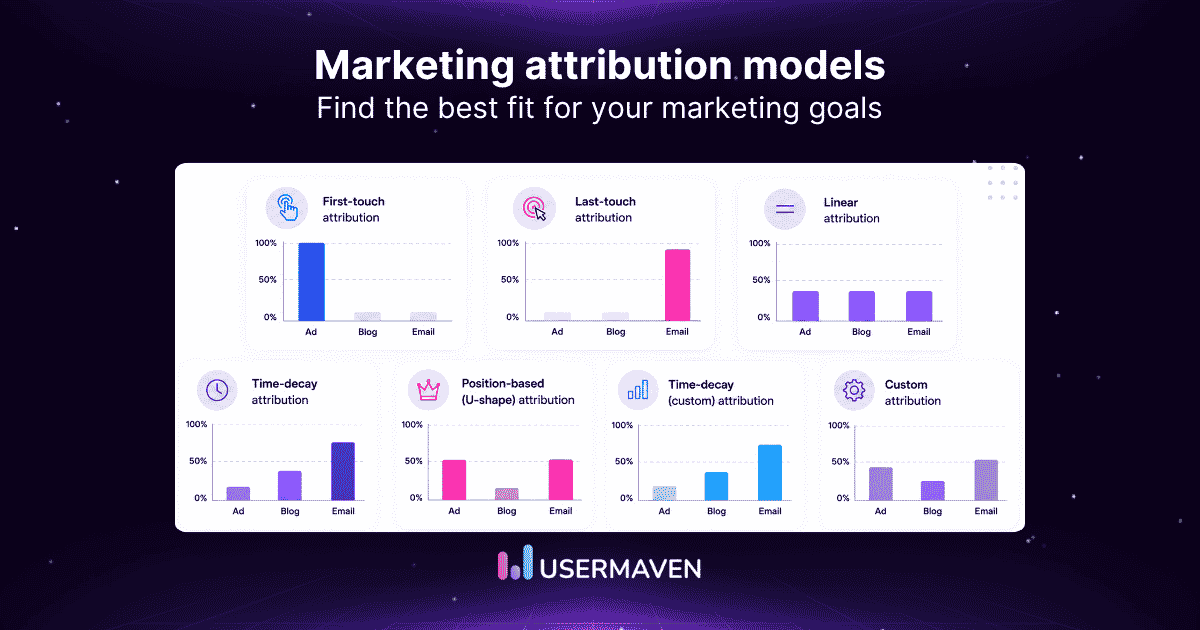
1. First-click attribution
First-click attribution gives 100% of the credit to the first recorded interaction. It is useful for identifying which channels introduce new prospects and create initial demand.
2. Last-click attribution
Last-click attribution gives all credit to the final recorded interaction before the lead or conversion. It is simple to explain and useful for studying closing touchpoints.
3. Linear attribution
A linear attribution model divides credit equally across every eligible interaction. It gives a balanced multi-touch view when several channels contribute to the journey.
4. Time-decay attribution
Time-decay attribution gives progressively more credit to interactions closer to lead conversion. It suits journeys where recent nurture or sales activity is expected to carry more influence.
5. U-shaped attribution
U-shaped attribution emphasizes the first interaction and the lead-conversion touchpoint. It is especially relevant when discovery and lead creation are the two milestones marketing wants to value most.
6. W-shaped attribution
W-shaped attribution adds substantial credit to opportunity creation as well as discovery and lead creation. That makes it particularly useful for B2B funnels with clear CRM stages.
7. Full-path attribution
Multi-touch attribution extends multi-touch logic across major CRM milestones such as first interaction, lead creation, opportunity creation, and closed revenue. It fits longer lead-to-revenue journeys with reliable stage tracking.
8. Data-driven attribution
Data-driven attribution uses observed journey patterns to estimate how eligible interactions contribute to conversion. It can adapt better than fixed rules when the underlying data is reliable.
9. Custom attribution
Custom attribution applies business-defined weights or rules. It is useful for mature teams that need attribution logic aligned with specific funnel stages, products, or revenue outcomes.
How to choose lead attribution software
Compare implementation, traffic or event limits, CRM requirements, analyst time, and add-ons alongside subscription price. Our guide to marketing attribution software cost explains how those pricing models differ.

Start with the final outcome
Decide whether the measurement should stop at a lead, qualified lead, opportunity, pipeline, customer, or revenue. Consistent sales lead tracking becomes more valuable as the business moves deeper into the funnel.
If marketing is accountable for pipeline, raw form volume is not enough. The platform should connect the lead with the stage or commercial outcome used to judge marketing performance.
Match the tool to your sales cycle
Short-cycle lead generation can often work with source tracking, calls, forms, and a smaller set of attribution views. Long B2B cycles need identity continuity, CRM integration, multi-touch journeys, account context, and revenue connection.
Check CRM depth
Do not ask only whether a tool “integrates with HubSpot.” Ask whether it can use lifecycle stage, deal value, opportunity status, Closed Won, and account context. The deeper marketing attribution CRM integration determines whether lead attribution can progress into pipeline and revenue.
Evaluate journey visibility
A good platform should preserve what happened before the form: source → landing page → content → return visit → form → demo. Customer journey analytics software becomes especially important when several interactions precede qualification.
Compare model flexibility
First-touch, last-touch, linear, time-decay, position-based, and custom models can answer different questions. More models are useful only when the underlying touchpoints, identity, and outcomes are trustworthy.
Check activation and feedback
The analysis becomes more valuable when it can influence action. Conversion syncs can return stronger first-party outcomes such as qualified leads, purchases, or customers to supported ad platforms so optimization is not based only on shallow conversions.
Validate data quality
Look for missing campaign data, identity mismatches, stale integrations, duplicate conversions, and broken CRM outcomes. An attribution checklist helps teams test the measurement foundation before debating which model deserves more credit.
Lead volume vs. lead quality
Lead attribution becomes most useful when it changes which campaign you would choose. The same campaigns can look completely different depending on whether you measure lead cost, opportunity creation, pipeline, or revenue.
Campaign A generates 100 leads at a $40 CPL, but only three opportunities and $15,000 in pipeline. Campaign B generates 50 leads at a $70 CPL, but creates 15 opportunities and $90,000 in pipeline.
If the dashboard stops at CPL, Campaign A wins. If the team measures qualified lead rate, opportunity rate, and pipeline, Campaign B is clearly stronger.
Metrics to compare beyond raw lead volume
| Stage | Metric | What it answers |
| Acquisition | Lead volume | Which sources create leads? |
| Acquisition | CPL | What does each lead cost? |
| Quality | Qualified lead rate | Which sources create useful leads? |
| Quality | Cost per qualified lead | Which channels acquire quality efficiently? |
| Funnel | Lead → opportunity rate | Which leads become pipeline? |
| Funnel | Time to opportunity | Which sources progress fastest? |
| Pipeline | Pipeline by source | Which channels create commercial value? |
| Pipeline | Pipeline velocity | Which sources move fastest? |
| Revenue | Revenue per lead | What is each acquired lead worth? |
| Revenue | Closed-won revenue | Which campaigns create customers? |
| Efficiency | CAC | What does customer acquisition actually cost? |
| Attribution | Attributed revenue | Which touchpoints receive commercial credit? |
A broader guide to marketing attribution metrics explains how pipeline, CAC, LTV, assisted conversions, and model-dependent credit fit into the wider measurement framework.
The same principle applies to revenue attribution: the campaign that creates the most leads is not automatically the campaign that creates the most revenue or the best customers.
See Usermaven in action
Book a free demo and discover how powerful analytics can grow your business.
Common lead attribution mistakes to avoid
The wrong software is not the only reason lead attribution fails. Most bad decisions start with unclear outcomes, disconnected data, or attribution rules that are applied before the measurement foundation is ready.
1. Defining success as any lead
A form submission is not automatically a qualified lead. Define the stage that marketing should optimize for, who owns that status, and which rejected, duplicate, or low-quality leads should be excluded.
2. Treating source as attribution
A CRM source field tells you where a lead was recorded as coming from; it does not explain every interaction that influenced the journey. Source attribution is useful, but it should not be confused with full multi-touch analysis.
3. Comparing models before fixing tracking
Changing credit rules cannot repair missing campaign parameters, duplicate events, broken forms, or incorrect revenue values. Validate conversion tracking before debating whether first-touch or multi-touch attribution gives the better story.
4. Stopping at the handoff to sales
A campaign can generate many leads and still create little pipeline. Keep the journey connected through qualification, opportunity, Closed Won, and revenue whenever those outcomes are available.
5. Letting every platform be the truth
Meta, Google, analytics, and CRM reports can all use different scopes and credit rules. Establish a single source of truth for the final commercial outcome, then use attribution to explain contribution around it.
6. Adding AI before connecting the data
AI can surface patterns quickly, but it cannot invent missing CRM stages or repair fragmented identity. Lead-quality questions become useful only when campaign, behavior, CRM, pipeline, and revenue data are connected well enough to support the answer.
Which lead attribution software should you choose?
Use the final business outcome and sales process to narrow the list. The following choices map directly to the most common buying situations.
- Best overall for SaaS and B2B: Usermaven
- Best for paid acquisition: Cometly
- Best for enterprise B2B journeys: HockeyStack
- Best for account-based B2B: Dreamdata
- Best for forms, calls, and offline revenue: Ruler Analytics
- Best for call-heavy lead generation: WhatConverts
- Best for CRM-native teams: HubSpot Marketing Hub
- Best for model flexibility: Attribution
- Best for enterprise Marketo stacks: Adobe Marketo Measure
- Best for direct-response funnels: Hyros
When two tools look strong, compare them at the stage that determines success. A form-attribution specialist may be less valuable if your team is judged on pipeline, while an enterprise account platform may be excessive for a short sales cycle.
Final verdict
The best lead attribution software depends on where the business needs attribution to stop: lead, qualified lead, opportunity, pipeline, customer, or revenue.
For B2B and SaaS, prioritize journey continuity, identity, CRM depth, pipeline, and revenue over raw source reporting. Those capabilities reveal whether low-cost leads actually become high-value customers.
Usermaven is the best overall fit for teams that want acquisition, customer behavior, CRM outcomes, revenue attribution, measurement validation, and AI analysis in one marketing attribution software workflow.
Ready to see Usermaven in action? Explore the platform or book a demo for a closer look.
Unlock insights that drive growth
FAQs
1. What is the best lead attribution software?
Usermaven is the best overall choice for SaaS and B2B teams that want to connect acquisition, customer behavior, CRM stages, pipeline, and revenue. Cometly is strong for paid acquisition, HockeyStack and Dreamdata for complex B2B journeys, Ruler Analytics and WhatConverts for call-heavy lead generation, and HubSpot for CRM-native teams.
2. What does lead attribution software do?
Lead attribution software tracks the marketing interactions that create or influence leads and connects those interactions with known contacts, CRM stages, opportunities, pipeline, and revenue. It helps teams identify which sources create valuable leads rather than only the most form submissions.
3. How is lead attribution software different from CRM software?
A CRM primarily manages contacts, companies, lifecycle stages, opportunities, and sales activity. Lead attribution software connects marketing touchpoints and customer journeys with those CRM outcomes so marketing can understand contribution and allocate budget.
4. What is the best lead attribution software for B2B?
The strongest B2B option depends on journey complexity. Usermaven is a strong overall fit for SaaS and B2B, HockeyStack for enterprise GTM intelligence, Dreamdata for account-based attribution, and Adobe Marketo Measure for mature enterprise Marketo stacks.
5. Can lead attribution software track pipeline and revenue?
Yes, when the platform connects marketing touchpoints with CRM opportunity stages and revenue data. That allows teams to compare channels using lead-to-opportunity rate, pipeline by source, Closed Won revenue, CAC, and attributed revenue.
6. Which attribution model is best for lead generation?
Updated

Written by
Adeel Khan
Growth Marketing Expert
Adeel Khan is a full-stack SaaS marketer with 10+ years of experience in content marketing, paid advertising, analytics, and conversion rate optimization. He shares practical insights and strategies drawn from hands-on experience, helping B2B SaaS marketers improve performance and make better marketing decisions.
All articles by Adeel →