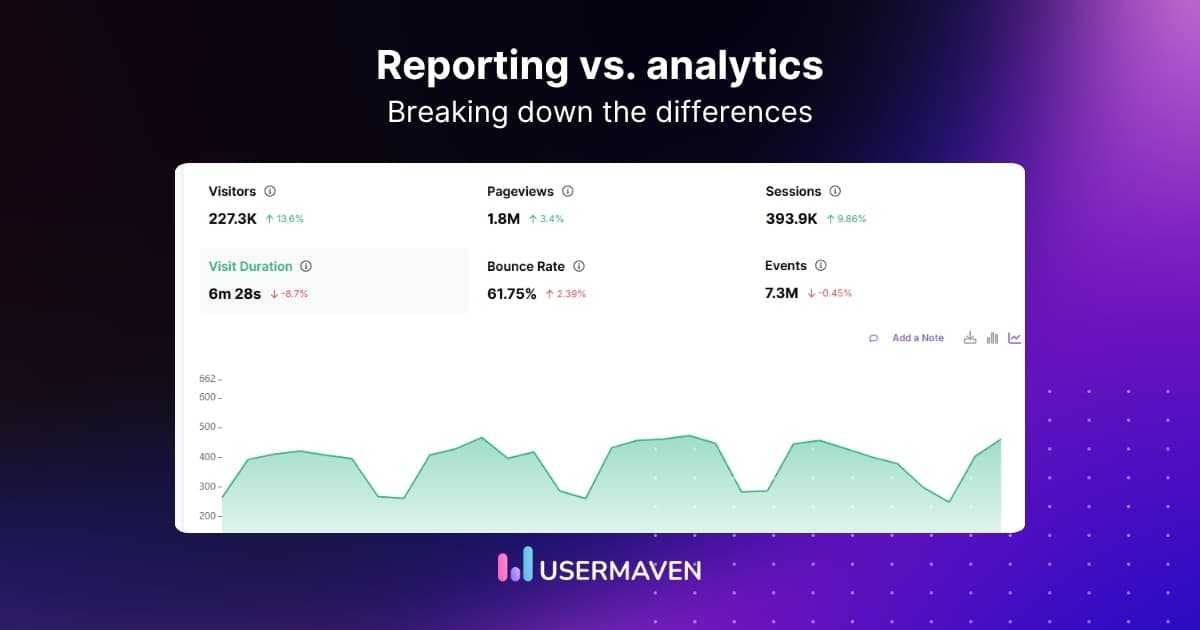
A marketing lead pulls up the analytics dashboard. 40,000 sessions this month. A 2.8% conversion rate. Bounce rate holding steady. Everything looks healthy.
Then the CFO asks one question: which channel actually drove the $180,000 deal that closed last week? The dashboard has no answer.
That is the exact moment analytics stops being enough. It is also exactly where marketing attribution becomes the tool that can answer it. The two disciplines get confused constantly, often used as if they mean the same thing. They do not.
This guide covers analytics vs. attribution, what each one actually measures, the technical mechanics that separate them, the common types of each, how AI is changing both, and when you need one, the other, or both working together.
Key takeaways
- Marketing analytics tells you what happened across your website, product, and campaigns. Marketing attribution tells you which specific touchpoint deserves credit for a conversion or revenue outcome.
- The two disciplines rely on different technical mechanics: analytics uses session and event tracking, attribution requires identity resolution across sessions plus a defined attribution window and a credit model.
- Marketing analytics commonly breaks into four types: descriptive, diagnostic, predictive, and prescriptive.
- Marketing attribution does not have one universal four-type framework. It spans single-toucs, multi-toucs, and algorithmic models.
- AI has shifted both disciplines from reactive reporting toward predictive and automated credit assignment, but most teams still need both analytics and attribution working together, not one replacing the other.
What is marketing analytics?
Marketing analytics is the practice of collecting and analyzing behavioral data across a website, product, and campaigns to understand how users engage, where they drop off, and what drives on-site or in-product activity.

What marketing analytics measures
At its core, marketing analytics tracks how users behave at every touchpoint with your website, product, and campaigns, from the moment they land on a page to the actions they take once there.
Important marketing analytics metrics
- Sessions: total visits to your site or product, broken down by source, device, or time period
- Page views: which pages users visit and how often, revealing content and product areas driving the most engagement.
- Bounce rate: the percentage of visitors who leave without taking further action, a key signal of relevance and first impression
- Time on page: how long users engage with specific content before leaving or converting
- Scroll depth: how far down a page users actually read before losing interest or leaving
- Funnel drop-off rate: where in a multi-step process, such as signup or checkout, users abandon before completing it
- Feature usage: which specific product features are being adopted, ignored, or abandoned
Why marketing analytics matters
- It reveals exactly where users are engaging and where they are dropping off, without which optimization decisions are just guesses
- It gives product and UX teams the visibility needed to identify friction points before they cost conversions or retention
- It provides the behavioral foundation that every other measurement layer, including attribution, ultimately depends on
- It surfaces patterns across devices, channels, and content that inform what to build, fix, or promote next
Types of marketing analytics
Marketing analytics is commonly organized into four types:
- Descriptive analytics summarises what already happened, such as sessions last month or top-performing content last quarter
- Diagnostic analytics explains why something happened, like a conversion rate drop in a specific week
- Predictive analytics forecasts what is likely to happen next based on historical patterns
- Prescriptive analytics goes furthest, recommending specific actions to take based on those patterns rather than just describing them.
What is marketing attribution?
Marketing attribution is the process of assigning conversion or revenue credit to the specific marketing touchpoints a customer interacted with before converting.
What marketing attribution measures
It measures which channel, campaign, or touchpoint contributed to a conversion and how much credit each gets by connecting ad spend, behavioral, and CRM revenue data.

Why marketing attribution matters
- Reveals which channels actually drive revenue, not just traffic or clicks
- Prevents budget waste caused by ad platforms double-counting the same conversion
- Connects marketing spend directly to pipeline and closed revenue
- Gives leadership and finance a defensible way to measure marketing ROI
Types of marketing attribution
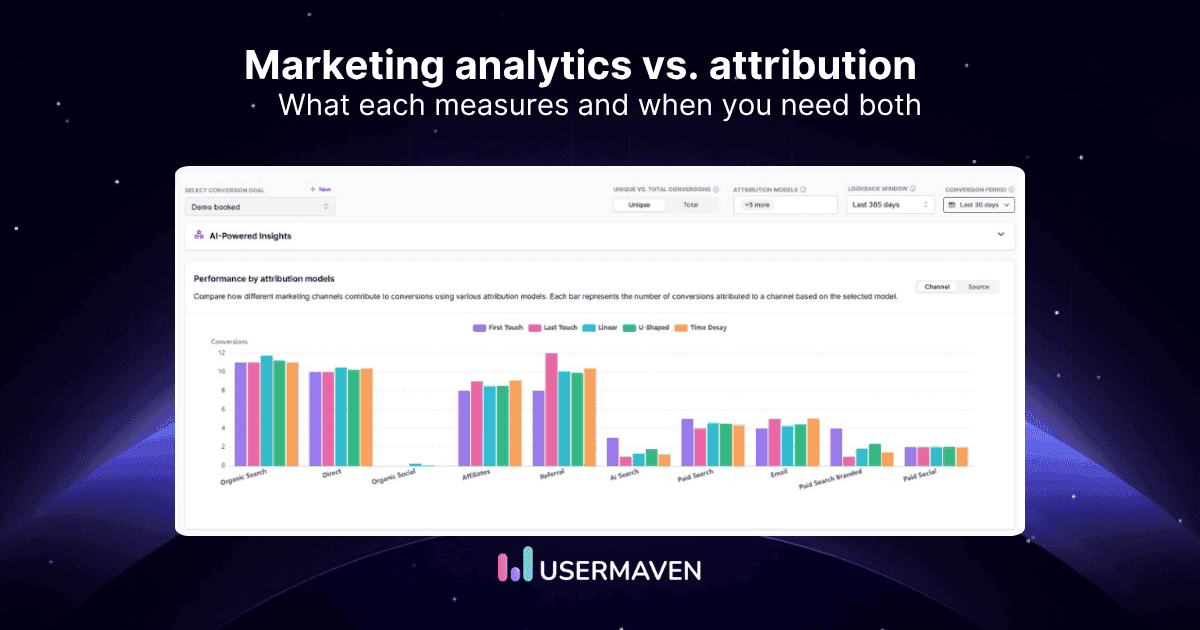
Attribution spans three categories of models.
Single-touch models
- First-touch attribution gives 100% credit to the very first interaction in the customer journey.
- Last-touch attribution gives 100% credit to the final interaction before conversion.
Multi-touch models
- Linear attribution splits credit equally across every touchpoint in the journey.
- Time-decay attribution gives more credit to touchpoints closer to the conversion event.
- Position-based attribution weights the first and last touch most heavily, with the remainder split across the middle.
Algorithmic models
Data-driven attribution uses machine learning to assign credit based on actual contribution patterns rather than a fixed rule, and, more broadly, marketing attribution models determine exactly how that credit is distributed across each touchpoint in the journey.
Important attribution metrics
- Conversion rate by touchpoint: the percentage of interactions at each specific touchpoint that lead to a conversion, revealing which stages of the customer journey are actually converting versus just generating activity
- Return on ad spend (ROAS): revenue generated per dollar of ad spend, the core metric for evaluating whether a channel is worth continued investment.
- Customer acquisition cost (CAC): the total cost of acquiring a customer through a specific channel, including both media spend and associated costs
- Cost per acquisition (CPA): the cost of driving one conversion event through a specific channel or campaign, a narrower and more immediate metric than CAC
- Customer lifetime value (CLTV): the total revenue a customer generates over their entire relationship with the business, essential for judging whether a cheap acquisition channel is actually profitable long-term, covered in depth in the guide to calculating SaaS LTV
- Time to conversion: how long it takes a customer to convert after their first touchpoint, useful for setting realistic attribution windows and sales cycle expectations
- Incremental lift: the additional conversions or revenue directly caused by a specific channel or campaign, isolating true impact from activity that would have happened anyway
The ad platform discrepancies guide shows why several of these numbers, particularly ROAS and CPA, often conflict across platforms reporting on the same campaign.
Marketing analytics vs. attribution: What’s the real difference?
The conceptual difference is simple to state. The real difference, and the outcome each one actually creates for a business, only becomes clear once you go through the specific dimensions where they diverge.
| Dimension | Marketing Analytics | Marketing Attribution |
| Purpose | Understand behavior and improve experience | Understand revenue impact and improve budget allocation |
| Data collected | On-site and in-product behavioral events | Ad spend, touchpoints, and CRM revenue data |
| Questions answered | What happened? What are users doing? | Which touchpoint deserves credit for this outcome? |
| Metrics | Sessions, bounce rate, time on page, scroll depth | Attributed revenue, cost per acquisition, credit by channel |
| Outputs | Behavioral reports, trends, and funnel visualizations | Credit distribution, channel ROI, and revenue reports |
| Common tools | GA4, product analytics platforms | Attribution and revenue platforms |
| Revenue measurement | Not measured directly, inferred at best | Measured directly by design, the core output |
| Customer journey | Shows what happened at each touchpoint | Shows how touchpoints connect and contribute together |
| Identity resolution | Session or single device scoped, rarely cross-session | Must resolve the same user across sessions, devices, and days |
| Attribution windows | No equivalent concept | Central mechanic, changes which channel gets credit |
| CRM integration | Rarely connected to CRM or revenue systems | Requires CRM integration to close the loop to revenue |
| AI capabilities | Predictive forecasting and anomaly detection | Data-driven credit modeling and channel recommendation |
| Decision making | Supports UX, content, and product decisions | Supports budget, channel, and investment decisions |
| Reporting | Reports on engagement and activity trends | Reports on ROI and revenue contribution by source |
| Stakeholders | Product, UX, content, and growth teams | Marketing leadership, finance, and revenue teams |
| Business outcomes | Better experience, higher engagement, fewer drop-offs |
Let’s look at how the two differ on several points.
Purpose
Analytics exists to help teams understand and improve experience. Attribution helps teams understand and improve return on marketing spend.
Confusing the two shows up fast: teams optimizing only for engagement can improve every on-site metric while still funding the wrong channels, because a better experience does not automatically mean the traffic arriving at it was worth the spend.
Data collected
Analytics captures behavioral events generated on-site or in-product. Attribution stitches that same behavioral data to ad platform spend and CRM revenue records.
Analytics alone can describe what a user did in detail, but it cannot put a dollar value on it; that requires the additional data layers that attribution connects to.
Questions answered
Analytics answers what happened. Attribution answers which touchpoint deserves credit for what happened.
Teams frequently try to answer a revenue question using an analytics tool, for example using bounce rate to argue a channel is underperforming, when bounce rate has no direct relationship to revenue.

Metrics
Analytics reports on sessions, bounce rate, time on page, and scroll depth. Attribution reports on attributed revenue, cost per acquisition, and credit distribution by channel.
Reporting the wrong metric to the wrong audience is costly; a CFO asking which channel drove a deal does not want a session count, and a product manager improving onboarding does not need channel-level ROAS.
Outputs
Analytics produces behavioral reports, trend lines, and funnel visualizations. Attribution produces credit distribution models and channel-level ROI reports.
The output format determines who can use the report: a funnel visualization is a product team tool, a channel ROI report is a budget conversation tool, and swapping them wastes both.
Revenue measurement
Analytics does not measure revenue directly; at best it can infer a rough relationship between behavior and outcomes. Attribution measures revenue directly; that is its core function.
Relying on analytics alone for revenue questions means every conclusion about financial performance is an inference, not a measurement, a materially weaker basis for a budget decision.
Customer journey
Analytics shows what happened during each touchpoint in isolation. Attribution shows how those touchpoints connect and contribute together toward a single outcome.
Without attribution, a team sees disconnected islands of activity rather than the throughline that led to a conversion, making it easy to misjudge which touchpoint mattered most.
Identity resolution
Analytics typically reports within a single session or a loosely connected user ID scoped to one device or browser. Attribution must resolve the same user across multiple sessions, devices, and days to reconstruct the full sequence of touchpoints leading up to a conversion.
This is significantly harder as browser privacy restrictions tighten. The full breakdown of how this resolution works without third-party cookies is in the guide to cookieless tracking.
Without reliable identity resolution, attribution systematically undercounts touchpoints that happened days or weeks before a conversion, making early-funnel channels look weaker than they actually are.
CRM integration
Analytics is rarely connected to CRM or revenue systems; it typically stops at the point of an on-site conversion event. Attribution requires CRM integration to close the loop from that event to actual closed revenue or deal size.
This matters most in B2B contexts, where a lead converting on a website is not the same as that lead becoming a closed, revenue-generating customer weeks or months later.
AI capabilities
On the analytics side, AI has moved capability toward predictive forecasting and automated anomaly detection. On the attribution side, AI has shifted capabilities toward data-driven credit modeling and channel-level recommendations.
Conflating the two leads teams to expect the wrong thing: an analytics tool with AI forecasting still cannot tell you which channel to defund, and an attribution tool with AI credit modeling still cannot tell you why a page is losing visitors.
Decision making
Analytics supports UX, content, and product decisions. Attribution supports budget, channel, and investment decisions.
Using analytics data to justify a budget reallocation is a common mistake precisely because analytics was never built to answer that question; it can tell you a page is underperforming, not whether the channel sending traffic to it deserves more spend.
Reporting
Analytics reports focus on engagement and activity trends over time. Attribution reports focus on ROI and revenue contribution by source.
These are built for different meetings; an engagement trend report belongs in a product review, a revenue-by-channel report belongs in a budget review, and presenting the wrong one undermines the argument being made.
Stakeholders
Analytics is primarily used by product, UX, content, and growth teams. Attribution is primarily used by marketing leadership, finance, and revenue teams.
Sending the wrong report to the wrong stakeholder either overwhelms them with detail they cannot act on, or leaves out the one number they actually needed.
Data sources and technical mechanics
Analytics is generally limited to on-site or in-product behavioral data alone. Attribution requires connecting three separate data layers simultaneously: ad platform spend data, website or product behavioral data, and CRM or revenue data.
The underlying event data typically needs to move through more reliable channels to do this well. Read the full guide to cross-platform ad tracking to see how these sources are reconciled, and to server-side tracking to see how the connection is made more reliably than client-side methods allow.
Analytics does not assign credit; it reports what happened. Attribution requires an actual model, rule-based or the algorithmic data-driven approach covered earlier in this guide, to calculate how credit gets distributed.
Without this connected, reliably collected data, attribution has nothing accurate to compute credit from in the first place.
Business outcomes
Analytics, applied well, produces a better experience, higher engagement, and fewer drop-offs. Attribution, applied well, produces smarter budget allocation and measurably higher marketing ROI.
One discipline improves the product and site; the other makes marketing spend more effective. Most growth-stage companies need both outcomes simultaneously, not one traded off against the other.
Why GA4’s built-in attribution isn’t full attribution
GA4 now offers a data-driven attribution model, which seems to solve the problem. It does not, at least not fully.
GA4’s own session data still binds GA4’s model. It does not include CRM revenue, and it cannot reconcile true cross-platform ad spend as a dedicated attribution layer can. See the guide to Google Analytics limitations for the full picture.
According to Google Analytics Help documentation on attribution, GA4’s attribution models operate within the scope of Google Ads and Analytics-linked data, which, by definition, excludes revenue events occurring outside that ecosystem.
Having analytics and attribution live in separate disconnected systems, as one of the leading barriers to marketing teams proving ROI to leadership.
When to use analytics vs. when to use attribution
The practical decision is simpler than the technical explanation makes it sound. It comes down to which question you are actually trying to answer.
Reach for analytics when optimizing a specific page or flow, diagnosing where users drop off, understanding feature adoption, or improving the on-site and in-product experience.
Reach for attribution when: allocating budget across channels, evaluating channel ROI, reporting revenue impact to finance or leadership, or deciding which campaigns to scale or cut.
In practice, most teams need both running simultaneously rather than choosing one. Overview the guide to conversion tracking for how goal events bridge both disciplines by feeding clean data into each.
Drive business growth
with AI-powered analytics
How analytics and attribution work together
The clearest way to see how these disciplines complement each other is through real scenarios where relying on only one leaves a gap.
SaaS scenario: A user signs up through a paid search campaign but does not activate until several days later, after completing a specific onboarding flow. Analytics shows exactly what happened during that onboarding flow and where similar users tend to drop off.
Attribution shows which channel and campaign brought that user in, connecting the eventual activation and revenue back to the original spend.
Ecommerce scenario: A buyer clicks a Meta ad, opens a follow-up email two days later, returns through a branded Google search, then purchases a week after the first touch. Attribution shows revenue contribution distributed across all four touchpoints.
Analytics shows what happened on-site during each visit, including which pages were viewed and where hesitation occurred before the final purchase.
Neither discipline alone tells the complete story in either scenario. For a full explanation, see ecommerce performance analytics to understand how this plays out specifically for online stores, and how to calculate ROI by connecting these combined insights to a defensible ROI figure.
How AI is changing both analytics and attribution
Both scenarios above already depend on AI more than most teams realize. Forecasting when a SaaS user is likely to activate, or reconciling which of four ecommerce touchpoints mattered most, are exactly the kinds of problems AI has changed the shape of on both sides of this stack.
On the analytics side, the shift has moved from purely descriptive reporting to predictive forecasting and automated anomaly detection, flagging a drop in conversion rate before a human notices it in a weekly review.
On the attribution side, data-driven and machine-learning-based credit assignment has moved from an advanced option to the practical default, replacing fixed, rule-based models that were never built to reflect how customers actually behave.
A new blind spot has emerged alongside this progress.
Buyers increasingly research through ChatGPT, Gemini, and AI Overviews before ever landing on a website. Traditional analytics cannot see that pre-visit research phase at all, and traditional attribution cannot assign credit to a touchpoint it never captured in the first place.
This is a genuine, currently unresolved gap, not a hypothetical one. AI-driven research conducted before a session even begins is, at the time of writing, not reliably attributable to any specific marketing channel or attribution model.
One honest caution worth adding here: a tool labeling itself AI-powered does not automatically mean it does more than before. An analytics tool with an AI chatbot layered on top is still analytics. It answers behavioral questions faster, but it has not become attribution simply because a natural-language interface was added.
How to build a modern marketing measurement stack
Most marketing measurement failures are not tool failures; they are stack failures. Data moves through eight layers before it becomes a decision, and a gap at any single layer breaks everything downstream.
Traffic
The raw input layer, sessions arriving from paid search, paid social, organic, referral, or direct.
Tracking
Captures page views, clicks, and conversion events, increasingly through first-party, server-side collection rather than client-side pixels alone.
Analytics
Organizes tracked data into behavioral reports, sessions, bounce rate, and funnel drop-off, but stops short of connecting behavior to revenue.
CRM
Turns on-site conversions into pipeline and closed revenue records, the layer where most stacks break down.
Attribution
Connects tracking, analytics, and CRM, assigning revenue credit to the channels and touchpoints that actually drove a conversion.
Revenue
Expresses attributed credit in actual currency, revenue by channel, cost per acquisition, and true return on ad spend.
AI
Sits across the stack, forecasting at the analytics layer and calculating credit distribution at the attribution layer.
Decision making
The output every layer exists to produce: budget, channel, and product decisions traced back to a number, not a hunch.
How Usermaven combines analytics and attribution in one platform

Usermaven is an AI-powered marketing attribution platform that connects ad platforms, CRM, and website data to track the full customer journey in real time using first-party and server-side tracking.
Most teams run separate analytics and attribution tools that were never built to talk to each other. Here’s how Usermaven closes that gap.
Unified behavioral and revenue data: One dashboard replaces the manual reconciliation most teams perform in a spreadsheet each reporting cycle, providing a single source of truth.
Website analytics software captures the full behavioral picture, sessions, engagement, and funnel performance, using a first-party pixel that bypasses most ad blockers.
Multi-touch attribution models: Connects that same behavioral data to ad spend and CRM revenue, applying seven attribution models side by side without requiring a second tool.
Maven AI: Answers analytics and attribution questions from one dataset, like which page has the highest drop-off among users acquired through paid search.
Customer acquisition visibility: Surfaces which channels drive the highest-lifetime-value customers, not just the cheapest clicks.
Start your free trial to see analytics and attribution working from one platform instead of two disconnected tools.
Drive business growth
with AI-powered analytics
Conclusion
Marketing analytics and attribution answer two different questions:
- Analytics tells you what happened across your website and product
- Attribution tells you which channel and touchpoint actually deserves credit for the revenue that resulted
- Identity resolution, attribution windows, and credit computation are genuinely different mechanics, not two labels for the same tool.
- Most growth teams need both running together, not one in place of the other.
Ready to see Usermaven in action? Explore the platform or book a demo for a closer look.
FAQs
1. What is the difference between marketing analytics and marketing attribution?
Marketing analytics measures behavior, sessions, bounce rate, funnel drop-off, and engagement across a website or product. Marketing attribution measures revenue credit, connecting ad spend, behavioral data, and CRM revenue to determine which channel or touchpoint drove a conversion. Analytics answers what happened; attribution answers which channel deserves credit for it.
2. Is marketing attribution part of marketing analytics?
Not exactly. The two are related but distinct disciplines with different data requirements. Attribution relies on behavioral data as one input, but it also requires ad spend and CRM revenue data that standard analytics tools typically do not collect or integrate. Attribution is better understood as a separate layer built on top of analytics data rather than a subset of analytics itself.
3. Can marketing analytics work without attribution?
Yes, but with a real limitation. Analytics can fully describe on-site behavior, engagement, and drop-off without ever touching attribution. What it cannot do is tell you which marketing channel or campaign is responsible for the revenue that behavior eventually produced.
4. Can marketing attribution work without marketing analytics?
Technically yes, but it produces an incomplete picture. Attribution can tell you that a channel drove a conversion without explaining what happened during that user’s actual visit, why they hesitated, or where a similar user might drop off before converting. Most effective marketing measurement uses both together rather than attribution in isolation.
5. Which is more important: marketing analytics or attribution?
Neither is more important; they answer different questions for different decisions. Analytics is essential for improving experience and product performance. Attribution is essential for allocating budget and proving marketing ROI. Most growth-stage businesses need both to run simultaneously rather than prioritizing one over the other.
Updated

Written by
Junaid Ahmed
Content Writer & Digital Marketer
Junaid Ahmed is a content and copywriter with 3+ years of experience creating research-driven content across SaaS, B2B, ecommerce, and digital marketing. He specializes in turning complex topics into clear, practical content that helps marketers better understand their challenges, evaluate solutions, and make informed decisions. His work spans educational content, industry insights, and actionable marketing guides.
All articles by Junaid →