Last-click attribution gives 100% of conversion credit to the final eligible click before a customer converts. It is one of the simplest attribution rules to understand and one of the easiest to misuse.
The model is useful when the question is narrow: which click was closest to the conversion? It becomes misleading when that closing interaction is treated as proof of which channel created demand or deserves the entire marketing budget.
This guide explains the rule, examples, limits, current GA4 and Google Ads behavior, and how last click compares with broader attribution approaches. It also shows where advanced attribution software can add the wider journey around the final click.
Last-click attribution at a glance
Last click is best understood as a closing-stage lens rather than a complete theory of marketing impact. The table below summarizes the rule and the tradeoff.
| Point | At a glance |
|---|---|
| What it is | Single-touch attribution model |
| Credit rule | 100% to the final eligible click |
| Best use | Understanding the closing interaction |
| Main limitation | Earlier touchpoints receive 0% attribution credit |
| Direct answer: Last-click attribution assigns 100% of conversion credit to the final eligible click before conversion and 0% to every earlier touchpoint. |
Key takeaways
The calculation is simple, but platform rules determine which click actually wins. These are the most important points to keep in mind.
- Closing-stage lens: Last click answers which eligible click immediately preceded the conversion.
- Simple rule: The final eligible click receives 100% of credit; earlier touches receive 0%.
- Useful but narrow: It works well for short journeys and direct-response optimization.
- Search can be overcredited: Branded search often appears late in journeys created by other channels.
- Last-click vs last-touch attribution: The terms are commonly used interchangeably, but last-touch attribution can refer more broadly to the final eligible interaction.
- Google has evolved: GA4 and Google Ads still support last-click reporting, while data-driven attribution plays a larger role in current Google measurement.
What is last-click attribution?
Last-click attribution is a single-touch attribution model that gives all conversion credit to the final eligible click before a conversion. Earlier interactions can still exist in the measured journey, but they receive zero attribution credit under this model.

| Example journey: Meta → Email → Organic Search → Paid Search → Conversion |
Under last-click attribution, Paid Search receives 100% of the conversion credit. Meta, Email, and Organic Search receive 0%, even though they may have helped create the demand that Paid Search later captured.
This is why marketing attribution should distinguish between the rule used to allocate credit and the wider customer journey the analytics system actually observed.
How last-click attribution works
The weighting rule is simple, but a platform still has to determine which interaction qualifies as the final eligible click. Attribution windows, direct traffic, device changes, and missing campaign data can all alter that answer.
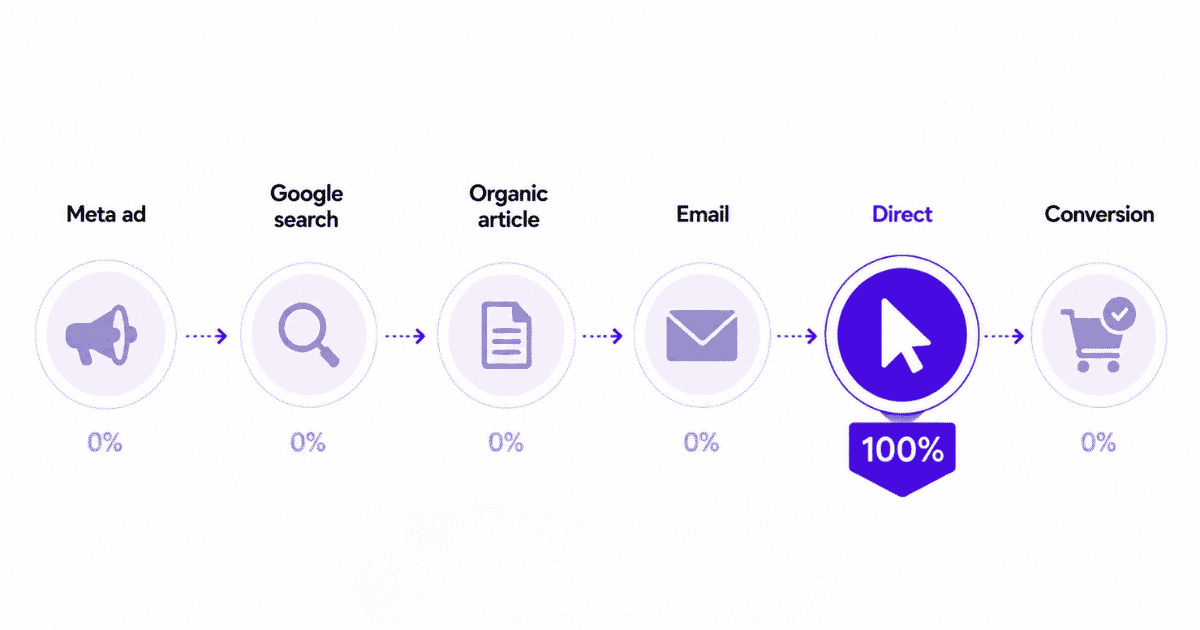
Track the journey
The measurement system records campaign and source interactions across the path to conversion. The journey can contain paid ads, organic visits, email clicks, referral traffic, content, or other eligible interactions.
Identify the conversion
A conversion can be a purchase, signup, demo request, qualified lead, opportunity, subscription, or revenue events. The model only becomes meaningful once the business has defined which outcome receives attribution.
Find the final eligible click
The platform looks backward from the conversion and identifies the last click that satisfies its attribution rules. An interaction outside the lookback window or excluded by the model cannot win.
Assign 100% of credit
The selected click receives the entire attributed conversion and revenue value. Every earlier eligible touchpoint receives zero credit under the model.
Last-click attribution formula
There is no weighted calculation across multiple interactions. Last click is a winner-takes-all rule once the final eligible click has been identified.
Conversion-credit rule
| Formula: Final eligible click = 100% credit |
| Earlier touches: Every previous interaction = 0% credit |
Revenue rule
| Formula: Attributed revenue to final eligible click = full conversion revenue |
| Touchpoint | Credit | Revenue on $1,000 conversion |
|---|---|---|
| Meta | 0% | $0 |
| 0% | $0 | |
| Organic Search | 0% | $0 |
| Paid Search | 100% | $1,000 |
Examples
These examples show how last-click attribution assigns revenue when the final touchpoint gets full credit. The model is easy to understand, but it can hide the role of earlier channels that introduced, educated, or nurtured the customer before conversion
Last-click attribution example for ecommerce
Ecommerce often makes the limitation visible because discovery and closing channels can be very different. Consider a $300 order with the following path.
| Journey: Meta ad → Email → Organic Search → Branded Google Search → Purchase |
Last click assigns the full $300 to Branded Google Search. Meta, Email, and Organic Search each receive $0 of attributed revenue.
The model correctly identifies branded search as the final eligible click. It does not establish that branded search independently created the order. That distinction matters when deciding whether to move budget away from the channels that introduced or nurtured the customer.
Last-click attribution example for B2B SaaS
The same effect becomes more pronounced in a longer B2B journey where multiple channels educate, retarget, and build trust before the final conversion.
| Journey: Organic article → LinkedIn ad → Webinar → Email → Branded Search → Demo → $20,000 Closed Won |
If Branded Search is the final eligible marketing click, last click attributes the entire $20,000 to Branded Search. The earlier content, LinkedIn, webinar, and email interactions receive no attributed revenue.
That can be useful for understanding which channel closed the measurable journey. It is a poor basis for deciding that the earlier demand-generation activity contributed nothing.
Last click vs last-touch attribution vs last non-direct
These terms are often blurred together, but the distinction matters when a platform defines eligibility differently. The safest approach is to check what the specific analytics product means by the label.
Last click
The final eligible click before conversion receives 100% of credit.
Last-touch attribution
The final eligible interaction receives 100%. In everyday marketing usage, last-click and last-touch attribution are often treated as synonyms, but last-touch attribution is technically broader because the final interaction does not always have to be a literal website click.
Last non-direct
Last non-direct attribution ignores a final Direct visit when an earlier known marketing source exists. This prevents Direct from replacing the most recent identifiable acquisition source.
| Model | What gets 100% credit |
|---|---|
| Last click | Final eligible click |
| Last touch | Final eligible interaction |
| Last non-direct | Final eligible non-direct source |
GA4’s current paid-and-organic last-click model follows this non-direct logic. Direct receives credit only when the path consists entirely of Direct traffic.
What counts as the last eligible click?
The credit rule is simple. Identifying the last eligible click is not. Small implementation choices can change which channel receives 100% of the conversion.

Attribution window
A click outside the permitted lookback period cannot receive credit. The attribution window therefore defines how far the platform is allowed to look backward from the conversion.
Direct traffic
Some last-click implementations credit Direct. Others look backward to the last known non-direct source. The difference can materially change reporting for returning customers.
Click vs view
A view-through interaction can still influence the journey without qualifying as the last click. Platforms that include engaged views or view-through logic can therefore report differently from click-only systems.
Cross-device identity
A mobile ad interaction followed by a desktop conversion can break the visible path if the user cannot be resolved across devices. The system may then credit a different final source.
Campaign tagging
Missing UTMs or click IDs can turn a genuine campaign interaction into Direct or unattributed traffic. Last click then awards 100% of credit to the wrong winner because the actual final click is missing.
Offline conversions
Calls, demos, opportunities, and sales need to reconnect to the earlier digital journey. Customer journey analytics software is useful when teams need to inspect what happened before the final credited interaction.
| Image brief: Last-click attribution flow. 1200×630. Show Meta → Email → Organic → Paid Search → Conversion, with 0% under the first three and 100% under Paid Search. Short alt text: Last-click attribution flow. |
Why last-click attribution overcredits search
Search often appears near the end of a journey because customers look for a brand, product, or solution after earlier marketing has already created awareness and intent. That makes search a natural closing channel.
| Journey: Meta ad → Content → Email → Podcast → Branded Search → Purchase |
Last click gives Branded Search 100% of the conversion. The model cannot tell whether the search created the demand or simply captured demand that already existed.
| Key distinction: Last-click attribution measures demand capture better than demand creation. |
This is why branded search, retargeting, closing email campaigns, affiliates, and other high-intent interactions can look disproportionately strong. The paid search attribution framework is more useful when teams need to understand search inside the wider path.
For journeys spanning several acquisition sources, cross-channel marketing attribution adds the context needed to separate a closing channel from the channels that introduced or nurtured the customer.
First-click vs last-click attribution
First click and last click use the same winner-takes-all structure but answer opposite questions. Comparing them is useful because it exposes how much the story changes when credit moves from discovery to closing.
| Journey: Organic article → LinkedIn → Email → Paid Search → Conversion |
| Model | 100% credit goes to | Question answered |
|---|---|---|
| First click | Organic article | What introduced the customer? |
| Last click | Paid Search | What closed the conversion? |
The first-click attribution view is acquisition-oriented, while last click is closing-oriented. A multi-touch attribution view is more useful when the goal is to keep several meaningful interactions visible.
Last click vs other attribution models
A useful comparison holds the journey constant and changes only the credit rule. This shows how much of the channel story depends on the model rather than the customer path itself.
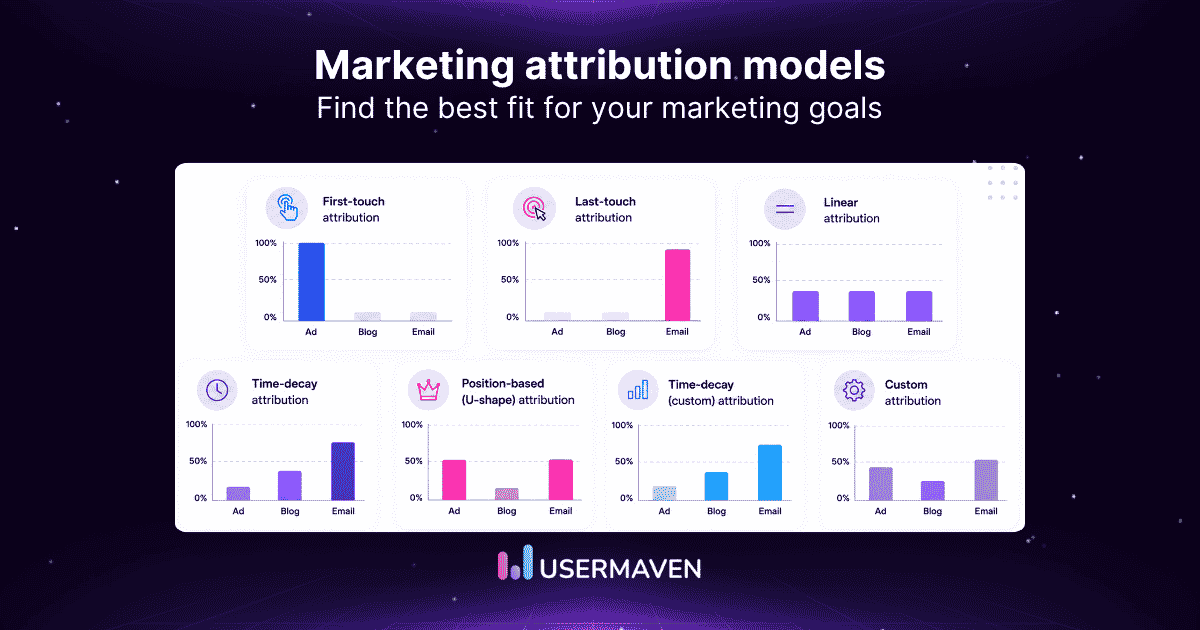
The broader marketing attribution models framework helps explain when a single-touch, multi-touch, recency-weighted, or data-driven approach better matches the reporting question.
| Journey: Organic → LinkedIn → Email → Paid Search → $1,000 conversion |
| Model | Credit behavior |
|---|---|
| Last click | Paid Search gets $1,000 |
| Linear | $250 to each touch |
| Time decay | More credit to later interactions |
| U-shaped | More credit to first and last positions |
| Data-driven | Credit estimated from observed path data |
The linear attribution model gives all eligible touches equal visibility. Time-decay attribution favors recent touches, while the U-shaped attribution model emphasizes selected positions.
Data-driven attribution uses observed data and algorithms to estimate contribution. It can provide a broader view than last click, but it still should not be interpreted as causal proof.
Advantages of last-click attribution
Last click remains widely used because its simplicity solves several practical reporting problems. Those strengths are real when the model is used for the question it actually answers.

Easy to understand
The final eligible click receives everything. There is no weighted formula or hidden allocation rule to explain.
Easy to reproduce
Two analysts using the same journey, conversion definition, and eligibility rules should reach the same result. That makes last click easy to audit.
Useful for closing-stage optimization
The model can answer tactical questions such as which keyword closed, which retargeting ad preceded purchase, or which email was closest to conversion.
Low data requirements
Last click does not require large conversion volumes or machine-learning inputs. It works even when data is too sparse for more complex models.
Fast reporting
Because the rule is deterministic, reports are straightforward to generate and interpret. That can be useful for direct-response campaign optimization.
Last-click reporting can still be practical where the operational question is which final click generated the lead. In high-intent categories such as PPC for lawyers, the closing-click view can help evaluate keywords and campaigns nearest to form submissions or calls, provided it is not mistaken for the full customer journey.
Limitations of last-click attribution
The problem begins when a closing-stage model is used as a complete explanation of marketing impact. Earlier interactions can remain important even when the model assigns them zero credit.
Earlier touchpoints receive zero credit
Content, social, display, email, webinars, and other assisting interactions can disappear from the attribution report even when they were necessary parts of the journey.

It overvalues demand capture
Branded search, retargeting, closing email, and late-stage affiliates can collect credit for customers whose intent was created elsewhere.
It undervalues awareness
Channels designed to create awareness often happen too early to receive last-click credit. Judging them only by final-click conversions can lead to systematic underinvestment.
Long journeys become oversimplified
Weeks or months of research can collapse into a single final click. The longer and more complex the buying process, the more information the model throws away.
Broken identity changes the winner
If the actual final marketing click is missing because of device changes, consent, tagging, or tracking gaps, another interaction receives all of the credit.
It does not establish causality
The click closest to conversion is not necessarily what caused the purchase. Attribution assigns credit; incrementality and experiments answer causal questions.
When should you use last-click attribution?
Last click works best when the conversion path is short or the business specifically wants a closing-stage operational view. It becomes weaker as more channels participate in creating demand.
| Situation | Fit | Why |
|---|---|---|
| Single-channel campaign | Strong | Little attribution ambiguity |
| Short purchase cycle | Strong | Few earlier meaningful touches |
| Direct-response PPC | Strong | Closing click is operationally useful |
| Retargeting optimization | Good | Measures conversion-closing behavior |
| Affiliate reporting | Conditional | Simple deterministic payout rule |
| Complex B2B journey | Weak | Earlier journey disappears |
| Brand + performance mix | Weak | Closing channels capture created demand |
| Full-funnel budget allocation | Weak | Favors late-stage channels |
| Incrementality analysis | Poor | Attribution is not causality |
When should you not use last click?
Avoid relying on last click as the primary budget model when the marketing system contains meaningful awareness, nurturing, or offline activity.
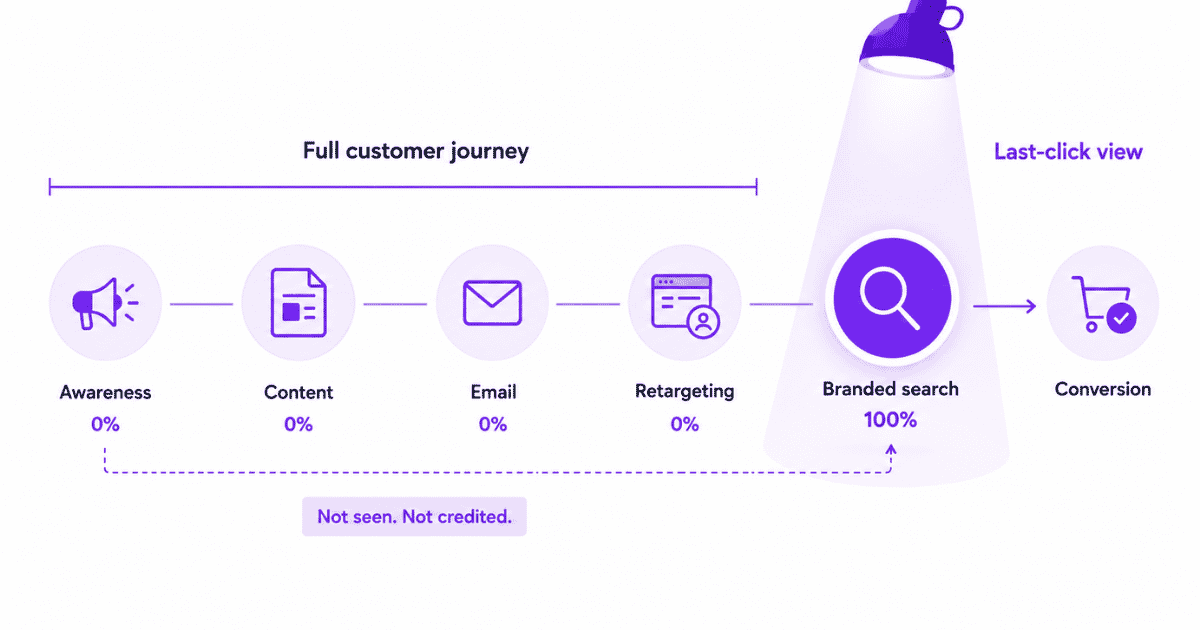
The more complex the journey, the less complete the final-click view becomes.
- Branded search: It can close journeys whose demand was created by other channels.
- Retargeting: Repeated late-stage ads can collect the final-click credit without creating the original demand.
- Content and SEO: These channels often create awareness or education but rarely appear as the closing click.
- Long B2B cycles: Weeks or months of meaningful activity can disappear behind one final interaction.
- Multi-stakeholder deals: Several people and channels may influence the purchase before the final click.
- Offline sales: Calls, demos, and salesperson interactions may be missing from the measurable path.
- Cross-device journeys: Identity breaks can change which interaction appears to be last.
- Full-funnel budgeting: Leadership needs more than closing-stage performance to allocate spend across awareness and demand capture.
- Incrementality questions: Last click allocates credit but does not measure causal lift.
What is non-last-click attribution?
Non-last-click attribution is any approach that does not give 100% of conversion credit solely to the final click. Historically that category included first click, linear, time decay, position-based, and data-driven models.
In current Google Ads, the practical native comparison is much narrower. Google no longer supports first click, linear, time decay, or position-based attribution, leaving data-driven attribution and last click as the supported model choices.
Does GA4 use last-click attribution?
Yes, but GA4 is not simply a last-click analytics platform. Current GA4 attribution supports data-driven reporting plus specific last-click variants, and the model shown can depend on the reporting context.
| GA4 context | What it represents |
|---|---|
| Key-event attribution | Configured data-driven or supported last-click model |
| Paid + organic last click | Final eligible non-direct marketing source |
| Google paid channels last click | Final eligible Google Ads channel |
| Session acquisition | Source that acquired the session |
| First-user acquisition | Source that originally acquired the user |
Google’s current GA4 attribution documentation states that paid-and-organic last click ignores Direct unless the entire path is Direct. It also notes that paid-and-organic last click and last non-direct click are two names for the same model.
The easiest GA4 alternative for marketers and product teams
*No credit card required
That distinction explains why different GA4 reports can tell different attribution stories. Session acquisition, first-user acquisition, and key-event attribution are not interchangeable views.
Does Google Ads use last-click attribution?
Yes. Google Ads still supports last click, but data-driven attribution is the current default for most conversion actions.
Google’s current attribution model documentation defines last click as giving all conversion credit to the last-clicked ad and corresponding keyword.
Google no longer supports first click, linear, time decay, or position-based attribution. The best attribution model for Google Ads therefore needs to be evaluated mainly as a choice between transparent last-click reporting and data-driven attribution.
Last click vs data-driven attribution
The current Google Ads comparison is especially important because both models answer the same conversion question with very different credit logic.
| Last click | Data driven |
|---|---|
| Fixed rule | Algorithmic allocation |
| Final click gets 100% | Credit can be distributed across interactions |
| Highly transparent | More complex to explain |
| Minimal data requirement | Benefits from richer observed data |
| Closing-stage lens | Broader contribution estimate |
Google Ads also provides a model-comparison report for comparing last click with data-driven attribution. This can reveal keywords, campaigns, or devices that look undervalued when only the final click receives credit.
Data-driven attribution is broader than last click, but it is still an attribution model. It should not be confused with incrementality or experimental proof of causality.
How attribution windows change last-click results
A last-click result depends on both sequence and eligibility. The winning click must fall inside the configured rules for the conversion.
| Example: Day 1: Meta → Day 10: Email → Day 20: Paid Search → Day 35: Conversion |
If Paid Search is still inside the eligible lookback window, it receives 100% of the credit. If that click falls outside the applicable window or is not captured, an earlier eligible interaction can become the winner.
This is why two systems can disagree even when both claim to use last click. They may apply different windows, identity rules, direct-traffic treatment, or conversion definitions.
The timing effect is not theoretical. In the ContentStudio case study, paid conversions often completed 7 to 14 days after the initial ad click, showing why conversion timing needs to match the real buying cycle.
How last-touch attribution works in Usermaven
Usermaven lets teams use last touch as one reporting lens without discarding the journey that happened before it. That makes the model useful for closing analysis without forcing it to become the only story.
Choose last-touch attribution
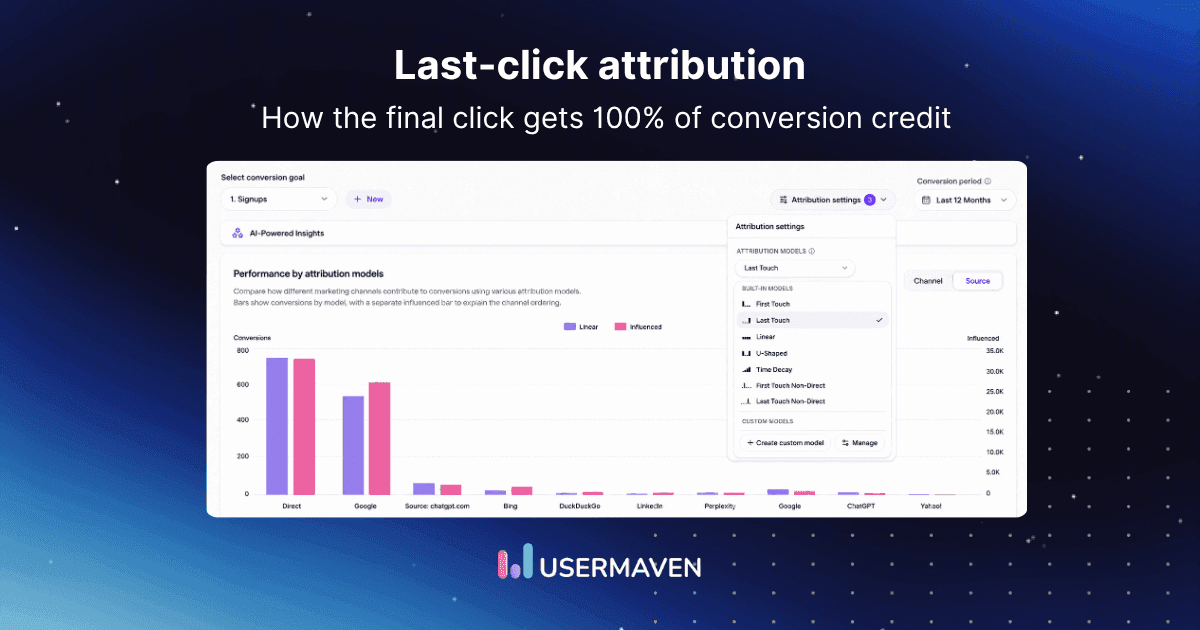
In Attribution settings, select Last Touch for the chosen conversion goal and reporting period. Usermaven then applies the closing-stage model to the channel or source view while keeping the underlying attribution dataset unchanged.

Usermaven supports First Touch, Last Touch, Linear, U-Shaped, Time Decay, First Touch Non-Direct, and Last Touch Non-Direct. Switching the model lets teams compare attribution perspectives without rebuilding the customer journey.
Identify the closing source
Last-touch attribution highlights the channel, source, campaign, or content interaction closest to the selected conversion. This gives teams a clean closing-stage view for tactical optimization.
Compare last touch with other models
The multi-touch attribution software workflow lets teams compare how the same conversion shifts under first touch, last touch, linear, U-shaped, time decay, and non-direct variants.
Review source-level credit
The source table below shows the same reporting layer with Linear selected, where conversions can be split into fractional credit across sources. Switching between Linear and Last Touch makes it easier to see which sources benefit from a closing-stage model and which contribute earlier in the journey.

Inspect the journey behind the winner
A report can say Paid Search receives 100% last-touch credit while the measured journey still contains Meta, content, email, and other earlier interactions. Usermaven’s conversion path analysis adds that sequence context behind the credited winner.
| Important distinction: Zero attribution credit does not mean zero observed involvement in the customer journey. |
Connect the final touch to revenue
For B2B, the outcome may be opportunity, pipeline, or Closed Won. For SaaS, it may be subscription or upgrade revenue. For ecommerce, it may be order value. The model should sit on top of the commercial outcome the business actually trusts.
Where AI helps last-click analysis
AI is useful when it explains why a channel looks strong under last click and whether that strength survives other attribution views. It should reduce investigation time rather than make the attribution decision automatically.
Compare closing and assisting channels
Maven AI can support questions such as:
- Which channels gain the most credit under last touch?
- Which channels lose the most credit compared with linear?
- Which sources start journeys that later close through branded search?
- Which retargeting campaigns appear disproportionately often as the final touch?
- Which campaigns remain strong across several attribution models?
- Which sources produce Closed Won revenue even when they rarely receive last-touch credit?
Explore from AI clients
Usermaven MCP can extend authorized attribution analysis into compatible AI clients, allowing technical teams to investigate journeys, models, funnels, and revenue without rebuilding each report manually.
Keep human judgment
AI cannot decide whether the final click created demand, whether a model represents causality, or which channel deserves the budget. Those remain measurement and business decisions.
Last-click attribution checklist
Before using last click for reporting or budget decisions, validate the inputs and the interpretation. A simple model can still produce a confident-looking answer from incomplete data.
- The final conversion is correctly defined.
- The attribution window matches the sales cycle.
- Direct-traffic handling is understood.
- UTMs and click IDs are intact.
- Cross-device identity limitations are considered.
- Offline conversions reconnect to the digital journey where possible.
- Branded search is not automatically interpreted as demand creation.
- Upper-funnel channels are evaluated with another lens.
- Last click is compared with at least one alternative model when the journey is multi-touch.
A structured attribution checklist helps teams validate conversion definitions, campaign data, identity, windows, and downstream revenue before a single-touch view becomes a budget decision.
Final verdict
Last-click attribution is not dead. It remains one of the simplest ways to identify the interaction closest to conversion and can be useful for short journeys, direct-response campaigns, and closing-stage optimization.
The problem is not the model itself. The problem is using a closing-stage model to make full-funnel conclusions about awareness, demand creation, or overall channel value.
Use last click for the question it answers well, then compare it with the wider customer journey and alternative attribution models before moving budget.
Ready to separate the channel that closes the conversion from the channels that helped create it? Compare attribution models in Usermaven with a free 14-day trial.
Drive business growth
with AI-powered analytics
*No credit card required
FAQs
1. What is last-click attribution?
Last-click attribution is a single-touch attribution model that gives 100% of conversion credit to the final eligible click before a conversion. Earlier interactions receive no attribution credit under the model.
2. How does last-click attribution work?
The platform identifies the conversion, looks backward through the eligible journey, finds the final qualifying click, and assigns that interaction 100% of the conversion and revenue credit.
3. What is the difference between last-click and last-touch attribution?
The terms are often used interchangeably. Last click refers specifically to the final eligible click, while last-touch attribution can refer more broadly to the final eligible interaction before conversion.
4. What is the difference between first-click and last-click attribution?
First click gives 100% of credit to the interaction that introduced the customer. Last click gives 100% to the final eligible click before conversion. They answer acquisition and closing questions respectively.
5. Why does last-click attribution overcredit search?
Search often appears late in the journey after other channels have created awareness or intent. Last click gives the final search interaction all the credit, so it cannot distinguish demand capture from demand creation.
6. What are the disadvantages of last-click attribution?
It gives earlier interactions zero credit, tends to favor closing channels such as branded search and retargeting, oversimplifies long journeys, and can change dramatically when identity or tracking data is missing.
7. What is non-last-click attribution?
Non-last-click attribution is any approach that does not give 100% of conversion credit solely to the final click. In current Google Ads, data-driven attribution is the main supported alternative to last click.
8. Does GA4 use last-click attribution?
GA4 supports paid-and-organic last click and Google paid channels last click, while data-driven attribution is also available for key-event reporting. GA4 is therefore not simply a last-click analytics platform.
9. Does Google Ads use last-click attribution?
Yes. Google Ads still supports last click, which gives all conversion credit to the last-clicked ad and corresponding keyword. Data-driven attribution is the current default for most conversion actions.

Written by
Adeel Khan
Growth Marketing Expert
Adeel Khan is a full-stack SaaS marketer with 10+ years of experience in content marketing, paid advertising, analytics, and conversion rate optimization. He shares practical insights and strategies drawn from hands-on experience, helping B2B SaaS marketers improve performance and make better marketing decisions.
All articles by Adeel →