A prospect sees a paid social ad, finds an organic article a week later, returns through email, searches the brand on Google, and finally converts from a direct visit.
A last-touch dashboard can make Direct look like the winner even though several channels helped create and develop the demand.
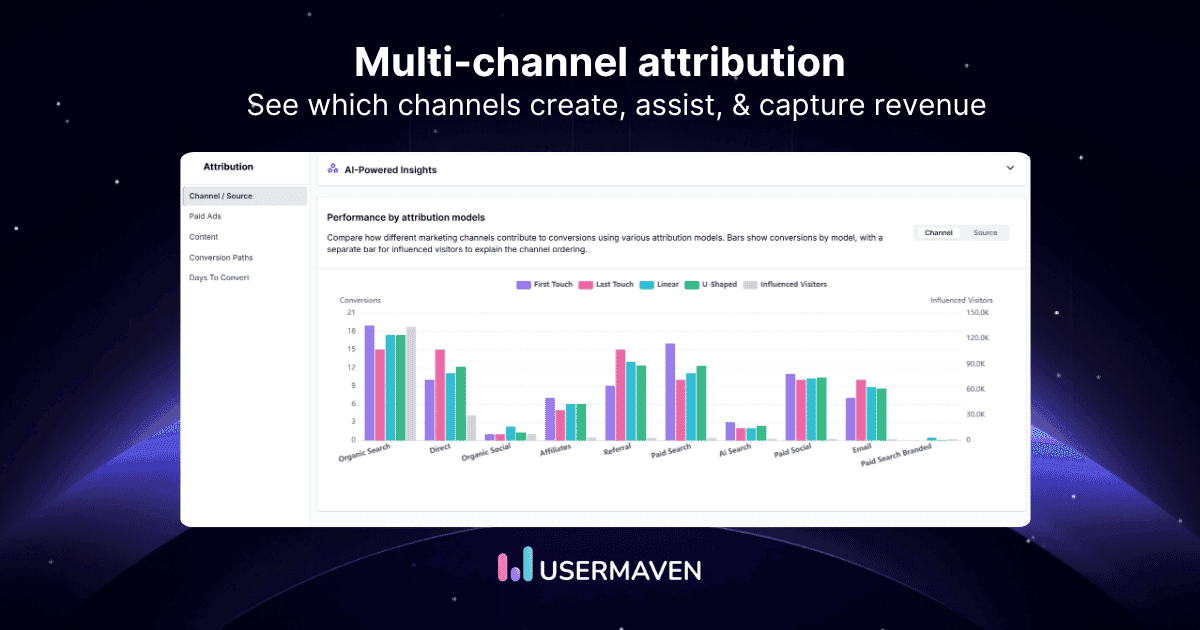
Multi-channel attribution measures how different marketing channels contribute to conversions and revenue so teams can understand channel roles and make better budget decisions.
Teams evaluating marketing attribution software should therefore look beyond the final click and connect channel credit with the commercial outcome that followed.
This guide explains multi channel attribution at the channel level, how models change the apparent winner, and what reliable reporting should contain.
It also shows how SaaS, B2B, and ecommerce teams can validate the underlying measurement and turn attribution into better budget decisions.
Multi-channel attribution at a glance
Multi-channel attribution is most useful when channel credit is connected with the business outcome the team is trying to improve. This summary separates the main measurement questions before the deeper implementation details.
| Question | Short answer | Why it matters |
|---|---|---|
| What does multi-channel attribution measure? | Conversion or revenue contribution across marketing channels | Shows which channels create, assist, re-engage, capture, or convert demand |
| What should teams optimize for? | Pipeline, revenue, retention, or LTV when possible | Prevents the final click from becoming the only budget signal |
| How is it different from multi-touch attribution? | Multi-channel compares channels; multi-touch analyzes individual interactions | Keeps channel budgeting separate from touchpoint-level journey analysis |
| What makes the data trustworthy? | Consistent UTMs, events, identity, windows, and revenue reconciliation | Reduces the risk of moving budget because of broken measurement |
| What can attribution not prove? | Causal lift | Incrementality is needed to estimate what happened because marketing occurred |
The rest of the guide shows how to build that channel-level view without confusing credited contribution with total business impact.
Key takeaways
- Channel credit is not channel value: A channel can create, assist, re-engage, capture, or convert demand, so the final click is only one role in the journey.
- Multi-channel and multi-touch are different: Multi-channel attribution compares contribution at the channel level; multi-touch attribution goes deeper into the individual interactions inside and across those channels.
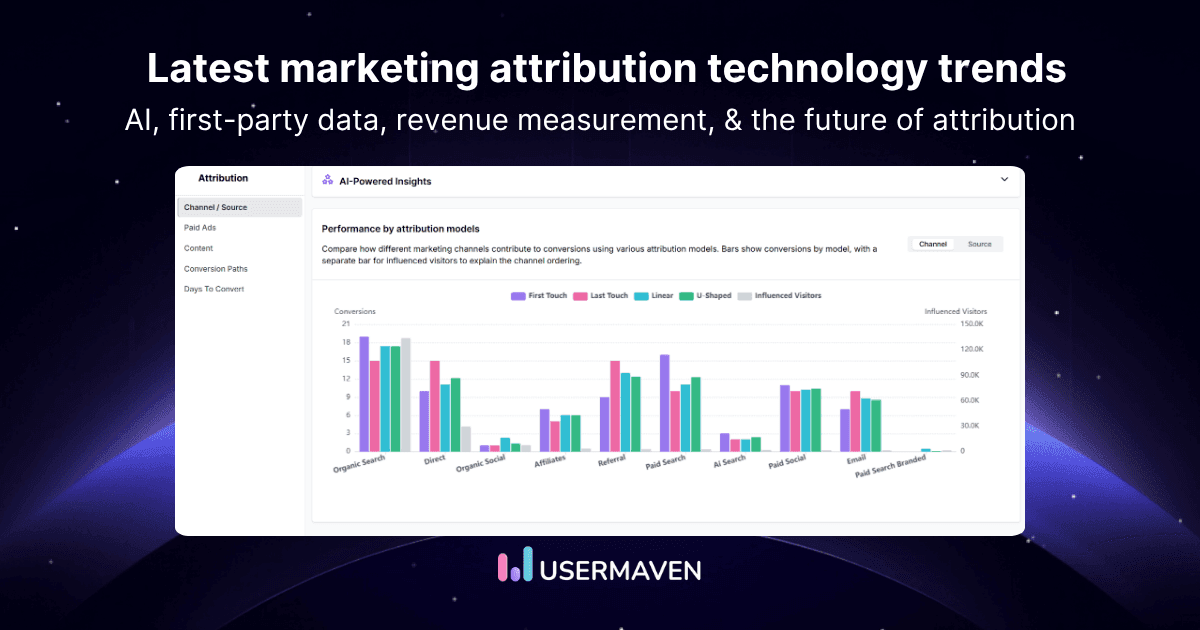
- Models change the apparent winner: The underlying customer and revenue can remain identical while first-touch, last-touch, linear, or time-decay models redistribute credit.
- Tracking quality comes before modeling: Broken UTMs, missing events, identity gaps, stale integrations, or incomplete CRM data can make sophisticated attribution look precise while still being wrong.
- Revenue matters more than conversions: A channel that produces fewer signups can still create better pipeline, retention, or LTV and deserve more budget.
- Attribution is not causality: Attribution explains observed contribution. Incrementality asks what additional outcome occurred because marketing happened.
What is multi-channel attribution?
Multi-channel attribution is the process of assigning conversion or revenue credit across channels such as paid search, organic search, social, email, affiliates, referrals, and direct traffic.
The purpose is to compare how channels participate in the customer journey and decide where budget should be increased, protected, or reduced.

Terminology is not perfectly standardized. Some vendors use multi-channel attribution and multi-touch attribution almost interchangeably.
For this guide, the operational distinction is simple: a channel is the higher-level source category, while a touchpoint is the individual interaction inside or across those channels.
A practical channel taxonomy may include paid search, organic search, paid social, organic social, email, affiliates, partnerships, referrals, Direct, AI referrals, and custom channels.
The exact list matters less than using the same definitions consistently across campaigns and reporting.
| Multi-channel attribution answers: Which channels contributed? Multi-touch attribution answers: Which individual interactions contributed? |
Why channel-level attribution matters
The value of channel-level attribution is not a prettier performance table. It is preventing budget from moving toward channels that merely capture demand while starving the channels that created, educated, or re-engaged the buyer.
Avoid rewarding only demand capture
Branded search, retargeting, and Direct often appear near the end of a customer journey. That makes them naturally strong in last-touch reporting.
The risk is interpreting proximity to conversion as proof that the closing channel created all of the value.
A channel can capture demand without having created it.
If paid social introduced the buyer and organic content moved the buyer forward, cutting those channels because branded search closed the conversion can damage the demand that branded search later captures.
Protect demand-creating channels
Channels such as paid social, educational content, partnerships, podcasts, communities, and non-branded organic search can play earlier roles.
They may produce fewer final clicks but still be essential to discovery and consideration. Multi-channel reporting lets those channels be evaluated against more than last-click conversions.
Compare customer quality, not just volume
Channel quality can also change after the first conversion. One source may generate many low-cost signups but poor activation and retention.
Another may create fewer signups but more upgrades and higher lifetime value. Reviewing customer retention metrics alongside attributed conversions helps reveal that difference.
The more useful question often becomes: “Which channel creates the customers the business actually wants?”
Understanding channel contribution first requires separating channels from the individual touchpoints inside them.
Unlock insights that drive growth
*No credit card required
Multi-channel vs. multi-touch attribution
Impact notes that marketers often interchange the terms, but its distinction is useful: multi-channel attribution evaluates credit at the channel level.
Multi-touch attribution goes deeper into specific interactions, messaging, and sequence. Impact’s multi-channel attribution guide makes the same practical separation.

Channel-level and touchpoint-level measurement
| Dimension | Multi-channel attribution | Multi-touch attribution |
| Primary unit | Channel | Individual interaction |
| Example | Paid social | Specific LinkedIn ad |
| Main question | Which channels contribute? | Which interactions contribute? |
| Best use | Channel budgeting | Journey analysis |
| Typical output | Channel credit, revenue, ROAS | Touchpoint credit and path |
| Detail level | Higher-level | Granular |
Consider the journey LinkedIn ad → organic article → email click → branded search → demo request.
A multi-channel view might report Paid Social → Organic Search → Email → Paid Search. A multi-touch view keeps the specific ad, article, email, search interaction, and demo page in the sequence.
For touchpoint-level credit, model reliability, eligibility, and journey analysis, the dedicated multi-touch attribution guide goes deeper without forcing this channel-level article to repeat the same job.
A practical multi-channel attribution example
Suppose one customer generates $10,000 in revenue after moving through five recorded channels:
- Paid social: Introduced the brand and created awareness.
- Organic search: Educated the buyer during independent research.
- Email: Re-engaged the prospect after an earlier visit.
- Branded search: Captured active demand when the buyer was ready to evaluate.
- Direct: Recorded the final return visit before the conversion.
A last-touch report can assign the full $10,000 to Direct. That is mathematically valid under the selected model, but it does not mean the earlier channels had zero business value.
Same revenue, different channel credit
| Model | Paid social | Organic | Branded search | Direct | |
| First-touch | 100% | 0% | 0% | 0% | 0% |
| Last-touch | 0% | 0% | 0% | 0% | 100% |
| Linear | 20% | 20% | 20% | 20% | 20% |
| U-shaped | Higher | Lower | Lower | Lower | Higher |
| Time-decay | Lower | Rising | Rising | Higher | Highest |
| The customer and $10,000 of revenue did not change. Only the credit rule changed. |
Channel attribution should be used as a decision lens, not as a claim that one model discovered the single true cause of revenue.
The journey stays the same, but the apparent channel winner changes as soon as the credit rule changes.
How attribution models change channel decisions
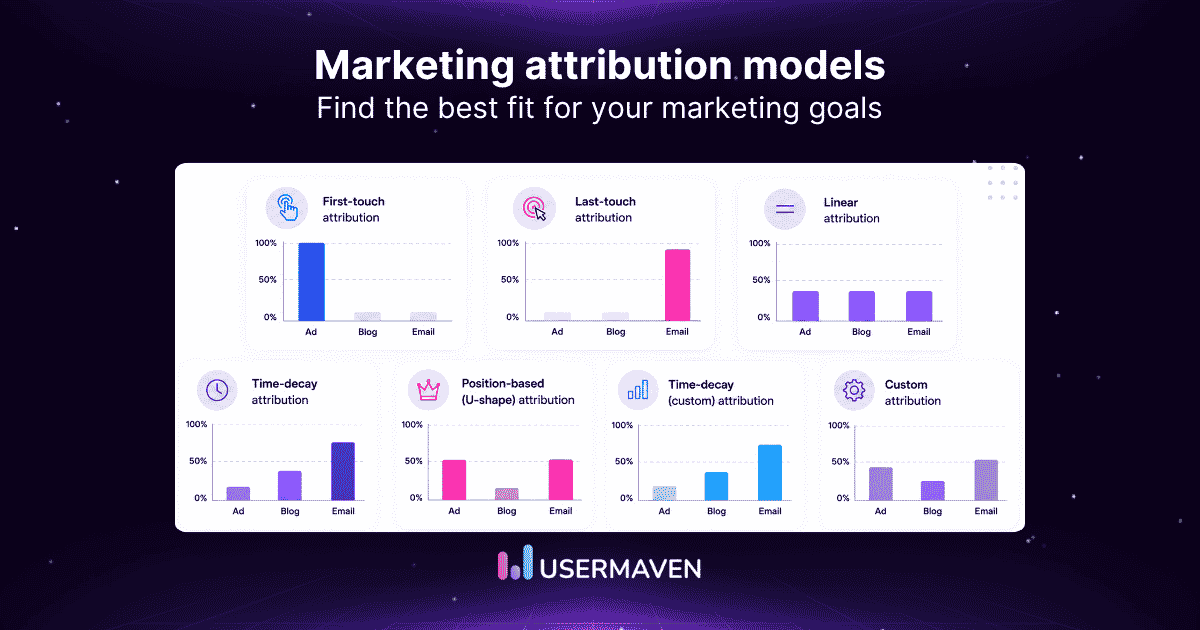
A model should be chosen according to the decision it supports. Re-explaining every attribution model in full would duplicate the model-specific pillar, so the useful channel-level question is what each model emphasizes.

First-touch: Which channel created demand?
First-touch gives all credit to the first eligible channel. It is useful for discovery and demand-creation analysis, but it ignores everything that nurtured or closed the journey later.
Last-touch: Which channel captured final demand?
Last-touch gives all credit to the final eligible channel. It can be useful for conversion-stage optimization, but it often overvalues Direct, branded search, retargeting, and other late-stage sources.
Linear: Which channels participated?
Linear attribution shares credit equally across eligible channels. It protects supporting channels from disappearing, but equal credit can overstate weak interactions and understate genuinely decisive ones.
Time-decay: Which channels influenced the later journey?
Time-decay gives progressively more weight to interactions closer to conversion. It can fit long journeys where recent engagement matters, but it reduces credit for early discovery by design.
Position-based: Which channels opened and closed the journey?
Position-based approaches put more weight on selected milestones, often the first and final interactions. They recognize both acquisition and conversion, but middle-funnel education can receive less credit.
There is no universally best multi-channel attribution model. The better model depends on the business decision, buying cycle, and observable journey.
Important budget decisions should be checked across more than one model so the conclusion is not an artifact of a single credit rule.
The detailed marketing attribution models guide covers model mechanics more deeply. Choosing a model is only useful after the underlying tracking and identity layers are reliable.
See Usermaven in action
Book a free demo and discover how powerful analytics can grow your business.
*No credit card required
How to build reliable multi-channel attribution
Reliable multi-channel attribution can be built as a measurement chain rather than a dashboard configuration exercise. The broader marketing attribution measurement process uses the same principle: define the inputs before interpreting the credit.
| Channel taxonomy → Events → Identity → Outcome → Window → Revenue → Reconciliation → Trust |

1. Standardize channel taxonomy
Decide how traffic will be grouped before performance is compared. Google Ads and organic Google traffic should not collapse into one “Google” bucket. LinkedIn organic, LinkedIn Ads, partner links, and malformed UTMs should not be mixed accidentally either.
The goal is one stable classification system for sources, mediums, campaigns, and custom channels. Channel mapping errors are especially dangerous because they can make a reporting change look like a performance change.
2. Track meaningful events
Channel data tells where the visitor came from. Event data tells what the visitor did after arriving. A useful sequence might be visit → signup → activation → demo → purchase → upgrade.
Usermaven Events can capture website and product actions, plus custom, server-side, revenue, and off-site events. The broader principle is vendor-independent: attribution becomes more useful when the selected outcome reflects real progress rather than an arbitrary page view.
3. Connect website behavior
A channel can send high-quality traffic into a weak experience. If the landing page, form, or checkout breaks, the acquisition source may look poor even though post-click friction caused the loss.
Connecting website analytics with attribution helps separate traffic quality from on-site friction.
4. Resolve anonymous and known identity
Many journeys begin anonymously and become identifiable only after a form submission, login, signup, or purchase. The useful identity chain is anonymous visitor → identified user → company/account → CRM record where applicable.
Identity resolution does not create perfect visibility across every device or private environment, but it prevents obvious fragmentation across sessions and known records. Usermaven Contacts Hub can provide unified user and company context when the visitor becomes known.
5. Define the conversion outcome
Changing the outcome changes the meaning of channel performance.
A SaaS team may choose signup, activated user, paid subscription, or renewal. A B2B team may choose qualified lead, opportunity, or Closed Won.
An ecommerce team may choose purchase, repeat purchase, or a contribution-margin outcome.
A documented conversion tracking framework should state exactly what counts, how it is identified, and which source-of-truth system owns the outcome.
6. Choose the attribution window
The attribution window defines how long a prior channel interaction remains eligible for credit.
A 90-day window can erase a discovery interaction that happened 120 days before a long B2B conversion, even if the attribution model itself is unchanged.
Use actual time-to-conversion data to set the attribution window. Short windows tend to emphasize late-stage channels; extremely long windows can retain interactions that are no longer decision-relevant.
7. Connect pipeline and revenue
The reporting chain should continue until the business outcome that matters. Different business models need different completion points:
- B2B: Channel → visitor → person → account → opportunity → Closed Won revenue
- SaaS: Channel → signup → activation → subscription → retention → LTV
- Ecommerce: Channel → product view → cart → checkout → purchase → repeat purchase
This is where revenue attribution becomes more valuable than conversion credit alone. The channel that creates the most leads or orders is not automatically the channel that creates the best economic outcome.
8. Reconcile against the source of truth
Ad platforms can all claim the same conversion under different windows and rules. That means self-reported platform totals should not simply be added together.
| Source | Conversions claimed |
| Google Ads | 55 |
| Meta | 45 |
| 20 | |
| Naive platform total | 120 |
| Backend source-of-truth conversions | 100 |
The company still had 100 real conversions, not 120. Multi-channel reporting should reconcile credited outcomes against backend, ecommerce, billing, or CRM totals and treat platform claims as overlapping perspectives rather than additive business facts.
The ad platform discrepancies guide covers the wider reasons Google, Meta, LinkedIn, analytics, and backend reports can disagree.
What should a multi-channel attribution report show?
A useful multi-channel attribution report should show both credited performance and the context needed to interpret that credit.
A channel revenue number without spend, model, window, or source-of-truth context is easy to misuse. The related marketing attribution metrics guide explains the formulas and interpretation limits behind these measures.
Core fields for multi-channel attribution reporting
| Field | Why it matters |
| Channel | Defines the reporting unit |
| Spend | Adds cost context |
| Conversions | Shows outcome volume |
| Pipeline | Shows B2B commercial value |
| Revenue | Shows financial contribution |
| CAC / ROAS | Shows efficiency |
| First-touch credit | Shows demand creation |
| Last-touch credit | Shows demand capture |
| Multi-touch credit | Shows shared contribution |
| Model | Explains the credit rule |
| Window | Explains eligibility |
| Retention / LTV | Shows long-term customer quality |
Segment the report before comparing channels
A blended channel average can hide important differences. Break performance down by campaign, country, device, landing page, customer type, company, plan, new vs. returning customer, or cohort when those differences change the budget decision.
Behavioral segments are particularly useful when the question is not simply which channel converted, but which channel created a specific type of customer or account.
Make reporting reusable
Attribution becomes easier to operate when the same definitions are available to marketing, growth, finance, and RevOps rather than rebuilt in separate spreadsheets.
Analytics dashboards can combine attribution with funnels, journeys, trends, and revenue-oriented metrics in one shared view.
A detailed report can still produce the wrong decision if the inputs behind it are incomplete. The next step is checking whether the measurement itself can be trusted.
How to trust multi-channel attribution data
Attribution logic answers who gets credit. Measurement trust answers whether that credit should be believed. Teams should validate the data layer before changing budget because the attribution model only redistributes what the measurement system captured.
Check campaign tracking
Look for missing UTMs, broken click IDs, inconsistent source names, untagged partner links, redirect problems, and campaign taxonomy drift.
Consistent UTM parameters help preserve source, medium, and campaign context. If paid visits lose that data, spend cannot be attributed reliably even when the model is configured correctly.
Check event coverage
Important conversions and supporting events should actually fire, carry the expected properties, and avoid duplicate delivery.
A funnel built on missing or duplicated events can make one channel appear to convert better simply because its event path is measured differently.
Check customer matching
Ask whether visits can connect to the signups, customers, accounts, and revenue outcomes they become.
A large volume of unmatched high-value customers creates an attribution blind spot regardless of model sophistication. The budget risk is highest when the missing identities are concentrated in valuable accounts or customers.
Check connected platforms and conversion feedback
Ad and CRM integrations need fresh data. Conversion feedback sent back to ad platforms should use consistent event definitions, values, and deduplication. Stale connections can create apparently sudden channel changes that are really data-delivery failures.
Check data confidence
Small samples can produce unstable channel rankings. Before moving a meaningful budget, check whether the conversion volume is large enough, whether the observation window is mature, and whether the result persists across comparable cohorts.
Use a measurement-health layer
Usermaven’s Measurement Trust Center checks five core areas: campaign tracking, customer matching, connected platforms, conversion feedback, and data confidence. It combines those checks into a Trust Score and prioritizes the highest-impact fixes.
| A sophisticated attribution model applied to incomplete tracking produces sophisticated-looking bad data. |
When not to trust the attribution report yet
Do not make a major channel-budget decision simply because the report looks complete. Several warning signs indicate the measurement layer should be investigated first.

Attribution warning signs
| Warning sign | Possible problem |
| Credited conversions exceed real conversions | Overlapping attribution or duplicate events |
| Direct suddenly dominates | Lost source data or returning traffic |
| CRM revenue cannot map to users/accounts | Identity gap |
| UTMs vary across campaigns | Channel taxonomy problem |
| Important events are missing | Tracking failure |
| Small window change rewrites the result | Window sensitivity |
| One platform claims more than the backend recorded | Self-attribution overlap |
| High-value customers have no acquisition source | Acquisition or identity data gap |
The purpose of this diagnostic is not to demand perfect tracking. It is to understand which uncertainty could materially change the budget decision and fix the highest-impact gap first.
Direct traffic, dark influence, and missing channels
Why Direct can be misleading
Direct traffic is frequently interpreted as a genuine acquisition channel.
In practice, it can also be the state left behind when the source is no longer identifiable because UTMs disappeared, a bookmark was used, the visitor returned later, an app opened the site, or tracking continuity was lost.
| Direct is often the final observed state, not necessarily the channel that created demand. |
Dark and offline influence still exists
Podcasts, word of mouth, private Slack or Discord groups, WhatsApp messages, sales conversations, conferences, offline referrals, and untracked cross-device activity can influence a conversion without appearing as a clean digital channel touch.
Observed channel contribution is not total marketing influence. Multi-channel attribution is strongest when it is treated as a structured view of recorded evidence rather than a claim that every influence is visible.
Multi-channel attribution vs. MTA, MMM, and incrementality
Several measurement methods can influence the same budget decision, but they answer different questions. Using the terms interchangeably can make teams expect causal certainty from a system designed only to assign observed credit.
Which measurement method answers what?
| Method | Primary question | Data level |
| Multi-channel attribution | Which channels contributed? | Journey / channel |
| Multi-touch attribution | Which interactions contributed? | Touchpoint |
| Marketing mix modeling | How did channel investment relate to outcomes? | Aggregated |
| Incrementality | What happened because marketing occurred? | Experimental / causal |
| Cross-channel marketing | How should channels coordinate? | Strategy / execution |
Multi-channel attribution vs. marketing mix modeling
Multi-channel attribution works from observed customer journeys and assigns credit across channels.
Marketing mix modeling works from aggregated historical data and statistical relationships. It can help estimate the contribution of channels that are difficult to observe at the individual-user level.
Attribution vs. incrementality
Attribution asks which observed channels received credit? Incrementality asks what additional outcome happened because the marketing activity occurred?
A channel can receive a large share of attributed revenue without proving that the revenue would disappear if the channel were removed.
Salesforce’s current multi-touch attribution configuration illustrates why attribution still depends on setup choices.
Its lookback window, identity resolution rule, and selected models determine eligibility and credit; they do not by themselves establish causal lift.
Multi-channel attribution by business model
The right channel outcome changes with the business model.
A SaaS company should not stop at signup attribution. A B2B company should not stop at lead attribution, and an ecommerce company should not treat the first purchase as the only useful customer-quality signal.
SaaS and PLG: Which channels create customers who activate and retain?
The useful SaaS chain is Channel → signup → activation → feature adoption → upgrade → retention → LTV.
A paid channel can generate inexpensive trials but weak activation. An organic or partner channel can create fewer trials with stronger retention and higher LTV.
Connecting attribution with product analytics shows whether acquisition quality continues after signup. Funnels can then reveal where users from different channels drop during onboarding, activation, or upgrade.
B2B and RevOps: Which channels create qualified pipeline and revenue?
For B2B, the unit eventually becomes the opportunity and often the account rather than one website conversion. A useful chain is Channel → visitor → person → account → CRM → opportunity → revenue.
That requires separating sourced pipeline from influenced pipeline, then comparing win rate, deal value, sales-cycle length, and Closed Won revenue. The dedicated B2B marketing attribution guide covers the account, CRM, pipeline, and buying-committee layer in more depth.
Ecommerce: Which channels create purchases and repeat customers?
Ecommerce attribution often needs to connect Channel → product view → cart → checkout → purchase → repeat behavior.
A channel may look efficient at the purchase stage but perform poorly on repeat revenue. It may also produce high-intent visitors who abandon because the checkout experience deteriorates.
Using customer journey analytics alongside revenue outcomes helps show how shoppers move across sessions and channels before purchase rather than evaluating each campaign in isolation.
How AI can analyze multi-channel attribution
Once channel, behavioral, and revenue data are connected, investigation becomes the next bottleneck. The useful role for AI is not to invent a new attribution truth, but to help teams interrogate the same governed measurement data faster.
Questions AI should help answer
- Which channels gained or lost attributed revenue this quarter?
- Which channels look strong in last-touch but weak in first-touch?
- Which acquisition sources create the highest-retention customers?
- Why did paid social ROAS fall after conversion volume stayed flat?
- Which channel combinations appear most often before Closed Won deals?
- Which campaigns generate traffic but little downstream revenue?
Maven AI
Maven AI can answer natural-language questions across attribution, traffic, conversions, funnels, journeys, product behavior, retention, and revenue. It can also save analyses as reports and build dashboards from a plain-English request.
External AI workflows with MCP
Usermaven MCP extends authorized analytics into compatible external AI clients.
Current public documentation includes read access for attribution, website/product analytics, funnels, journeys, conversion analysis, segments, dashboards, and reports.
It also documents approval-gated write actions for objects such as funnels, segments, dashboards, and attribution views.
The distinction is practical: Maven AI is the native analytics investigation layer inside Usermaven, while MCP lets teams bring governed Usermaven analytics into external AI workflows.
How Usermaven supports multi-channel attribution
Usermaven connects channel attribution with the behavior and commercial outcomes that happen after the visit.
The measurement chain can continue from channel → visitor → event → user/company → journey → conversion → CRM/revenue → retention/LTV instead of stopping at the ad-platform conversion.

Channel and campaign attribution
The marketing attribution layer compares paid ads, sources, channels, campaigns, content, conversion paths, and revenue-oriented outcomes.
Teams can switch attribution views to see whether a channel is creating demand, participating across the journey, or capturing the final conversion.

Content attribution adds the page layer
Channel-level performance can hide which articles, landing pages, or resources helped move the buyer forward.
Content attribution adds that layer by comparing page contribution across models. This helps teams separate content that attracts traffic from content that repeatedly participates in journeys that convert.

Conversion paths reveal channel position
A channel can look very different depending on whether it appears early, in the middle, or immediately before conversion.
Conversion paths make those roles visible across complete journeys. That context helps explain why Direct or branded search can dominate late-stage reporting while organic, referral, email, or paid channels still contribute earlier.

Multi-touch depth when the channel view is not enough
When the budget question requires interaction-level detail, Usermaven’s multi-touch attribution software goes deeper into specific touchpoints and conversion paths.
The current product page documents seven attribution models and a lookback window of up to 365 days for longer journeys.
Behavioral and revenue context
Events, website behavior, funnels, journeys, product usage, CRM outcomes, and retention analysis can sit beside the attribution result.
This matters when a channel looks strong at signup but weak at activation, or strong at first purchase but weak at repeat revenue. The goal is to make channel credit explain a business outcome that can change budget.
Customer evidence: Multi-channel decisions in practice
Our Taap: faster campaign and funnel decisions
Our Taap is an ecommerce brand that needed clearer visibility into campaign attribution, funnels, checkout behavior, and revenue-driving traffic across multiple channels.
Its Our Taap case study describes a shift from fragmented reporting toward one real-time analytics and attribution workflow.
The vendor-published results report a 31% reduction in campaign analysis time and twice-as-fast identification of funnel and checkout issues.
The case also reports 3+ hours per week saved switching among GA4, Northbeam, and BigCommerce.
It further reports that 32% of orders were tracked back to campaigns and that the team gained more confidence in budget allocation.
The useful evidence is not simply that another dashboard was added. The outcome was shortening the distance between a channel signal and the decision to adjust campaign budget or fix a conversion problem.
Multi-channel attribution implementation checklist
- Define channels: Create one stable channel taxonomy before comparing performance. Keep paid, organic, referral, partner, Direct, and custom sources distinct enough to support the actual budget decision.
- Standardize UTMs: Use consistent source, medium, and campaign naming so one channel does not fragment into multiple labels or collapse with unrelated traffic.
- Track meaningful events: Capture the actions that represent real progress, not only page views. Signups, activations, opportunities, purchases, upgrades, renewals, and refunds can change how channel quality is interpreted.
- Resolve identity: Connect anonymous behavior to known users, customers, accounts, or CRM records where possible. Document what remains unobservable rather than assuming every journey is complete.
- Choose the business outcome: Decide whether the report optimizes for signup, qualified pipeline, Closed Won revenue, purchase, retention, or LTV. The selected outcome determines the meaning of channel performance.
- Set the attribution window: Use real time-to-conversion data to choose a window that can capture the relevant journey without preserving stale interactions indefinitely.
- Choose the model: Use the model that fits the question, then compare another model before making a large budget move. Model sensitivity is information, not a reporting inconvenience.
- Connect revenue: Complete the journey through CRM, billing, ecommerce, or backend systems so attribution can be evaluated against the economic outcome rather than proxy conversions alone.
- Reconcile totals: Credited conversions and revenue should reconcile to source-of-truth outcomes. Treat ad-platform claims as overlapping views, not additive company totals.
- Validate measurement: Check campaign tracking, event coverage, customer matching, connected platforms, conversion feedback, and data confidence before changing budget.
Once these layers are stable, attribution becomes a decision system rather than another dashboard.
Final verdict
Multi-channel attribution should not be used to declare one universal winning channel. The more useful goal is understanding how channels perform different jobs across the journey and whether those jobs contribute to the outcome the business actually values.
The strongest channel report separates create → assist → re-engage → capture → convert demand, then connects those roles with pipeline, revenue, retention, or LTV.
That prevents teams from protecting a channel only because it appears near conversion or cutting one only because it rarely receives the last click.
Trustworthy attribution requires a stable chain of channel taxonomy → events → identity → outcome → window → model → revenue → reconciliation before budget moves.
Attribution will never observe every influence, but it can still make channel decisions materially better when the underlying measurement is explicit and tested.
Start a 14-day Usermaven trial to connect channels, customer journeys, attribution, and revenue in one measurement workflow. No credit card required.
FAQs
1. What is multi-channel attribution?
Multi-channel attribution assigns conversion or revenue credit across marketing channels such as paid search, organic search, social, email, affiliates, referrals, and Direct. It helps teams compare channel roles and make better budget decisions.
2. How does multi-channel attribution work?
It tracks eligible channel interactions before a defined conversion, connects those interactions to the same customer or account where possible, applies an attribution window and model, and then distributes conversion or revenue credit across channels.
3. What is the difference between multi-channel and multi-touch attribution?
Multi-channel attribution compares higher-level channels such as Paid Social, Organic Search, or Email. Multi-touch attribution analyzes the specific interactions inside and across those channels, such as an individual ad click, article visit, email click, or demo page.
4. What is the best multi-channel attribution model?
There is no universally best model. First-touch is useful for demand creation, last-touch for demand capture, linear for participation, and time-decay for later-stage influence. Important budget decisions should be checked across more than one model.
5. How do you measure multi-channel attribution?
Start with consistent channel taxonomy and event tracking, resolve identity where possible, define the business outcome, set the attribution window, connect revenue or CRM data, apply the model, reconcile totals, and validate measurement quality before acting on the report.
6. What should a multi-channel attribution report include?
A useful report includes channel, spend, conversions, pipeline or revenue, CAC or ROAS, first-touch and last-touch credit, shared attribution credit, model, attribution window, and customer-quality metrics such as retention or LTV when relevant.
7. What is the difference between multi-channel attribution and MMM?
Multi-channel attribution works from observed customer journeys and distributes credit across recorded channels. Marketing mix modeling uses aggregated historical data and statistical relationships to estimate how broader channel investment relates to outcomes.
8. How do you avoid double counting channels?
Reconcile attributed conversions and revenue against the backend, CRM, billing, or ecommerce system of record. Do not add Google, Meta, LinkedIn, and other platform-reported conversions together because the same real conversion can be claimed by multiple platforms.
9. What is the best multi-channel attribution tool?
The best tool should support consistent channel mapping, meaningful event tracking, identity resolution, configurable models and windows, CRM or revenue completion, cross-channel reporting, measurement-health checks, and enough journey depth to explain why channel performance changed. Usermaven is designed around this connected attribution and analytics workflow.

Written by
Adeel Khan
Growth Marketing Expert
Adeel Khan is a full-stack SaaS marketer with 10+ years of experience in content marketing, paid advertising, analytics, and conversion rate optimization. He shares practical insights and strategies drawn from hands-on experience, helping B2B SaaS marketers improve performance and make better marketing decisions.
All articles by Adeel →