A listener hears your company on a podcast during their commute. Twelve days later they Google the brand, read two articles, return through LinkedIn, and request a demo. Analytics says “Organic Search.” The buyer says “Podcast.”
Both can be correct. Podcast exposure often happens away from the website, without a click, on another device, and days or weeks before the eventual conversion.
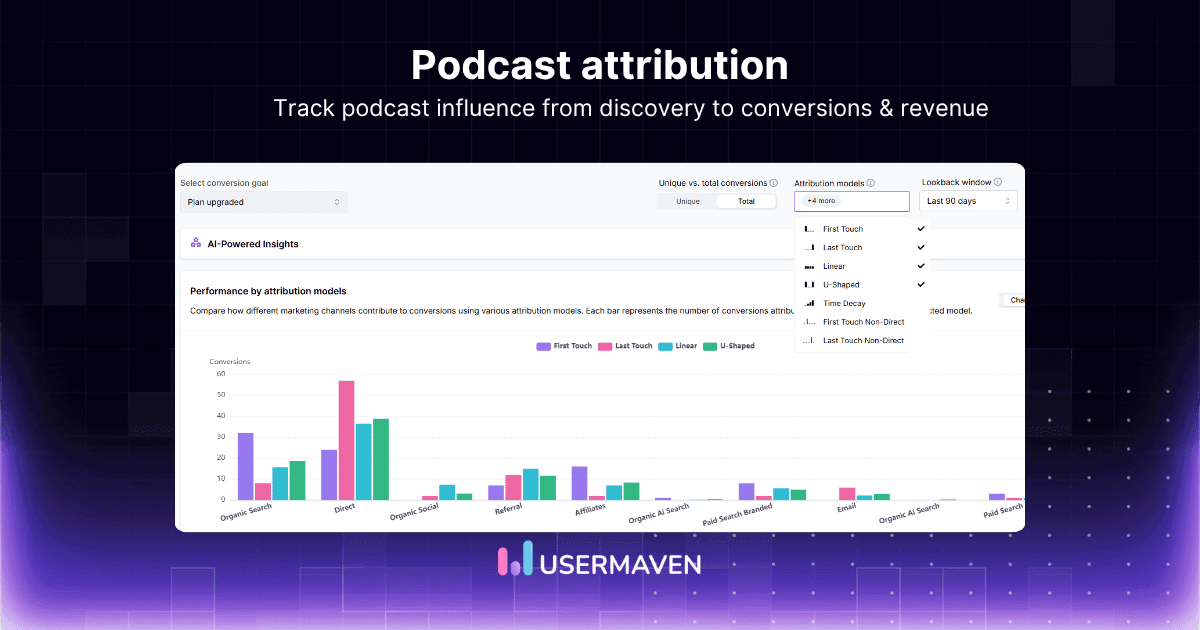
The useful goal is not perfect proof of every listen. A strong marketing attribution software workflow combines direct-response signals, exposure matching, self-reported discovery, customer journeys, and downstream revenue evidence to estimate how podcast activity contributes.
Podcast attribution at a glance
Podcast attribution is the process of connecting podcast exposure, listening, or podcast-driven traffic with later business outcomes such as website visits, leads, purchases, pipeline, or revenue.
It is rarely perfectly deterministic. A listener may hear an episode, never click a link, return through search weeks later, and finally convert from a different device.
The commercial influence is still meaningful: Edison Research reported that 46% of podcast listeners who listen weekly had purchased a product or service as a result of hearing a podcast ad.
| Question | Short answer |
| What does podcast attribution measure? | How podcast exposure or podcast-driven activity relates to later outcomes |
| Can every listener be tracked? | No |
| Common direct signals | Promo codes, vanity URLs, UTMs, tracked landing pages |
| Broader methods | Exposure matching, surveys, journey attribution, CRM/revenue matching |
| What can be attributed? | Visits, leads, purchases, pipeline, revenue |
| Is Spotify attribution independent measurement? | No; it is a platform-specific measurement view |
| Does self-reported attribution matter? | Yes, especially when no click occurred |
| Is attribution the same as lift? | No |
| Best approach | Combine multiple evidence sources |
The goal is not to prove every listen. It is to build enough trustworthy evidence to understand whether podcast activity contributes to valuable outcomes.
Key takeaways
- Podcast influence often happens without a click: Branded search, Direct, or another channel may become the measurable return path even when audio created the initial demand.
- No single tracking method is complete: Promo codes, pixels, surveys, journey attribution, and CRM data each capture a different part of the evidence.
- Podcast analytics is not podcast attribution: Downloads and listeners describe consumption; attribution connects podcast activity with business outcomes.
- Platform attribution is one perspective: Spotify can measure audio performance inside its methodology, while broader attribution compares podcast influence with other channels.
- Self-reported attribution is unusually valuable here: It can surface remembered discovery that never produced a measurable click.
- Long consideration cycles need realistic windows: Podcast influence may happen weeks before the conversion.
- B2B podcast ROI should reach pipeline and revenue: Lead count alone may understate or exaggerate commercial impact.
- Attribution is not incrementality: Credited revenue does not prove the podcast caused the revenue.
Podcast attribution can mean two different things
The phrase “podcast attribution” is used for two different measurement problems. Separating them avoids a common source of confusion.

Audience acquisition attribution
This asks what caused someone to become a podcast listener. For example, a LinkedIn campaign may send people to a show page and then into an episode stream.
Business-outcome attribution
This starts with podcast exposure and asks whether it contributed to a later business outcome, such as a lead, purchase, opportunity, or customer.
| Dimension | Audience attribution | Business-outcome attribution |
| Starting point | Marketing source | Podcast exposure or listen |
| Outcome | Listener / stream | Lead, purchase, pipeline, revenue |
| Common use | Grow the show | Prove marketing impact |
| Typical data | Campaign links, listener data | Website, CRM, revenue, surveys |
| Main challenge | Cross-platform listening | No-click and delayed conversion |
Where AI helps podcast attribution
AI can speed up the analysis once podcast-related evidence exists. It can summarize recurring paths, compare attribution-model results, identify podcast landing pages in high-value journeys, and surface unusual source or revenue patterns.
It cannot infer an audio exposure that was never recorded. AI can analyze the evidence available to the measurement system; it cannot manufacture a podcast listen that the system never observed.
Podcast analytics vs. podcast attribution
Downloads, streams, reach, and audience size answer whether people consumed the show. They do not automatically tell a marketer whether that audience later created customers.

| Podcast analytics | Podcast attribution |
| Downloads | Website visits influenced |
| Streams / listeners | Leads |
| Reach | Purchases |
| Frequency | Opportunities |
| Completion | Pipeline |
| Geography | Revenue |
| Consumption | Business outcome |
That distinction is partly technical. The IAB Tech Lab Podcast Measurement Technical Guidelines explain that open podcast measurement commonly relies on server-side delivery logs, which produces a different measurement environment from ordinary browser-based digital media.
In practical terms, podcast analytics tells you about consumption. Podcast attribution tries to connect that exposure with what happened afterward.
See what's working. Fix what's not. Grow faster.
*No credit card required
Why podcast attribution is difficult
Podcast measurement becomes difficult because the exposure and the commercial outcome often live in completely different environments.
Listening happens away from the conversion environment
People listen while driving, walking, cooking, or exercising. There may be no browser session that can carry a campaign source directly into the later website visit.
The conversion may happen on another device
A listener might hear the episode on a phone, research the company on a laptop, and request a demo from a work computer. Identity can fragment across those steps.
Buyers often search instead of clicking
Audio creates memory. The listener later searches the brand, so analytics records Organic Search or Direct even though the podcast may have created the original demand.
Conversions can be delayed
This is especially common in B2B, enterprise, high-consideration purchases, and thought-leadership podcasts where the commercial response arrives long after the episode.
Delivery metrics are not conversion evidence
Downloads and ad delivery are useful exposure signals, but they do not by themselves establish who visited, purchased, or entered pipeline afterward.
The four evidence layers of podcast attribution
A reliable setup combines evidence layers instead of expecting one technique to explain the entire customer journey.
Layer 1: Direct-response evidence
Promo codes, vanity URLs, episode-specific UTMs, and dedicated landing pages create explicit evidence when listeners follow the intended route. Their weakness is equally clear: many listeners will not.
Layer 2: Exposure-matched attribution
Podcast ad measurement platforms can match eligible ad exposure with later digital activity using their own identity and attribution methodologies. This broadens coverage beyond direct clicks, but the result depends on match quality, privacy rules, and window settings.
The same limitations that affect ad tracking without third-party cookies apply here: matched or modeled conversions should be treated as inferred evidence rather than direct observations of every listener.
Layer 3: Self-reported attribution
A simple “How did you hear about us?” response can reveal remembered podcast discovery that never generated a trackable click.
Combining tracked journey evidence with self-reported attribution captures more of that no-click influence without pretending surveys are perfectly objective.
Layer 4: Downstream business evidence
Qualified leads, opportunities, purchases, Closed Won revenue, and LTV show whether podcast-influenced acquisition created business value instead of merely generating traffic.
Podcast attribution methods compared
Each method has a different evidence boundary. The right stack depends on what is being measured and how expensive a wrong decision would be.
| Method | Best for | Strength | Main limitation |
| Promo code | Direct response | Explicit | Under-counts non-code buyers |
| Vanity URL | Campaign isolation | Simple | Listeners may search instead |
| UTM link | Click attribution | Precise when clicked | Misses no-click response |
| Dedicated landing page | Show/episode attribution | Easy to analyze | Leakage to other routes |
| Pixel / exposure matching | Broader ad measurement | Captures post-exposure action | Matching and privacy limits |
| Post-purchase survey | Discovery source | Captures dark influence | Recall bias |
| CRM source field | B2B pipeline | Connects to commercial stages | Depends on field quality |
| Multi-touch attribution | Wider journey | Preserves other channels | Only sees observable touches |
| Lift study | Causal impact | Measures incrementality | More complex and costly |
The strongest podcast attribution setup combines methods because each one covers a different part of the journey.
See Usermaven in action
Book a free demo and discover how powerful analytics can grow your business.
*No credit card required
How Spotify podcast attribution works
Spotify Ad Analytics can connect audio-ad exposure with later website activity when the advertiser has implemented the required measurement setup.
The current Spotify Pixel is website JavaScript that measures actions such as visits, leads, add-to-cart events, and purchases. Spotify says its attribution uses a combination of IP-matching methodologies and device graphs to connect ad exposure with website actions.
That gives advertisers a useful platform-specific view of which audio campaigns, shows, or placements correlate with measurable actions after exposure.
It does not remove the need for an independent cross-channel view. The same listener can also interact with search, social, email, content, and sales before converting.
What happened to Podsights and Chartable?
Older podcast measurement guides can be confusing because the product landscape changed faster than the search results.
Podsights
Spotify acquired Podsights in 2022 and later rebranded the measurement service as Spotify Ad Analytics. Older instructions that treat Podsights as the primary standalone Spotify-era workflow are therefore dated.
Chartable
Chartable, another Spotify acquisition, shut down as a standalone service in December 2024. That makes “Chartable podcast attribution” a legacy query rather than a current implementation recommendation.
The useful takeaway is to optimize for the measurement problem, not an old product name: direct response, exposure matching, self-report, journey attribution, and downstream outcomes still need to work together.
Owned podcasts vs. podcast advertising attribution
Paid podcast advertising and owned or guest podcast activity create different measurement problems, even when both ultimately contribute to demand.
| Dimension | Podcast advertising | Owned / guest podcast |
| Media relationship | Paid | Owned or earned |
| Direct-response signal | Code, URL, pixel | URL, UTM, search, survey |
| Measurement unit | Campaign, show, ad | Episode, show, appearance |
| Common outcome | Purchase or lead | Awareness, lead, pipeline |
| Attribution challenge | Exposure matching | Dark discovery |
Owned podcast measurement often depends more heavily on branded search, episode pages, show-note landing pages, surveys, and downstream journey analysis because the audio exposure itself may remain invisible.
How self-reported and tracked attribution work together
Consider a buyer whose analytics path is “Branded Search → Demo,” while the form response says “I heard about you on Podcast X.” Those answers are not necessarily contradictory.
The search may be the measurable return path. The podcast may be the remembered discovery source. A useful attribution system keeps both pieces of evidence instead of forcing one to overwrite the other.
| Evidence | What it tells you |
| First tracked source | First observable digital interaction |
| Conversion source | Immediate measurable route before the goal |
| Self-reported source | Remembered discovery or influence |
| Journey | Observable actions between entry and conversion |
| CRM / revenue | Commercial outcome |
Tracked attribution and self-reported attribution are complementary evidence, not competing versions of truth. A reliable source attribution layer keeps the first observable digital source distinct from what the buyer later reports influenced discovery.
Podcast attribution models
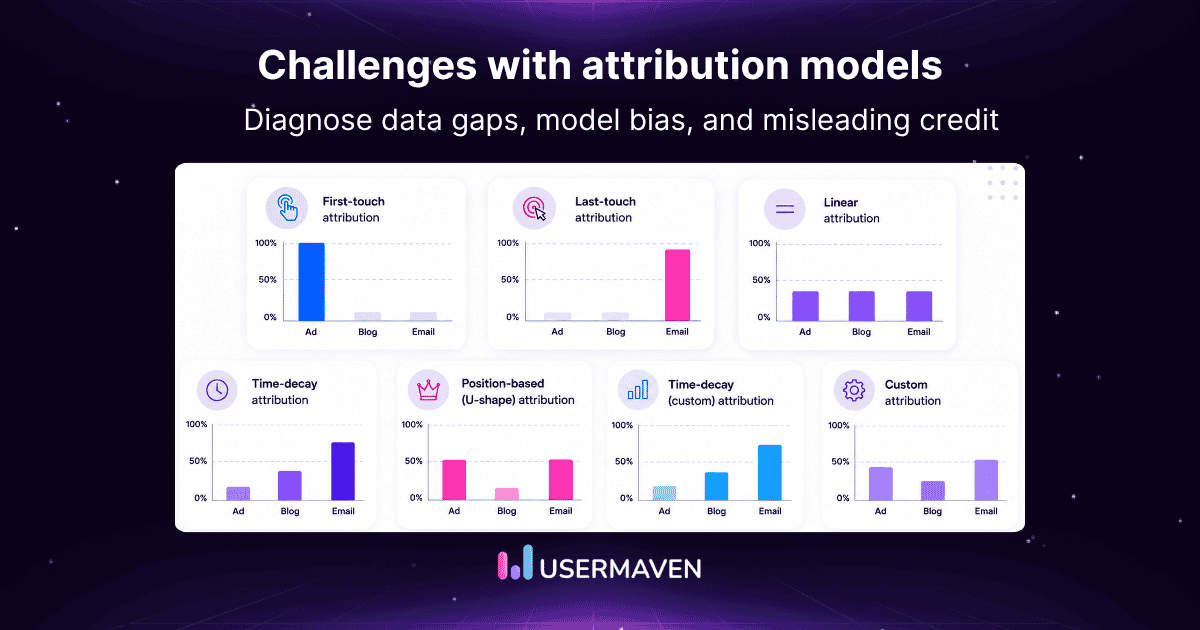
Model choice matters once podcast-related interactions become observable. The broader marketing attribution models framework shows why different credit rules can produce different answers from the same journey.
| Model | Podcast question | Main limitation |
| First touch | Did podcast introduce the customer? | Ignores later influence |
| Last touch | Was podcast closest to conversion? | Undercredits discovery |
| Linear | Which observed touches participated? | Equal weighting |
| Time decay | Which recent touches mattered most? | Can underweight podcast discovery |
| U-shaped | What introduced and helped close? | Fixed assumptions |
| Custom | How should podcast and other channels share credit? | Encodes business assumptions |
When podcast activity is one of several measurable touches, multi-touch attribution can preserve its role alongside other channels instead of giving all credit to the final interaction.
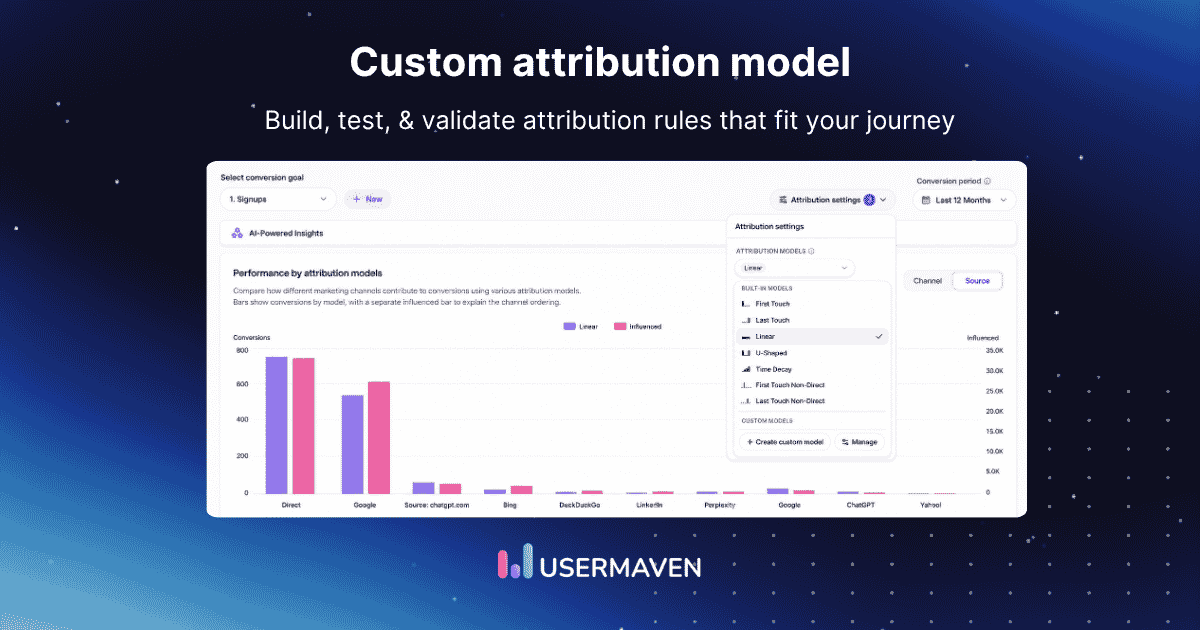
For businesses with a defensible reason to weight discovery or specific channels differently, a custom attribution model can make those assumptions explicit rather than hiding them inside a default rule.
Choose a podcast attribution window carefully
Podcast response can be slow. A listener might hear a show on day 1, search the brand on day 8, read an article on day 17, and request a demo on day 31.
If the deal closes on day 52, a short attribution window can remove the original podcast-related evidence long before revenue appears.
A seven-day window would miss most of that journey. The right attribution window should reflect observed conversion delay and buying-cycle length rather than an arbitrary default.
| Window tendency | Usually better suited to |
| Shorter | Promo codes, immediate-response offers, low-consideration purchases |
| Longer | B2B, enterprise, thought leadership, expensive products, owned podcasts |
Usermaven supports attribution lookback windows up to 365 days, which can be useful when podcast-led demand enters a long sales cycle before revenue appears.
Podcast attribution is not incrementality
Attribution distributes credit among observed signals. It does not prove that a listener would not have converted without the podcast.
| Method | Main question |
| Podcast attribution | Which podcast exposure or touchpoint receives credit? |
| Self-reported attribution | What does the buyer remember influencing them? |
| Lift study | Did podcast exposure cause additional response? |
| MMM | How did podcast spend relate to aggregate outcomes over time? |
A podcast can receive attribution credit without proving that it caused the conversion. When causal validation matters, the distinction between multi-touch attribution and marketing mix modeling helps clarify when journey-level credit should be complemented by broader measurement methods.
Podcast attribution metrics that matter
Useful metrics should move from media delivery toward business value instead of stopping at downloads.
| Measurement level | Example metrics |
| Exposure | Downloads, ad delivery, reach |
| Engagement | Landing-page visits, code use |
| Lead | Attributed leads, qualified leads |
| Opportunity | Podcast-influenced opportunities |
| Revenue | Attributed purchase or Closed Won revenue |
| Efficiency | CPA, CAC, cost per opportunity |
| Quality | Retention, repeat purchase, LTV |
For ecommerce, that can mean attributed purchases, new-customer revenue, repeat purchase, and LTV. For B2B, it can mean qualified leads, opportunities, pipeline, Closed Won revenue, and cost per opportunity.
A broader marketing attribution metrics framework helps teams connect those podcast signals with acquisition efficiency, revenue, and customer quality instead of optimizing around exposure alone.
Podcast ROI: use the right denominator and outcome
A basic direct-response calculation is straightforward: Podcast attributed ROAS = attributed revenue ÷ podcast spend.
For owned podcasts, spend may include production, editing, distribution, promotion, and internal time. For B2B, revenue may lag months behind the episode, so pipeline and opportunity metrics can become useful leading indicators.
| Show | Spend | Opportunities | Attributed pipeline | Closed Won |
| Podcast A | $8,000 | 12 | $180,000 | $45,000 |
| Podcast B | $6,000 | 4 | $60,000 | $30,000 |
The “winner” depends on whether the business optimizes for opportunity count, pipeline, Closed Won revenue, CAC, or longer-term customer value.
B2B podcast attribution
B2B podcast journeys are rarely single-session. A prospect may hear a podcast, later read a blog, return through organic search, engage on LinkedIn, request a demo, and become an opportunity weeks later.
For B2B podcasts, clear calls to action and multi-channel promotion can create more measurable entry points, but attribution still needs to follow those prospects beyond the first response into pipeline and revenue.
That is why B2B SaaS teams often need attribution that follows marketing activity beyond the lead and into account, pipeline, and revenue outcomes.
For marketing teams, the stronger budget signal is not simply “podcast mentioned on the form.” It is whether podcast-related journeys are associated with qualified pipeline and customers worth acquiring.
Connecting early influence with revenue attribution prevents the analysis from stopping at traffic or lead volume when the real business outcome appears much later.
How to build a podcast attribution setup
A practical setup can start simple and become more sophisticated as podcast spend and decision risk increase.

1. Define the podcast role
Decide whether the podcast is paid sponsorship, owned media, founder distribution, guest-led demand generation, or direct response. The role determines which evidence matters most.
2. Define the outcome
Choose the business event the analysis should connect to: visit, signup, purchase, demo, opportunity, Closed Won, or revenue.
3. Give each campaign a measurable entry point
Use vanity URLs, dedicated landing pages, codes, and consistent UTM parameters where listeners can realistically use them.
4. Capture podcast source context
Preserve the show, episode, host, campaign, placement, offer, and source fields needed to compare podcast activity later.
5. Add self-reported discovery
Ask how buyers first heard about the brand at a suitable point, but treat the response as complementary evidence rather than the only attribution source.
6. Preserve the later customer journey
Use customer journey analytics to understand the observable return visits and channels that connect podcast-driven discovery with later conversion.
7. Connect downstream outcomes
Bring CRM, purchase, payment, opportunity, and revenue data into the measurement layer so podcast influence can be evaluated against commercial results.
8. Compare model and window assumptions
Test whether the podcast appears mainly as discovery, assistance, or closing influence under reasonable models and windows.
9. Validate large decisions with lift or experiments
When podcast investment becomes material, use incrementality or lift methods where practical rather than treating attribution credit as causal proof.
Podcast attribution improves when each layer adds evidence instead of replacing the layer before it.
Podcast attribution measurement stack by maturity
Not every company needs a complex podcast measurement stack. Match the sophistication to the size of the investment and the cost of making a wrong decision.
| Level | Measurement approach | Best for |
| 1 | Codes, vanity URLs, UTMs | Starting out |
| 2 | Self-reported source | Capturing dark discovery |
| 3 | Pixel / exposure matching | Paid audio at scale |
| 4 | Journey + CRM / revenue attribution | Multi-channel businesses |
| 5 | Lift, experiments, MMM | High-spend causal validation |
The goal is not to reach level five for its own sake. The measurement stack should become more sophisticated only when the budget decision requires it.
What should a podcast attribution tool or stack do?
Podcast measurement usually spans several tools because direct response, exposure matching, customer journeys, CRM outcomes, and causal validation are different jobs.
| Capability | Why it matters |
| Campaign-specific URLs and UTMs | Track direct response |
| Promo-code support | Identify explicit conversions |
| Exposure matching | Capture post-listen response |
| Self-reported data | Surface no-click discovery |
| Multi-touch journeys | Preserve other channels |
| Flexible windows | Handle delayed conversion |
| CRM / revenue integration | Move beyond leads |
| Model comparison | Test credit assumptions |
| Data-quality checks | Know when evidence is incomplete |
| Lift / incrementality support | Validate causal effect when needed |
The right stack is the one that answers the decision at hand without pretending one product can make every part of podcast influence observable.
How Usermaven fits into podcast attribution
Usermaven is an AI marketing attribution platform, not a podcast-listening measurement platform. Its role begins where podcast-related activity becomes measurable: a tagged landing-page visit, episode page, form response, return journey, CRM event, conversion, pipeline stage, or revenue event.

Track measurable podcast-driven entry points
Dedicated episode pages, UTMs, source data, and meaningful Events give the measurable part of the podcast journey a consistent starting point without claiming that every visitor definitely listened to the episode.
Preserve the journey after the first visit
Once a visitor enters the measurable journey, User Journeys can show what happens before or after an anchor event or page across sessions, including common paths, conversion, and drop-off behavior.
Measure episode and show-note content influence
Owned podcasts often create trackable episode pages, transcripts, show notes, and campaign landing pages. Content attribution can show how those pages participate in conversions rather than evaluating them only by pageviews.
Compare attribution models
Usermaven supports standard attribution views and, for Enterprise workspaces, custom attribution models with configurable weighting and channel multipliers.
Teams can test whether measurable podcast touchpoints act mainly as discovery, assistance, or closing influence without treating one credit rule as objective truth.
Bring off-site outcomes into attribution with Event Sources
The Event Sources workflow can bring CRM events, payments, webinars, CSV history, webhooks, and other off-site conversions into Usermaven so accepted events can participate in goals, funnels, journeys, and attribution.
For example, a measurable path can continue from podcast landing page → website → demo → CRM opportunity → payment instead of ending when the browser session ends.
Connect CRM pipeline and revenue
A reliable marketing attribution CRM integration keeps marketing activity connected with leads, opportunities, deal stages, and revenue so B2B podcast influence can be tested against outcomes that matter.
Check measurement quality before trusting the result
The Measurement Trust Center evaluates Collection, Identity, Integrations, Delivery, and Reliability so preventable tracking gaps are visible before teams make budget decisions from an already uncertain channel.
Investigate podcast-related journeys with Maven AI
Maven AI can help investigate which podcast landing pages appear before high-value conversions, which sources introduce customers, and how attribution credit changes across models once the relevant data exists.
Explore attribution through MCP
With MCP, authorized Usermaven analytics can be queried through compatible clients such as ChatGPT, Claude, Claude Code, Cursor, and Codex. Permissions and OAuth scope still govern what the connected client can access.
First-party evidence: Hyperengage
Hyperengage is a strong example because its acquisition mix includes content, organic search, podcast-led distribution, LinkedIn, email, and partnerships, exactly the kind of long, multi-touch mix where discovery channels can disappear under last-click reporting.
Before Usermaven, the team was piecing together Google Analytics, CRM data, platform dashboards, and manual tracking. Channels that started the journey, including podcasts, blogs, and LinkedIn, rarely received credit when a later interaction closed the conversion.
After unifying attribution and journey analysis, Hyperengage expanded attribution coverage from 4 channels to 6 and recorded a 22.19% visitor-to-goal conversion rate.
The team also surfaced 8 organic-search first-touch conversions where the old view showed zero and uncovered 2 additional acquisition sources.
The Hyperengage case study also shows the more important decision change: the team began reallocating budget toward channels with a clearer connection to qualified pipeline instead of relying on whichever platform or final click claimed the conversion.
This does not mean Usermaven proved every podcast listen. It shows the broader value of preserving early measurable signals and the multi-touch journey around a discovery channel that would otherwise be undercredited.
Podcast attribution checklist
- Role: Is the podcast paid, owned, earned, or guest-led?
- Outcome: Which business event should it influence?
- Entry points: Are episode/show URLs and UTMs consistent?
- Direct response: Is a code or vanity URL appropriate?
- Self-report: Can buyers state how they discovered the brand?
- Journey: Are later return visits preserved?
- Identity: Can known customers be connected with earlier activity?
- CRM/revenue: Does measurement continue past the lead?
- Window: Does it reflect the actual buying cycle?
- Model: Have first-, last-, and multi-touch views been compared?
- Platform view: Is Spotify attribution being distinguished from independent attribution?
- Trust: Are tracking gaps understood before decisions are made?
- Causality: Does the decision require a lift study rather than attribution alone?
Final verdict
Podcast attribution will rarely produce a perfectly observable customer journey because listening often happens away from the eventual conversion environment.
The strongest approach combines direct-response tracking → exposure matching → self-reported discovery → journey attribution → CRM/revenue evidence instead of expecting one signal to explain everything.
That gives teams a more defensible way to decide whether podcast investment creates awareness, assists conversion, generates pipeline, or contributes to revenue while remaining explicit about what is still unobservable.
Start a free 14-day Usermaven trial to connect measurable podcast-driven journeys with conversions, pipeline, and revenue across the rest of your marketing mix.
FAQs about podcast attribution
1. What is podcast attribution?
Podcast attribution is the process of connecting podcast exposure, listening, or podcast-driven traffic with later outcomes such as website visits, leads, purchases, pipeline, or revenue.
2. How do you track podcast attribution?
Use a combination of direct-response links or codes, exposure matching where available, self-reported discovery, customer journey tracking, and downstream CRM or revenue data. No single method captures every listener.
3. How does podcast ad attribution work on Spotify?
Spotify Ad Analytics can use the Spotify Pixel and its matching methodology to connect eligible audio-ad exposure with later website actions such as visits, leads, add-to-cart events, and purchases.
4. Podcast analytics vs. attribution: What’s different?
Podcast analytics measures consumption metrics such as downloads, streams, reach, and audience. Podcast attribution connects podcast activity with later business outcomes.
5. What is the best podcast attribution method?
There is no universal best method. Direct-response tracking is strong when listeners use it, while surveys, exposure matching, multi-touch journeys, CRM data, and lift studies cover other parts of the measurement problem.
6. Can UTMs track podcast attribution?
UTMs can track podcast-driven visits when listeners click or use a tagged link. They cannot capture someone who hears the podcast and later returns through branded search or another untagged channel.
7. How long should a podcast attribution window be?
The window should reflect the real conversion delay. Short windows can work for immediate-response offers, while B2B and high-consideration purchases often need much longer windows.
8. How do B2B companies measure podcast ROI?
B2B teams can connect podcast-related evidence with qualified leads, opportunities, attributed pipeline, Closed Won revenue, CAC, and revenue rather than stopping at downloads or form fills.
9. Is podcast attribution the same as incrementality?
No. Attribution assigns credit among observed interactions. Incrementality asks how much additional outcome occurred because the podcast campaign ran.

Written by
Ryan Mitchell
Marketing Analytics Strategist
Ryan Mitchell is a marketing analytics strategist specializing in campaign measurement, customer journeys, and marketing performance. He writes about analytics, reporting, and data-driven marketing strategies, helping SaaS and B2B teams measure what matters across every stage of the customer journey.
All articles by Ryan →