Getting a lead is easy to record. Knowing which marketing interactions actually created or influenced that lead is much harder.
A CRM might label the source as Google Ads, yet the same person may have first discovered you on LinkedIn, read an organic article, attended a webinar, returned through search, and only then requested a demo.
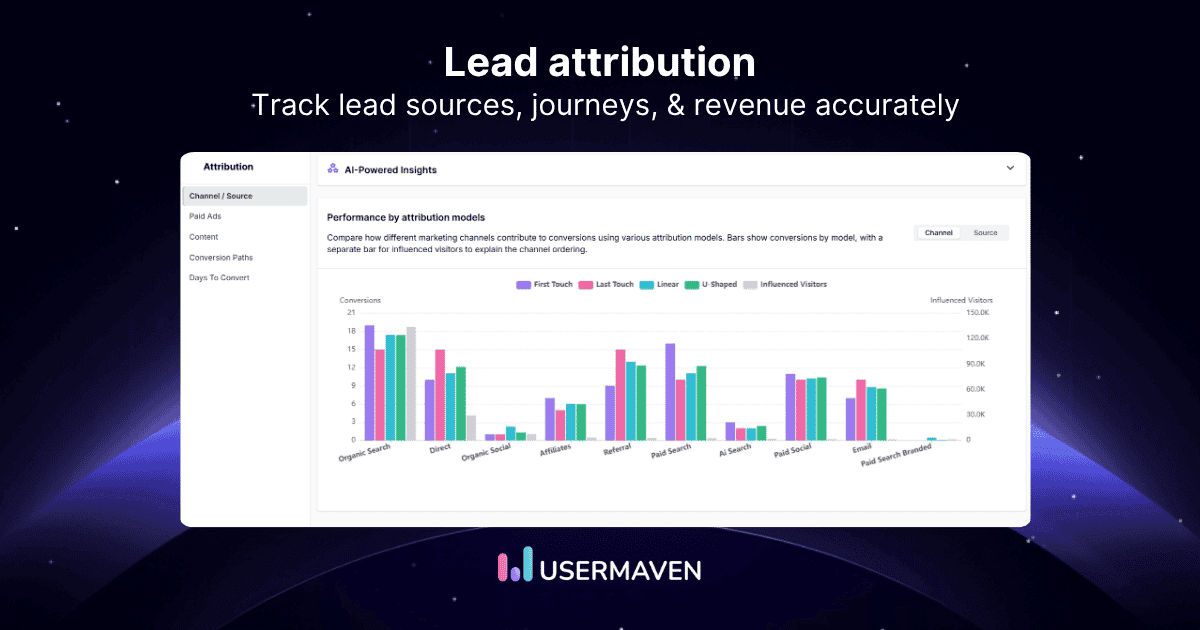
Lead attribution connects those interactions so marketing teams can see what generates qualified demand. This guide explains how marketing attribution software works, how models assign credit, how to track the journey, and how to connect lead data with pipeline and revenue.
Key takeaways
- Lead attribution explains influence: It identifies which marketing interactions contribute to lead creation instead of relying on a single source field.
- Lead source is only one part of the story: A source can describe where a lead came from, while attribution can preserve several meaningful touchpoints.
- Models change the answer: First-click, last-click, linear, time-decay, U-shaped, W-shaped, and custom models distribute credit differently.
- Tracking quality comes first: Campaign tagging, event collection, identity, and CRM stages need to be reliable before attribution models are useful.
- Lead quality matters more than volume: The best channel is often the one that creates qualified opportunities and revenue, not simply the most forms.
- Mature attribution reaches revenue: Lead reporting becomes more valuable when marketing touchpoints remain connected through pipeline and closed-won outcomes.
What is lead attribution?
Lead attribution is the process of identifying the marketing interactions that contributed to a person becoming a lead and assigning credit to those interactions.
It connects channels, campaigns, content, ads, website behavior, and other touchpoints across the customer journey with a lead conversion such as a demo request, signup, contact form, or marketing-qualified lead.
The result is a clearer answer to a practical question: which marketing activities create leads worth pursuing? The broader marketing attribution discipline can extend the same logic from acquisition through customers and revenue.
A simple lead attribution example
Consider a prospect who clicks a LinkedIn ad, reads an organic comparison article, joins a webinar, opens a nurture email, and later books a demo through Google search.
A first-click model gives the LinkedIn ad all the credit. A last-click model credits Google search. A multi-touch model can distribute credit across several interactions.
How does lead attribution work?
A lead attribution system works by preserving acquisition context, collecting meaningful interactions, resolving identity, connecting CRM stages, and then applying a rule for assigning credit.

1. Capture the acquisition source
Record source, medium, campaign, ad, referring page, and landing page. Consistent UTM parameters make campaign-level reporting easier to reconcile later.
2. Record meaningful interactions
Track the actions that show progression: article views, CTA clicks, webinar registrations, form submissions, demo bookings, trial signups, and product activity. A practical event tracking plan keeps those events consistent.
3. Identify the lead
The critical transition happens when an anonymous visitor becomes a known person through a form, account, email, or signup. This is where behavioral history can be connected with the lead record.
4. Preserve the journey
Do not overwrite the original acquisition source every time a lead returns. Keep the first known source plus later touchpoints so the journey remains available for multi-touch analysis.
5. Connect CRM stages
Lead attribution becomes more useful when a marketing lead can be followed into MQL, SQL, opportunity, and customer stages. This is the basis of reliable sales lead tracking.
6. Apply an attribution model
Once the data is connected, an attribution model determines which eligible interactions receive credit and how that credit is divided.
Anatomy of lead attribution data
The following data points connect acquisition activity with lead identity, qualification, and commercial outcomes.
| Data | Example | Why it matters |
| Source | Acquisition channel | |
| Medium | CPC | Traffic type |
| Campaign | enterprise-demo | Campaign context |
| Landing page | /enterprise | Entry point |
| Events | webinar_registered | Behavioral intent |
| Contact | Known lead | Identity connection |
| CRM stage | Opportunity | Lead quality |
| Revenue | $12,000 | Commercial outcome |
Why is lead attribution important?
Lead attribution matters because buyers rarely convert after a single marketing interaction. Without the journey, teams can overvalue the channel that happened to capture the form and undervalue the interactions that created demand.
Understand what creates demand
Statistics show that 81% of customers conduct online research before purchasing. That research can include search, social content, comparison pages, reviews, webinars, email, and direct visits before a lead ever reaches sales.
Compare channels by lead quality
A campaign that creates 200 leads is not automatically better than one that creates 70. If the smaller campaign produces more qualified opportunities and more revenue, it may deserve more budget.
Improve budget allocation
Attribution helps teams move beyond cost per lead and evaluate which channels consistently produce the kinds of leads the business can convert.
Understand longer buying journeys
This is especially important in SaaS and B2B, where several interactions can occur before a prospect becomes a lead and many more can happen before the deal closes.
Lead source vs lead attribution
A lead source usually answers one question: where was this lead recorded as coming from? Lead attribution asks a broader question: which marketing interactions contributed to the lead?
For example, the lead source might be Google Ads while the attributed journey shows LinkedIn → organic article → webinar → Google Ads. A dedicated lead source tracking process is useful, but it should not replace multi-touch context when the buying journey is longer.
Lead source vs lead attribution
| Lead source | Lead attribution | |
| Question | Where did the lead come from? | What influenced the lead? |
| Typical value | One source | One or multiple touchpoints |
| Example | Google Ads | LinkedIn → email → Google |
| Complexity | Low | Moderate to high |
| Best use | Basic reporting | Marketing optimization |
Lead attribution vs marketing attribution
Lead attribution normally focuses on the path to a lead conversion. Marketing attribution can extend the same logic through customer acquisition, pipeline, revenue, renewals, and expansion.
Think of lead attribution as a narrower use case inside the broader marketing attribution discipline. The distinction keeps this page focused on lead creation while still connecting the result with later commercial outcomes.
Lead attribution vs sales attribution
Lead attribution focuses on what creates or influences a lead. Sales or revenue attribution focuses on which interactions contribute to opportunities, purchases, or closed revenue.
Mature B2B measurement often needs both. Marketing may create the lead, sales may progress the opportunity, and the final commercial result can occur weeks or months after the original acquisition touchpoint.
That is why teams eventually need to connect lead-level reporting with revenue attribution rather than treating the first conversion as the end of the journey.
Lead attribution models
An attribution model is the rule used to decide how much credit each eligible marketing interaction receives. Different models answer different business questions, so there is no single model that is correct for every funnel.
1. First-click attribution
First-click attribution assigns 100% of the credit to the first tracked interaction. It is useful for understanding which channels create initial discovery, but it ignores every interaction that nurtures the lead afterward.
2. Last-click attribution
Last-click attribution assigns all credit to the final tracked interaction before lead conversion. It is easy to interpret for conversion analysis, but it can overvalue closing channels and understate demand creation.
3. Linear attribution
Linear attribution divides credit equally across every eligible touchpoint. It gives a balanced multi-touch view, but it assumes each interaction contributed equally.
4. Time-decay attribution
Time-decay attribution gives progressively more credit to interactions closer to the lead conversion. It fits journeys where recent engagement is expected to carry more influence.
5. U-shaped attribution
U-shaped attribution places the greatest weight on the first interaction and the lead-conversion interaction, with the remaining credit shared across the middle. It works well when discovery and lead creation are the two milestones you care about most.
6. W-shaped attribution
W-shaped attribution emphasizes three major stages, commonly the first interaction, lead creation, and opportunity creation. That makes it especially relevant to B2B funnels with a clearly defined CRM stage between lead and revenue.
7. Custom attribution
Custom attribution models use business-defined weights or rules. They can reflect a specific funnel more closely, but they also require stronger data quality and clear governance so assumptions do not become permanent reporting bias.
Lead attribution models compared
This comparison shows how each model assigns credit, where it fits best, and what it can overlook.
| Model | Credit | Best for | Main limitation |
| First-click | First interaction | Demand generation | Ignores nurture |
| Last-click | Final interaction | Conversion analysis | Ignores discovery |
| Linear | Equal across touches | Multi-touch journeys | Treats touches equally |
| Time-decay | More to recent touches | Longer journeys | Underweights discovery |
| U-shaped | First + lead conversion | Lead generation | Simplifies middle |
| W-shaped | First + lead + opportunity | B2B funnels | Requires CRM stages |
| Custom | Business-defined | Mature teams | More governance |
Which lead attribution model should you use?
Choose the model based on the decision you are trying to make, not because one model appears more sophisticated. The same customer journey can produce very different channel rankings under different rules.
Use first-click for demand creation
Use first-click when you want to understand which channels introduce new prospects to the business.
Use last-click for conversion triggers
Use last-click when the main question is which interaction immediately preceded lead creation.
Use multi-touch for longer journeys
Linear, time-decay, and position-based models become more useful when leads interact with several channels before converting.
Use W-shaped when pipeline stages matter
W-shaped attribution is particularly useful when lead creation and opportunity creation are distinct, consistently tracked milestones.
The most advanced model is not automatically the best model if the journey is incomplete. If source data, identity, or CRM stages are unreliable, fix those gaps before adding more attribution complexity.
How to track lead attribution
A reliable setup starts by defining the conversion, then preserves the journey from anonymous acquisition through known lead and CRM outcome.

1. Define what counts as a lead
Choose the conversion that matters to your lead generation process: contact form, demo request, trial signup, booked meeting, MQL, or another clearly defined outcome.
2. Standardize campaign tracking
Use consistent source, medium, campaign, and ad naming. Preserve referrers and campaign IDs where relevant so the lead can be tied back to the correct acquisition context.
3. Track meaningful interactions
Record the actions that show progress toward conversion, not every possible click. Good event definitions make the journey easier to interpret and compare.
4. Connect anonymous and known users
When a visitor identifies through a form or account, connect that known lead with the earlier anonymous session history where your consent and identity rules allow it.
5. Preserve original and later sources
Store the first known acquisition source while continuing to append later marketing interactions. Avoid replacing the original source each time the lead returns.
6. Connect your CRM
Send lead identity, lifecycle stage, opportunity, and deal context into the attribution workflow. A proper marketing attribution CRM integration closes the gap between a form submission and what sales later learns about the lead.
7. Choose the attribution model
Start simple, compare several views, and use a model that matches the sales cycle and the decision you need to support.
8. Validate reporting differences
Ad platforms, analytics tools, and CRMs can report different totals. Use a structured process for resolving marketing attribution discrepancies between tools instead of forcing every dashboard to match.
9. Measure qualified leads and revenue
Do not stop at raw lead count. Compare the channels that generate leads with the channels that generate qualified opportunities, pipeline, and customers.
Measured vs self-reported attribution
Not every meaningful influence is visible in tracking data. A stronger lead attribution system can use measured attribution and self-reported attribution as complementary signals.
Measured attribution
Measured attribution uses observable data such as UTMs, referrers, campaign IDs, website events, first-party identifiers, CRM records, and connected platform data. It is systematic, but it can miss offline or hard-to-track influence.
Self-reported attribution
Self-reported attribution asks prospects how they heard about the business. A simple survey popup or form field can surface podcasts, communities, recommendations, word of mouth, and other influences that instrumentation may not capture.
Use both together
Measured attribution shows observable behavior. Self-reported attribution adds the prospect’s memory of influence. Neither should automatically replace the other.
How lead attribution works with a CRM
CRM data changes lead attribution from a marketing-only report into a commercial measurement system. It connects the acquisition journey with lifecycle stage, account context, opportunity, pipeline, and revenue.
A journey might look like Google Ads → article → webinar → demo → CRM contact → SQL → opportunity → closed won. Without the CRM connection, marketing may only see the demo booking.
With CRM stages, teams can compare which channels create qualified opportunities rather than simply which channels create forms. This is especially important in B2B and SaaS where sales cycles are longer and lead quality varies widely.
Connect lead attribution to pipeline and revenue
Lead attribution becomes substantially more useful when the lead conversion is treated as a milestone rather than the end of the journey.
Illustrative example: lead volume vs commercial value
| Channel | Leads | Opportunities | Revenue |
| Meta | 120 | 8 | $18K |
| 65 | 17 | $61K | |
| Organic | 40 | 13 | $49K |
In this illustrative example, Meta creates the most leads, but Google creates the most revenue. Optimizing only around lead volume would send budget toward a different winner than revenue-aware attribution.
The mature question is therefore not only “What generated leads?” It is “What generated leads that became pipeline and customers?”
Common lead attribution problems
Even a suitable attribution model can mislead teams when the underlying journey data is incomplete or inconsistent.
1. First-click data gets overwritten
A returning visit replaces the original acquisition source, making it impossible to compare first interaction with later touchpoints.
2. UTMs disappear
Redirects, landing-page changes, or inconsistent campaign tagging break the link between the campaign and the lead.
3. Anonymous and known users stay disconnected
The form submission is recorded, but earlier browsing behavior remains attached to a separate anonymous profile.
4. CRM stages are missing
Marketing knows which source created the lead but cannot see whether the lead became qualified, an opportunity, or revenue.
5. Source names do not match
Marketing, CRM, and ad platforms use different labels for the same channel, creating duplicate or conflicting categories.
6. Dark-social influence is invisible
Communities, recommendations, podcasts, or private sharing can influence the lead without producing a clean referral path.
7. One model receives too much authority
Teams treat a first-click or last-click report as the truth instead of one way of viewing the journey.
8. Lead quantity becomes the optimization goal
Cheap form submissions look successful even when they rarely become pipeline or customers.
How to improve lead attribution accuracy
Accuracy improves when teams treat attribution as a measurement system rather than a report. The focus should be on consistent data collection, identity, CRM definitions, and ongoing validation.
- Standardize UTMs: Use consistent campaign naming across paid, email, partner, and other tracked channels.
- Preserve original acquisition: Keep first-click data even as new touchpoints are added to the journey.
- Define events consistently: Use the same meaning for demo, signup, MQL, opportunity, and other key events across systems.
- Connect CRM stages: Make lifecycle and opportunity changes available to the attribution layer.
- Resolve identity carefully: Connect anonymous and known activity without creating duplicate people or accounts.
- Use one measurement vocabulary: Map channel names, campaign fields, and lifecycle definitions into a single source of truth for reporting.
- Measure commercial outcomes: Compare lead count with opportunity rate, pipeline, revenue, and customer value where possible.
- Audit the setup regularly: Campaigns, websites, CRMs, and integrations change, so attribution quality needs continuous checks.
See Usermaven in action
Book a free demo and discover how powerful analytics can grow your business.
Lead attribution tools
Once the measurement foundation is clear, the next step is choosing a tool that matches the journey, CRM, and outcomes your team needs to analyze.
| Tool | Best for | Lead attribution strength |
| Usermaven | SaaS, B2B, marketing teams | Journeys, multi-touch attribution, CRM + revenue |
| HubSpot | CRM-centric teams | Contact, deal, and revenue attribution reports |
| Dreamdata | B2B teams | Account journeys and revenue attribution |
| HockeyStack | B2B SaaS | Buyer journeys, pipeline, and revenue attribution |
| Ruler Analytics | Lead generation teams | Form and call lead attribution |
| Cometly | Paid acquisition teams | Ad-to-lead, pipeline, and revenue attribution |
The best platform depends on your sales cycle, CRM setup, channel mix, and whether you need lead, pipeline, or revenue-level attribution. For a detailed comparison, see our guide to lead attribution software.
How Usermaven handles lead attribution
Usermaven connects acquisition data with website behavior, customer journeys, conversion goals, CRM context, pipeline, and revenue so teams can evaluate more than the source attached to a form.

Capture acquisition context
Preserve source, medium, campaign, landing page, and paid-channel identifiers so the journey starts with usable acquisition data. This complements deeper source attribution analysis when teams need to separate original discovery from later touches.
Track lead-generating behavior
Usermaven events can capture forms, signups, key interactions, product activity, and other actions that explain what happened between acquisition and lead conversion.
Connect customer journeys
Use customer journey analytics software to see the sequence of touchpoints across channels and sessions instead of reducing every lead to one source field.
Build lead conversion funnels
With funnel analytics software, teams can measure stages such as visit → content engagement → form → demo → activation and identify where leads progress or drop.
Connect CRM outcomes
CRM-connected attribution can tie marketing touchpoints to later lead and opportunity stages, helping teams compare which campaigns create qualified pipeline rather than front-end forms alone.
Compare models and revenue impact
AN attribution software layer can compare first-click, last-click, multi-touch, pipeline, and revenue views under the same journey data instead of relying on one platform’s self-reported credit.
Send meaningful outcomes back to ad platforms
With conversion syncs, teams can send selected first-party outcomes back to advertising platforms so optimization can learn from the conversions that actually matter.
Where AI helps with lead attribution
AI can make attribution analysis faster, but it should sit on top of trustworthy measurement rather than compensate for broken tracking.
Ask attribution questions naturally
Maven AI can help teams ask questions about channel performance, conversion paths, lead quality, and attribution without rebuilding every report manually.
Investigate journeys with MCP
The Usermaven MCP server can connect authorized Usermaven data with MCP-compatible clients such as ChatGPT, Claude, Codex, and Cursor for deeper analysis of journeys, funnels, campaigns, and conversions.
Check measurement quality first
The Measurement Trust Center helps teams check campaign tracking, customer matching, platform connections, conversion feedback, and overall data confidence before using attribution reports to make budget decisions.
Detect anomalies and missing attribution
AI can surface unusual drops in attributed leads, sudden channel shifts, missing campaign data, or differences between traffic and downstream outcomes so teams know where to investigate first.
Keep human judgment in the loop
AI can identify patterns, but marketers still need to decide which conversion matters, which model fits the sales cycle, and whether the business should optimize for MQLs, pipeline, revenue, or longer-term value.
Lead attribution best practices
These practices help teams keep attribution useful as campaigns, funnels, and sales processes evolve.
- Define lead stages clearly: Make sure marketing and sales use the same definitions for lead, MQL, SQL, opportunity, and customer.
- Standardize campaign parameters: Use consistent source, medium, campaign, and ad naming.
- Preserve the original acquisition: Do not overwrite first-click context when the lead returns through another channel.
- Track meaningful interactions: Prioritize events that indicate intent or progression.
- Connect CRM data: Follow the lead into qualification, pipeline, and revenue.
- Compare several attribution views: Use models as lenses rather than treating one as the permanent truth.
- Use self-reported data selectively: Capture hard-to-measure influence without replacing behavioral tracking.
- Measure quality, not only volume: Evaluate opportunities and customers alongside raw lead count.
- Audit measurement regularly: Tracking quality changes as campaigns, forms, websites, and integrations evolve.
Final verdict
Lead attribution explains which marketing interactions contribute to lead creation instead of relying on a single source field.
Reliable attribution depends on campaign data, meaningful events, identity, CRM stages, and revenue context being connected before sophisticated models are applied.
The goal is not simply to know where leads came from. It is to understand which marketing investments consistently generate qualified pipeline and customers.
Ready to see Usermaven in action? Explore the platform or book a demo for a closer look.
Unlock insights that drive growth
FAQs
1. What is lead attribution?
Lead attribution is the process of identifying the marketing interactions that contributed to a person becoming a lead and assigning credit to those interactions.
2. How does lead attribution work?
It captures acquisition data and touchpoints, connects anonymous activity with a known lead, preserves the journey, adds CRM stages, and applies an attribution model to determine credit.
3. What is the difference between lead source and lead attribution?
Lead source usually records one origin such as Google Ads. Lead attribution can show several interactions that influenced the lead before conversion.
4. What are the main lead attribution models?
Common models include first-click, last-click, linear, time-decay, U-shaped, W-shaped, and custom attribution.
5. How do you track lead attribution?
Define the lead conversion, standardize campaign parameters, track meaningful events, connect anonymous and known users, preserve original and later sources, integrate CRM stages, and validate results across systems.
6. Which lead attribution model is best?
There is no universal best model. First-click is useful for demand creation, last-click for conversion triggers, and multi-touch or W-shaped models for longer journeys with several meaningful stages.
7. How does lead attribution work with a CRM?
A CRM adds lifecycle, company, opportunity, pipeline, and revenue context so marketing can see which leads became qualified commercial outcomes.
Updated

Written by
Lauren Brooks
Lifecycle Marketing Strategist
Lauren Brooks is a lifecycle marketing strategist with 4+ years of experience helping SaaS businesses create meaningful customer experiences. She specializes in user engagement, retention, and conversion optimization, helping brands build stronger customer relationships beyond acquisition.
All articles by Lauren →