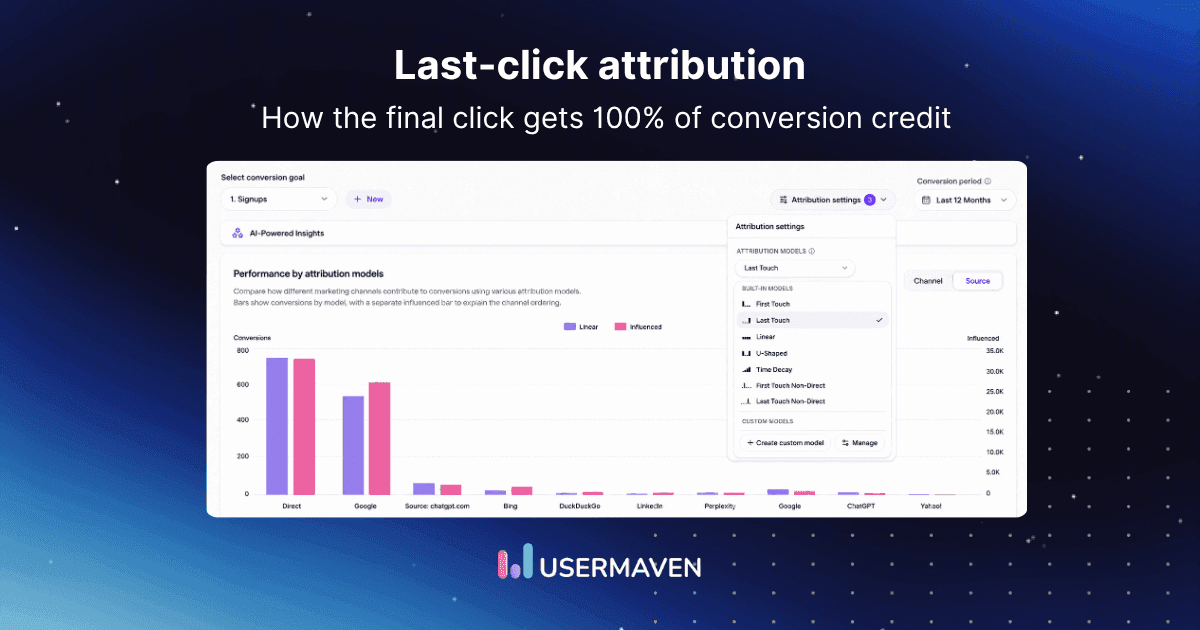
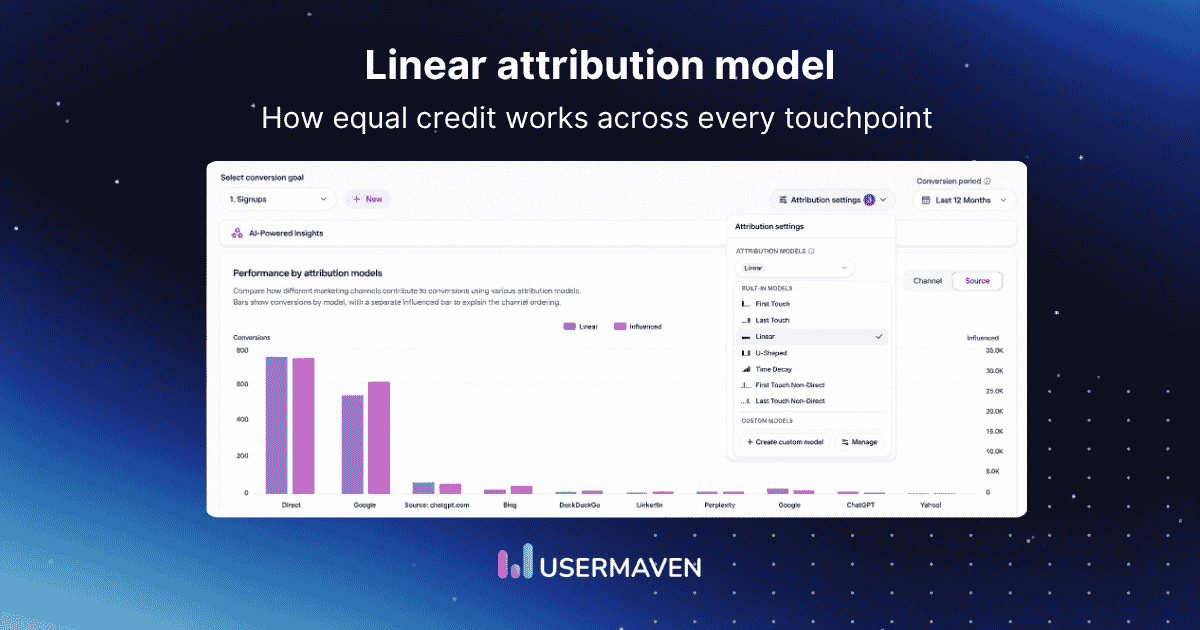
Google Ads says it drove the sale. Meta says the same. The CRM credits Direct, while a last-touch report says branded search won. The customer journey did not change; only the measurement lens did.
That contradiction is why attribution problems are often blamed on the model first. In reality, the failure may begin earlier with missing touchpoints, fragmented identity, inconsistent source data, or an attribution window that excludes important interactions.
This guide shows how to diagnose the failing layer before changing the formula. The goal is to make marketing attribution software useful for decisions without pretending any model can reveal evidence the measurement system never captured.
Attribution model challenges at a glance
An attribution-model challenge is any measurement, modeling, or interpretation problem that causes conversion credit to misrepresent the customer journey or support an unreliable marketing decision.
| Failure layer | Example problem | What gets distorted |
|---|---|---|
| Coverage | Touchpoint was never recorded | Journey completeness |
| Identity | Mobile and desktop cannot be joined | Customer path |
| Classification | Source or UTM is wrong | Channel credit |
| Eligibility | Window excludes earlier touches | Eligible journey |
| Model | Credit rule favors one position | Distribution of credit |
| Outcome | Leads used instead of revenue | Business value |
| Interpretation | Attribution treated as causality | Budget decision |
Before changing the attribution model, identify which layer is actually failing. A new formula cannot repair data that never entered the model.
Key takeaways
- The model is often not the first problem: Incomplete tracking, weak identity, and inconsistent campaign data can distort attribution before the credit rule runs.
- A more advanced model does not repair missing evidence: Multi-touch, custom, or AI-assisted attribution can only analyze interactions the system actually captured.
- Every model contains assumptions: First touch, last touch, linear, time decay, data-driven, and custom models simply encode those assumptions differently.
- Attribution windows matter as much as model choice: A touchpoint excluded before modeling can never receive credit.
- Conversions are not always the right outcome: Pipeline, revenue, retention, and LTV can lead to different channel conclusions.
- Platform attribution is not independent measurement: Several advertising platforms can claim the same conversion under their own rules.
- Attribution is contribution, not causality: Incrementality or experiments are still needed when the question is what marketing actually caused.
The three layers of attribution failure
Cookies, model bias, UTMs, privacy, and causality are often placed in one list. They become easier to diagnose when separated into measurement, modeling, and decision failures.

| Layer | Core question | Typical failures |
|---|---|---|
| Measurement | Can we observe the journey? | Missing events, broken identity, poor UTMs, disconnected CRM, privacy limits |
| Modeling | How is observed credit calculated? | Window choice, model bias, custom assumptions, sensitivity |
| Decision | Does the result support the business choice? | Lead quality, revenue, retention, causality, budget allocation |
See what's working. Fix what's not. Grow faster.
*No credit card required
Measurement challenges
Measurement failures occur when the journey itself is incomplete or incorrectly assembled. A sophisticated model cannot compensate for touchpoints that are missing, duplicated, misclassified, or assigned to the wrong person.
Modeling challenges
Modeling failures occur after the journey is assembled. The attribution window, credit rules, channel weights, and algorithmic assumptions determine how the same observed journey is translated into credit.
Decision challenges
Decision failures happen when technically valid attribution is used to answer the wrong business question. A channel can win on conversions and still lose on pipeline, revenue, retention, or incremental lift.
Where AI helps – and where it does not
AI can speed up analysis by comparing models, surfacing anomalous channels, summarizing journey patterns, and investigating conversion differences. That makes AI-driven marketing attribution useful when the underlying measurement is reliable.
AI cannot recover an offline conversation that was never recorded, reconnect an identity the system cannot observe, or prove causal lift from observational attribution alone. Faster analysis of incomplete evidence is still incomplete evidence.
The useful principle is simple: AI can analyze the evidence available to the measurement system. It cannot manufacture evidence the system never collected.
Challenge 1: Important touchpoints are missing
Attribution cannot distribute credit to an interaction that never entered the dataset. This is why apparently simple customer journeys often become much shorter inside an analytics report.
Common blind spots include word of mouth, podcasts, private communities, WhatsApp or Slack conversations, conferences, offline advertising, zero-click social exposure, and recommendations from AI assistants.
Better collection can recover some of the gap. Events can capture meaningful first-party and backend actions, while self-reported attribution can surface influences such as podcasts, communities, or word of mouth that do not generate a trackable click.
Neither method creates perfect visibility. Self-reported answers introduce memory and salience bias, while tracked attribution remains limited to observable signals. The stronger approach uses both as complementary evidence.
Challenge 2: One customer becomes several identities
A complete set of events can still produce a broken journey when those events cannot be matched to the same person or account.
| Mobile ad → desktop article → work laptop demo → teammate joins → opportunity |
Without identity resolution, those interactions can become separate visitors. In B2B, the problem expands because several contacts may participate in one buying account before an opportunity is created.
The goal is to reconstruct the sequence from anonymous activity to known users and commercial outcomes. customer journey analytics is most useful when earlier anonymous behavior remains connected after signup or identification.
Identity should therefore be audited before model choice. If the same buyer is split into three profiles, a multi-touch model only distributes credit across three incomplete journeys.
Challenge 3: Every platform claims the conversion
Advertising platforms measure participation from inside their own ecosystems. Their numbers can therefore disagree even when each platform is applying its reporting rules correctly.
| Meta ad → Google search → LinkedIn retargeting → purchase |
Meta may credit the purchase because a Meta interaction occurred inside its window. Google can do the same for search, while LinkedIn may also report influence under its own eligible interaction rules.
This is why cross-platform ad tracking should reconcile the journey independently instead of adding platform-reported conversions together as though each claim were exclusive.
Platform reporting answers whether that platform participated under its rules. It does not answer which platform deserves exclusive credit across the entire customer journey.
Google explains that attribution settings change how eligible ad interactions receive conversion credit and can influence conversion-based bidding.
Google Ads attribution models also shows why platform-specific attribution is a defined reporting framework rather than universal truth.
Unlock insights that drive growth
*No credit card required
Challenge 4: Privacy and consent reduce observable coverage
Privacy changes attribution by reducing how much identity and behavioral data can be observed consistently across sessions, devices, and external platforms.
Both first-party data and server-side tracking can improve measurement of owned-site activity, authenticated users, payments, CRM updates, and confirmed conversions.
They cannot restore interactions a user did not consent to share, private conversations, inaccessible platform data, or exposure that never created an observable signal. Privacy reduces coverage; it does not make attribution impossible.
Challenge 5: Bad source data makes good models look wrong
Attribution depends on classification before it depends on mathematics. Inconsistent campaign taxonomy can split one channel into several rows or push known traffic into Direct and Unknown.
| facebook / paid_social | facebook / cpc | meta / paid | Meta Ads / social |
Those labels may describe essentially the same acquisition source. A sophisticated model will still distribute credit incorrectly if the underlying taxonomy is inconsistent.
Standardize UTM parameters and review source attribution rules before interpreting model differences. Source quality should be treated as a measurement prerequisite, not a cleanup task after reporting.
| Symptom | Likely taxonomy issue |
|---|---|
| Direct is unusually high | Missing source or referrer |
| Same platform appears across several rows | Inconsistent UTMs |
| One campaign appears under multiple channels | Channel mapping rules |
| CRM and analytics source disagree | Field overwrite or sync logic |
Challenge 6: The attribution window removes valid influence
A touchpoint can disappear before the attribution model even sees it. The attribution window defines which interactions remain eligible for credit.
| Day 1 LinkedIn → Day 18 article → Day 61 webinar → Day 95 demo |
With a 30-day window, the early LinkedIn and article interactions are excluded. Changing Linear to Time Decay cannot restore interactions that were removed before the model ran.
Use actual time-to-convert patterns to choose an attribution window. Long-cycle B2B SaaS journeys often need a wider eligibility window than short direct-response purchases.
Windows that are too long create a different problem: unrelated or weak historical visits can remain eligible. The objective is not maximum history; it is a window that matches the buying cycle.
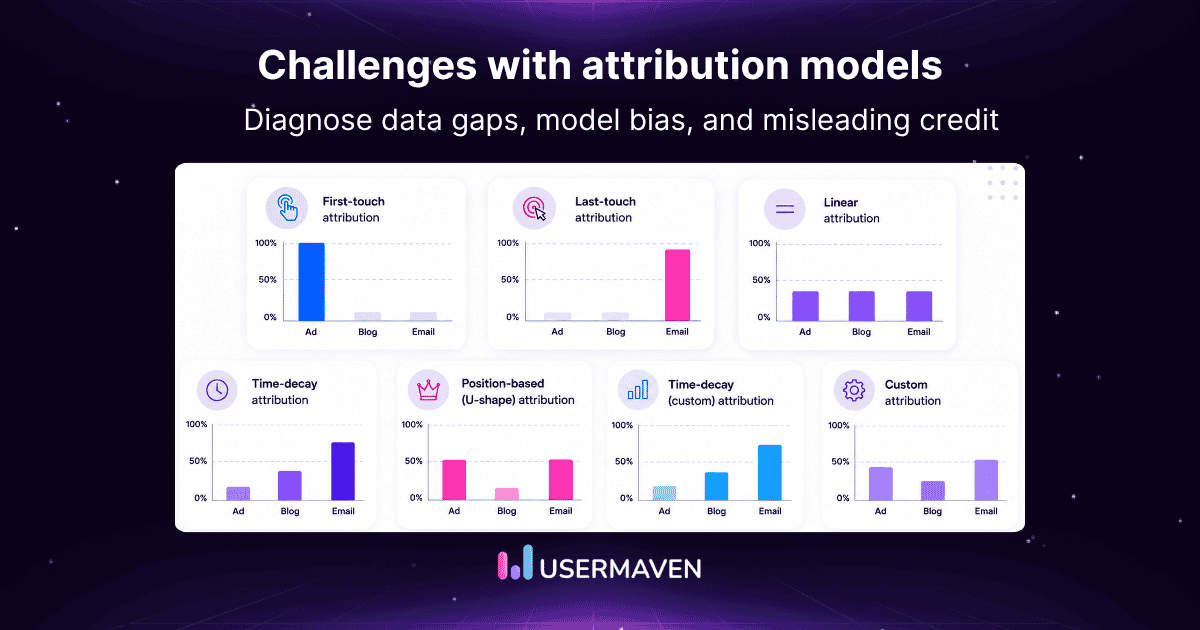
Challenge 7: Every attribution model introduces bias
Once the journey is assembled, the credit rule still reflects an assumption about what matters. Different models simply encode different assumptions.

| Model | What it tends to favor | Main limitation |
|---|---|---|
| First touch | Discovery | Ignores later influence |
| Last touch | Demand capture | Overcredits closers |
| Linear | Participation | Assumes equal value |
| Time decay | Recent activity | Can undervalue awareness |
| Position-based | First + closing milestones | Simplifies the middle journey |
| Data-driven | Learned patterns | Depends on data and model assumptions |
| Custom | Business assumptions | Can encode analyst bias |
A dedicated marketing attribution models comparison can help explain those rules in more depth. Data-driven attribution changes how credit is learned, but it still depends on observed data and model assumptions.
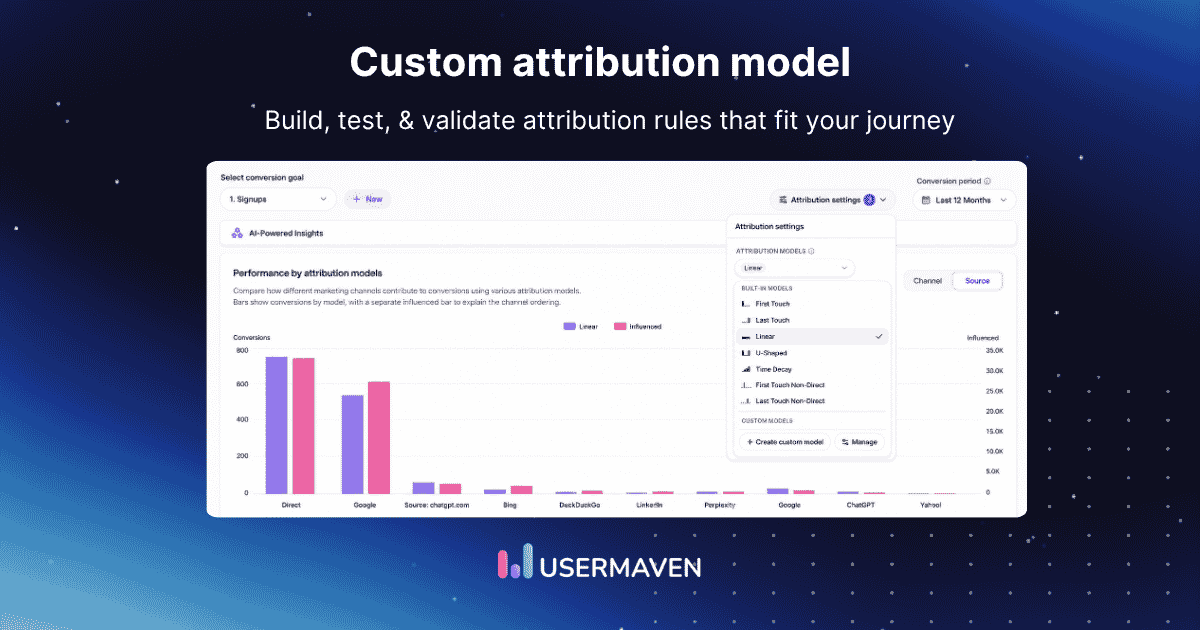
A custom attribution model can better reflect a specific buying motion by changing weights or channel treatment. That makes assumptions more explicit; it does not remove them.
Challenge 8: Model choice can change the winning channel
The most dangerous attribution result is not necessarily a wrong number. It is a business recommendation that changes completely when the credit framework changes.
| Model | Channel ranked #1 |
|---|---|
| First touch | Organic search |
| Last touch | Branded search |
| Linear | |
| Time decay | Paid search |
| Custom | Partner |
The underlying revenue did not change. Only the allocation framework changed. That is why model comparison should test how sensitive the strategic conclusion is to reasonable assumptions.
multi-touch attribution is most useful when it reveals how channels participate across the journey, not when one multi-touch model is promoted as the single objective answer.
If modest model changes repeatedly reverse the channel winner, inspect the actual journeys and avoid large budget shifts until the conclusion is stable across plausible alternatives.
Challenge 9: Conversion credit can ignore customer quality
A channel can generate many conversions and still create weak customers. Attribution becomes more useful when acquisition credit is connected with downstream commercial value.
| Channel | Customers | CAC | 12-month LTV |
|---|---|---|---|
| Paid social | 100 | $80 | $220 |
| Organic | 60 | $110 | $900 |
A conversion-count view favors Paid Social. A customer-value view may favor Organic because the smaller cohort creates much more durable value after acquisition.
Extend the measurement chain through revenue attribution, customer retention metrics, and SaaS LTV when those outcomes matter to the business.
| Channel → conversion → pipeline → revenue → retention → LTV |
pipeline attribution can show which acquisition sources create opportunities, while full-funnel revenue attribution carries the analysis into customers, revenue, and downstream value.
Attribution measures contribution, not causality
Attribution assigns credit across observed touchpoints under a defined framework. It does not prove that a buyer would have failed to convert if a credited channel had never existed.
| Method | Main question |
|---|---|
| Attribution | Which observed touches receive credit? |
| Incrementality | What happened because marketing ran? |
| MMM | How do aggregate marketing inputs relate to outcomes over time? |
| Self-reported attribution | What does the buyer remember influencing them? |
This is why multi-touch attribution vs marketing mix modeling is a useful distinction. Different methods answer different questions rather than competing to become one universal truth.
Google describes Conversion Lift as an incrementality experiment designed to estimate conversions directly caused by advertising exposure. That is a different question from allocating credit across the observed journey.
A channel can therefore receive attribution credit without being incrementally responsible for the conversion. Attribution supports contribution analysis; causal claims require causal evidence.
Diagnose attribution problems before changing the model
When the dashboard looks wrong, the fastest route is to start with the visible symptom and inspect the earliest layer that could explain it.
| What you see | Likely cause | Check first |
|---|---|---|
| Direct gets too much revenue | Missing source or identity | UTMs + referrers |
| Every ad platform claims the sale | Platform overlap | Independent journey view |
| Content gets no credit | Last-touch bias or short window | Model + conversion lag |
| CRM revenue differs from analytics | Integration gap | Deal/order matching |
| Mobile and desktop look separate | Identity fragmentation | Visitor stitching |
| Winner changes by model | Model sensitivity | Compare assumptions |
| High-volume channel creates poor customers | Wrong outcome | Revenue / retention / LTV |
| Strong ROAS but little measured lift | Attribution ≠ causality | Incrementality |
| Offline sales disappear | Missing event source | CRM / backend events |
What better attribution can – and cannot – fix
The objective is not perfect attribution. It is enough trustworthy evidence to make a better decision while understanding which parts of the journey remain uncertain.
| Challenge | Better attribution can help? | Fully solve? |
|---|---|---|
| Inconsistent UTMs | Yes | Often |
| Cross-session identity | Yes | Partially |
| CRM revenue connection | Yes | Often |
| Ad-platform overlap | Yes | Reconcile substantially |
| Wrong attribution window | Yes | Yes, if configured well |
| Model bias | Compare and test | No universal truth |
| Offline/private influence | Limited | No |
| Word of mouth | Limited | No |
| Zero-click exposure | Limited | No |
| Incremental lift | No | Requires causal measurement |
Better software should therefore improve observability, consistency, and model comparison without claiming to eliminate uncertainty that no measurement system can observe.
How Usermaven helps address attribution challenges
Usermaven is an AI marketing attribution platform that approaches attribution as a measurement system rather than only a credit formula: collect the journey, resolve identity, connect external outcomes, compare models, and validate marketing against pipeline and revenue.

Capture the interactions the model needs
The first requirement is coverage. Website and product events should capture meaningful actions, while backend and external outcomes need to enter the same measurement layer when they determine business value.
Usermaven Event Sources can bring payments, CRM updates, webinar attendance, spreadsheet data, Zapier events, and other external actions into the workspace as native events with identity resolution and attribution compatibility.
Resolve journeys before assigning credit
Anonymous activity becomes much more useful when it remains connected after signup or identification. User Journeys can expose the sequence of channels, pages, events, conversions, and connected CRM outcomes behind an individual customer.
Contacts Hub adds the profile layer for known users and companies, making it easier to inspect the people and accounts behind those attributed journeys.
Bring campaign and CRM context together
Paid-media integrations can add Google, Meta, LinkedIn, and Microsoft advertising context, while HubSpot and Salesforce can extend measurement from website conversions into contacts, opportunities, stages, and revenue.
The useful chain is not an integration catalog. It is campaign → visitor → person or company → conversion → opportunity → revenue.
Compare models instead of trusting one
Usermaven supports side-by-side attribution analysis so teams can see how credit shifts across models rather than treating one view as objective truth.
Its September 2026 Custom Attribution Models release also gives Enterprise workspaces business-defined weighting and channel multipliers. Customization makes assumptions explicit, but those assumptions still need validation against real journeys and outcomes.
Check the measurement before changing spend
The Measurement Trust Center is particularly relevant to attribution troubleshooting because it evaluates data health across Collection, Identity, Integrations, Delivery, and Reliability before teams act on reports.
It provides a Trust Score plus high-impact fixes, helping teams determine whether a disappointing attribution result is a model issue or a data-health issue. Model sophistication cannot compensate for unreliable measurement inputs.
Connect attribution with pipeline and revenue
Marketing performance should not stop at form fills. Connected CRM stages and commercial outcomes let marketing teams compare channels against opportunities, Closed Won revenue, and downstream customer value before reallocating budget.
Investigate the data with Maven AI and MCP
Maven AI can investigate attribution, campaigns, funnels, journeys, and revenue in plain language. It is useful for questions such as why Organic lost credit after a model change or which sources produce revenue despite low lead volume.
MCP extends authorized Usermaven analytics into compatible AI clients including ChatGPT, Claude, Cursor, and Codex. The same principle still applies: AI can interrogate available evidence; it cannot replace missing measurement.
First-party evidence: Our Taap
Our Taap is not a case study about one attribution model. It shows why ecommerce brands can struggle when attribution has to be reconstructed across fragmented analytics and store reporting systems.
Before centralizing reporting, the team moved between GA4, Northbeam, and ecommerce data. After implementing Usermaven, the Our Taap case study reports a 31% reduction in campaign-analysis time and 32% of orders tracked back to campaigns.
The team also gained clearer UTM-level attribution, faster funnel diagnostics, and better visibility into conversion sources. The lesson is not that one model became perfect; it is that decisions improved after the measurement layer became more unified.
Metrics used in the evidence block include campaign-analysis time, order attribution, UTM-level campaign performance, funnel progression, and conversion-source visibility.
How to improve attribution reliability step by step
Better attribution is usually the result of several measurement improvements, not one sophisticated model. The attribution checklist provides a broader setup audit; the sequence below focuses on troubleshooting this specific measurement stack.
- Audit collection. Confirm that important website, product, CRM, payment, and conversion actions are captured.
- Check identity. Verify that anonymous and known sessions, users, and accounts can be joined where appropriate.
- Normalize channel taxonomy. Standardize UTMs, referrers, campaign names, and channel mappings before comparing credit.
- Connect downstream outcomes. Bring CRM stages, payments, pipeline, revenue, and other commercial records into the measurement chain.
- Check the attribution window. Compare the eligibility period with actual days to convert rather than relying on a default window.
- Compare multiple models. Look for conclusions that remain stable across plausible credit rules.
- Inspect large credit changes. Open the journeys behind channels that gain or lose substantial credit when the model changes.
- Validate with revenue and customer quality. Do not optimize only for lead or conversion volume if customer economics matter.
- Add complementary evidence. Use self-reported attribution, MMM, or incrementality when tracked attribution cannot answer the question alone.
- Document uncertainty. Separate stable conclusions from findings that depend heavily on assumptions or incomplete coverage.
Attribution troubleshooting checklist
Use this checklist before changing spend, rebuilding dashboards, or declaring that the attribution model is broken.
- Coverage: Are important website, product, CRM, payment, and offline events represented?
- Identity: Can anonymous and known activity be joined across the relevant journey?
- Sources: Are UTMs, referrers, and channels consistently classified?
- Integrations: Are ad, CRM, and payment systems importing the expected data?
- Window: Does the attribution period reflect actual time to conversion?
- Model: Have multiple attribution models been compared?
- Sensitivity: Does the channel winner change drastically when the model changes?
- Outcome: Are channels evaluated against pipeline or revenue, not only conversions?
- Quality: Are retention and LTV considered where they affect customer economics?
- Causality: Is attribution being mistaken for incremental lift?
- Trust: Are known data gaps documented before budget decisions are made?
Final verdict
Attribution models are useful, but every result is constrained by what the measurement system observed and how the analyst chose to distribute credit.
The highest-value fixes usually begin before the model: better collection, stronger identity, cleaner source data, an appropriate window, and a meaningful commercial outcome. Model comparison becomes useful after those foundations are reliable.
The goal is not one perfect attribution number. It is a measurement system where the team understands what is known, what is assumed, what is missing, and which decisions the evidence can support.
Start a free 14-day Usermaven trial to connect customer journeys, compare attribution models, and validate channel performance against pipeline and revenue.
FAQs
1. What are the biggest challenges with attribution models?
The biggest challenges fall into three layers: measurement problems such as missing touchpoints and broken identity, modeling problems such as attribution windows and credit bias, and decision problems such as optimizing conversions instead of revenue or confusing attribution with causality.
2. Why are attribution models inaccurate?
Attribution can become inaccurate when the journey is incomplete, sources are misclassified, identities are fragmented, the attribution window excludes relevant interactions, or the selected model applies assumptions that do not fit the buying process.
3. What are the limitations of last-click attribution?
Last-click attribution gives all credit to the final eligible interaction. It is easy to understand, but it can overvalue demand-capture channels and ignore earlier discovery, education, and nurturing that helped create the conversion.
4. What are the challenges with multi-touch attribution?
Multi-touch attribution still depends on reliable journey data. Missing identities, untracked offline influence, inconsistent UTMs, unsuitable attribution windows, and model assumptions can all distort how fractional credit is distributed.
5. How does privacy affect marketing attribution?
Privacy and consent reduce the amount of user-level activity that can be observed and joined consistently. First-party and server-side measurement can improve owned-data coverage, but they cannot restore data that was never collected or should not be collected.
6. Why do Google, Meta, and other platforms report different conversions?
Each platform uses its own identity signals, eligible interactions, attribution windows, and reporting logic. Several platforms can therefore claim the same conversion without those claims being mutually exclusive.
7. Can a custom attribution model solve attribution problems?
A custom model can better reflect a company’s buying motion and make weighting assumptions explicit. It cannot repair missing journey data, broken identity, poor source taxonomy, or prove that a credited channel caused the conversion.
8. Is attribution the same as incrementality?
No. Attribution distributes credit across observed interactions. Incrementality estimates what happened because marketing was present, usually through experiments or other causal methods.
9. How can marketers improve attribution accuracy?
Start with collection, identity, source taxonomy, connected business outcomes, and an appropriate attribution window. Then compare models, inspect sensitive conclusions, and validate attributed performance against pipeline, revenue, retention, or incrementality where relevant.

Written by
Ryan Mitchell
Marketing Analytics Strategist
Ryan Mitchell is a marketing analytics strategist specializing in campaign measurement, customer journeys, and marketing performance. He writes about analytics, reporting, and data-driven marketing strategies, helping SaaS and B2B teams measure what matters across every stage of the customer journey.
All articles by Ryan →